
The Threat Nobody Wrote Down in 1780
Almost every popular history of Kings Mountain repeats the same origin story: in early September 1780, Ferguson paroled a captured Patriot, Samuel Phillips, and sent him back over the Blue Ridge with an ultimatum for militia colonel Isaac Shelby, warning that if the backcountry men did not desist from opposing British arms, Ferguson would march his army across the mountains, hang their leaders, and lay their country waste with fire and sword. Lyman Draper's 1881 King's Mountain and Its Heroes carried the line, and it has been repeated in essentially the same wording by J.D. Bailey in 1925, John Buchanan in 1997, Randell Jones in 2011, and Melissa Walker in 2013, among others.
Historian William Caldwell traced that quote's actual paper trail in a 2024 Journal of the American Revolution study and found it doesn't hold up. The earliest text of the threat he could locate is Shelby's 1823 pamphlet, published when Shelby was a two-time governor of Kentucky burnishing his Revolutionary War record, 43 years after the events it describes. A Virginia Gazette account from November 18, 1780, just six weeks after the battle, describes Ferguson's advance as merely "threatened to cross the mountains," with no fire-and-sword language attached. Fellow commander Arthur Campbell's own recollection credited the Patriot muster instead to roughly 150 refugees fleeing Burke County, North Carolina, not to any message from Ferguson, and Caldwell found no mention of the threat in any of over 300 additional contemporary statements from men who served on the campaign. The Revolutionary War's opening battle produced its own retroactively invented line, Paul Revere never actually shouted "the British are coming", and Kings Mountain's most quoted sentence has an even longer gap between the event and its first written appearance.
One Brit on a Field of Americans
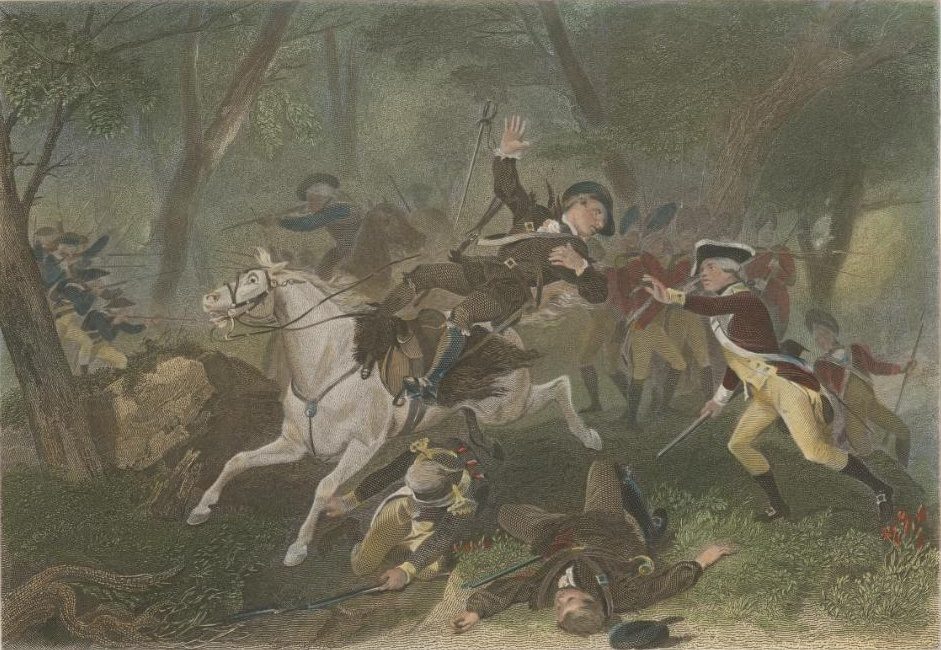
The battle itself pitted roughly 900 to 910 Patriot militia against Ferguson's force of about 1,000 to 1,125 men, a mix of some 100 American-born Provincial regulars in red coats and several hundred locally recruited Loyalist militia. By Wikipedia's summary of the engagement (checked 12 October 2026), Ferguson was the only regular British soldier present on either side; every other combatant, Patriot and Loyalist alike, was American-born. The Patriots surrounded the Loyalist position on the wooded ridge and attacked from multiple directions at once, and the fighting, once it started around 3 p.m., was over in roughly 65 minutes.
Ferguson directed his men from horseback with a silver whistle, a habit that dated to Brandywine in 1777, where a wound had left his right arm permanently crippled and forced him to fight left-handed for the rest of his career. As the Patriots charged the hill screaming, Loyalist Capt. Abraham de Peyster reportedly turned to Ferguson and said, "These things are ominous – these are the damned yelling boys!" Ferguson refused calls to surrender and was killed by Patriot fire before the position collapsed; his second-in-command, de Peyster, surrendered what remained of the Loyalist force minutes later. Battles fought entirely by citizen-soldiers rather than professional armies go back much further than the American Revolution: the Greek coalition that crushed Persia's invasion at the 479 BC Battle of Plataea left behind a bronze column, cast from captured enemy weapons, that still stands in Istanbul today.

A Casualty Count Nobody Has Ever Agreed On
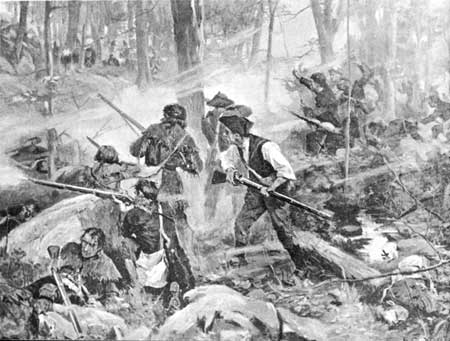
The numbers still repeated today trace to an undated report drafted within days of the battle by Colonels William Campbell, Isaac Shelby, and Benjamin Cleveland and forwarded by Gen. Horatio Gates to the Continental Congress, which published it as the official account. Historian Jim Piecuch's 2024 review of that document, held in the Gates Papers at the New-York Historical Society, found that Shelby himself later admitted the report was "nothing more than a brief and harried account in general terms of the expedition and the battle, drawn up to authenticate the intelligence of our victory and to give tone to public report," a description closer to a press release than a battlefield tally.
The figures the report contains, 225 killed (19 Provincials and 206 Loyalist militia), 163 wounded (35 Provincials and 128 militia), and 716 captured (68 Provincials and 648 militia), a total of 1,104 Loyalist casualties, have never held steady across the historians who have worked from them. Draper's 1881 recalculation from the same document reached 1,103. Shelby's separate letter of October 12, 1780, written just five days after the battle, gave a lower total of 1,016. Unlike the more thoroughly documented turning point at Saratoga three years earlier, Kings Mountain's casualty record was already contested within the week. Modern historians have not settled it either: John S. Pancake's 1985 academic history put Loyalist losses at 157 killed and 163 wounded; Stanley Carpenter's more recent account gave a range of 119 to 157 killed; J. David Dameron's popular history reported 244 killed; and the American Battlefield Trust's current page on the battle gives 1,018 total Loyalist casualties. Five reconstructions, drawn from the same surviving paperwork, five different numbers.
Nine Men Hanged From an Oak
Roughly 700 Loyalists surrendered at the battle's end, and the Patriot column marched its prisoners toward the plantation of Aaron Biggerstaff, a Loyalist mortally wounded at Kings Mountain whose own brother, a Patriot, was at that moment held prisoner on a British ship in Charleston harbor. On the rainy night of October 14 into the early hours of October 15, a court-martial of twelve Patriot officers heard testimony, some of it from men who had fought alongside the accused before switching sides, on charges of "breaking open houses, killing the men, turning the women and children out of doors, and burning the houses." Thirty-six prisoners were condemned to death.
Nine were hanged three at a time from a large tree beside the Biggerstaff home: Ambrose Mills, Robert Wilson, James Chitwood, Arthur Grimes, Thomas Lafferty, Walter Gilkey, John McFall, John Bibby, and Augustine Hobbs. One condemned man escaped when his younger brother, permitted to embrace him one last time, used a hidden knife to cut his restraints during the hug. Patriot soldier Paddy Carr reportedly gestured at the tree afterward and said, "Would to God every tree in the Wilderness bore such fruit as that." Loyalist surgeon Dr. Uzal Johnson recorded that Mrs. Mills spent the night walking in the rain beside her husband's corpse "with a Young child in her Arms, and not even a Blanket to cover her from the inclemency of the Weather." Officers, with the Biggerstaff women among those pressing to stop it, halted the executions after the ninth hanging and quietly returned the other 27 condemned men to the general prisoner group. Benedict Arnold defected to the British just twelve days before Kings Mountain and lived out the war drawing a pension; the Loyalist militiamen hanged at Biggerstaff's were never offered anything like that exit.
A Victory the Patriots' Own Officers Called Wasted
The killing at Biggerstaff's did not secure the remaining prisoners. On the forced march that followed, guards denied the column food, and in the chaos and rain of October 15 alone, roughly 100 Loyalists escaped. Wikipedia's account of the battle states (checked 12 October 2026) that by the time the column reached its next stop, "all but 130" of the Loyalists captured at the battle had gotten away; a separate, more granular 2021 reconstruction published in the Journal of the American Revolution applies that same number, about 130 remaining, to a later point in the march, when the prisoners reached the Continental Army's camp at Hillsborough, North Carolina, on November 23. The two accounts don't agree on exactly when the number applies, but they agree on the scale: within weeks, a captured force of several hundred had shrunk to roughly a hundred still under guard.
Word of the Biggerstaff executions and the collapse of prisoner security reached British Gen. Charles Cornwallis, who wrote to Continental Gen. William Smallwood in November 1780 protesting the hangings and offering to exchange captured Patriot militiamen for the surviving Loyalists; no exchange agreement was ever reached. The fullest modern account of the prisoners' fate, published in the Journal of the American Revolution and built on Draper's 19th-century research, puts the number still in Continental custody at Salisbury, North Carolina, by January 1781 at sixty, out of the roughly 700 who had surrendered on October 7; the same account's author notes plainly that what became of those final sixty men afterward has not been traced. Continental Col. Henry Lee summed up the frustration common among Patriot officers when he wrote that January that "The North Carolina government has in a great degree baffled the fruits of victory." A different Patriot general's flight from a battlefield some six weeks earlier left an even murkier paper trail: Horatio Gates rode 180 miles in three and a half days after the rout at the Battle of Camden, and historians still disagree on whether a court of inquiry into his conduct was ever actually held.