
A Cut Water Line and a Retreat the Persians Misread
After the Persian fleet's defeat at Salamis in 480 BC, King Xerxes withdrew most of his army back to Asia and left his general Mardonius in Thessaly with a hand-picked force to finish the conquest the following year. By the summer of 479 BC, Mardonius and a coalition of Greek city-states led by the Spartan regent Pausanias were facing each other across the Asopus River near the small town of Plataea. The standoff opened badly for the Persians: their cavalry commander Masistius led an attack on the Athenian and Megarian contingents, and after an arrow brought down his horse, Athenian hoplites closed in and killed him, a loss Herodotus says the Persian army mourned openly.
For more than a week afterward, neither side would leave the ground suited to its own way of fighting, the Persians on open plain that favored cavalry, the Greeks on broken hill terrain that favored the phalanx. Mardonius eventually forced the issue by sending his cavalry to seize the Gargaphia spring, the Greeks' main water source, and cut their supply line back to the Peloponnese. Pausanias ordered a night withdrawal to a new position closer to Plataea itself, but the retreat went wrong: contingents lost contact with each other in the dark, and by dawn the Greek line was scattered across broken ground instead of reformed on it.
Mardonius read the scattered retreat as a full Greek collapse and ordered a general pursuit, sending his infantry across the Asopus after an enemy that, in reality, still had its best troops intact and now waiting on ground his cavalry could no longer exploit. The Spartan and Tegean phalanx that met the pursuing Persians broke their line in close combat, and a Spartan soldier Herodotus names Aeimnestus, called Arimnestus in Plutarch's later account, killed Mardonius by throwing a stone that struck him in the head. With their commander dead, Persian resistance collapsed and the Greeks stormed the fortified camp Mardonius had built on the Boeotian plain, the kind of single command misjudgment that decides a war and outlives the general who made it, not unlike the five-day march on Rome a modern paper argues Hannibal may never have actually been urged to make.
Herodotus Wrote Down 300,000. The Camp Itself Says Otherwise.
Herodotus states that Mardonius kept back 300,000 hand-picked troops in Greece when Xerxes withdrew the rest of the invasion force, a figure historians have flagged as the shakiest part of his account almost since it was written. Against that Persian total, Herodotus's city-by-city list of the Greek contingents at Plataea adds up to roughly 108,200 men, just over 38,000 of them hoplites and the rest lighter-armed troops. Ancient writers didn't even agree with each other on the Persian number: writing centuries later, Diodorus Siculus put Mardonius's army at 500,000, well above Herodotus's already large figure, while separately estimating the Greek side at close to 100,000, in line with Herodotus's count. It's not the only instance of two ancient authors flatly contradicting each other on a hard number from this era; the two surviving descriptions of a giant siege tower's failure at Rhodes, fought some 170 years later, disagree just as directly, down to its dimensions.
Modern historians have mostly stopped trying to referee between the ancient figures and instead worked backward from what the Persian camp could physically have held. Comparing it to the documented size of later Roman legionary camps, classicist J.F. Lazenby calculated a Persian force of around 70,000, including 10,000 cavalry. Military historian Peter Connolly, running a similar calculation from the reported dimensions of Mardonius's stockade, arrived at a higher figure of roughly 120,000. A third, unrelated method lands in the same general range: historian Hans Delbrück worked from how far the Persian army could plausibly have marched in a single day when it moved against Athens, and concluded the force couldn't have exceeded about 75,000 men. Three separate methods, none of them built on Herodotus's own count, all land roughly between a quarter and two-fifths of his 300,000, which would put the two armies at Plataea closer to evenly matched than any ancient source admits.
The Monument That Outlasted the Record
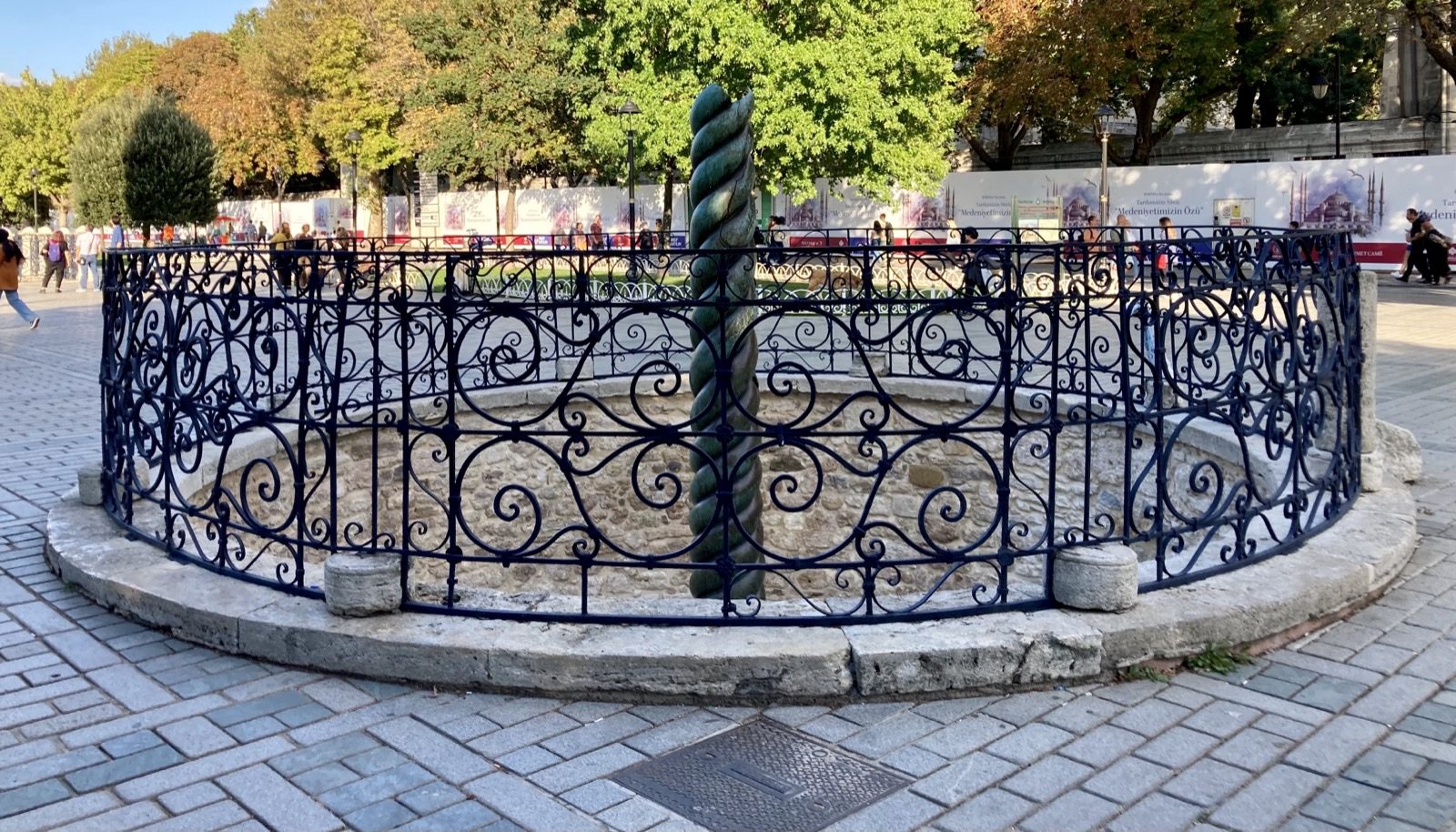
In the aftermath, the 31 Greek city-states that had fought at Plataea dedicated a bronze tripod at Delphi, cast, according to ancient tradition, from a tenth of the Persian weapons captured in the campaign. Its shaft took the form of three intertwined bronze serpents, and their coils carried an inscription listing the participating cities, ordered roughly by the size of the force each had contributed. It's the only physical object connected to the battle to survive into the present, and it has outlived every written account of the fighting that produced it. That kind of survival is unusual on its own; most ancient siege technology only gets reconstructed today because physical remains and written descriptions turn up together, the way Rome's standardized torsion catapults are known through both recovered bronze fragments and Vitruvius's own construction notes, down to tuning the paired springs by ear, rather than either kind of evidence alone.
The tripod's golden bowl didn't make it that far. During the Third Sacred War, fought from 356 to 346 BC, Phocian generals who had seized Delphi stripped its gold to pay mercenary armies, but the bronze serpent column beneath it stayed in place at the sanctuary for centuries afterward. Roman Emperor Constantine the Great later had it moved to his new capital at Constantinople to decorate the spina of the Hippodrome; sources differ on whether the order was issued around 324 AD or the column arrived closer to the city's dedication in 330, but it has stood on that same spot, now Istanbul's Sultanahmet Square, ever since.
The column isn't complete. The three serpent heads that once topped its coils disappeared sometime around the end of the 17th century, almost certainly broken off rather than lost to natural decay. Only one fragment survives, the upper jaw of a single head, recovered during 19th-century restoration work near the Hagia Sophia and now held at the Istanbul Archaeological Museums. The inscribed city names have worn smooth after more than a thousand additional years of exposure since the move, though travelers who visited Constantinople in the 1700s and 1800s recorded the roster before it faded past reading.
An Oath a Fourth-Century Historian Called a Forgery
Later Greek tradition held that the allied army swore a collective oath before the battle, promising among other things to leave the temples the Persians had destroyed unrepaired as a permanent reminder of the invasion. That pledge survives on a stone inscription found at Acharnae, near Athens, dated to roughly the 340s BC, more than a century after the battle it claims to record.
That gap was noticed at the time. The 4th-century BC historian Theopompus, writing not long after the Acharnae stele was carved, said flatly that the oath was an Athenian invention and that nothing like it was actually sworn before Plataea. Modern classicists remain split on whether he was right. German philologist Peter Siewert, in a detailed 1972 study, argued that the oath's specific vocabulary and ritual phrasing preserve genuinely archaic Greek that a 4th-century writer would have had little reason to reconstruct so precisely if inventing the text from nothing. Other scholars have countered that a skilled writer working from earlier oath formulas could produce exactly that effect on purpose. More than fifty years after Siewert's book, classicists still don't agree on how much of that sworn text, if any, actually dates to 479 BC.