.jpg)
A Nine-Story Machine, Measured Two Different Ways
In 305 BC, Demetrius Poliorcetes, son of the Macedonian general Antigonus I, brought roughly 40,000 troops and a fleet of warships and pirate auxiliaries against Rhodes, a small mercantile island republic that had kept a close trading relationship with his rival Ptolemy I. Rhodes could field only about 6,000 citizen soldiers, 1,000 non-citizen residents, and a promise of freedom to any slave willing to fight, so Demetrius leaned on engineering as much as numbers. The machine that made his reputation as a city-taker was a giant siege tower built for the assault and nicknamed the Helepolis, Greek for "Taker of Cities." The design began with the engineer Polyidus of Thessaly and was reworked by Epimachus of Athens into the version that actually rolled toward Rhodes' walls.
Two ancient writers who described the finished machine give different numbers for it. The Roman architect Vitruvius, writing in his treatise De Architectura close to three centuries later, puts its height at 125 feet, its width at 60 feet, and its total weight at 360,000 pounds. Diodorus Siculus, writing his own history around the same distance from the siege, gives a different figure: a nine-story tower whose body he measured at 90 cubits, roughly 135 feet, sitting on four wheels 8 cubits high, faced on three sides with iron plate to stop enemy fire from catching the wood underneath.
That same account describes the machine down to its moving parts. Eight wheels, each roughly 15 feet across, carried the tower forward and also swiveled on casters so it could be steered sideways without ever turning its armored face away from the wall. Moving that much weight took a small army of its own: about 3,400 men, most of them pushing from behind while 200 more turned a capstan that drove the wheels through a belt system. Inside, the Helepolis carried its own battery of torsion catapults, the same class of siege artillery Rome would later issue by the dozen to every legion. Two heavy machines threw 180-pound stones from the ground floor, three more threw 60-pound stones one level up, and lighter 30-pound throwers sat on each of the five floors above that, all firing out through shutters lined with wool and seaweed to keep them from catching fire.
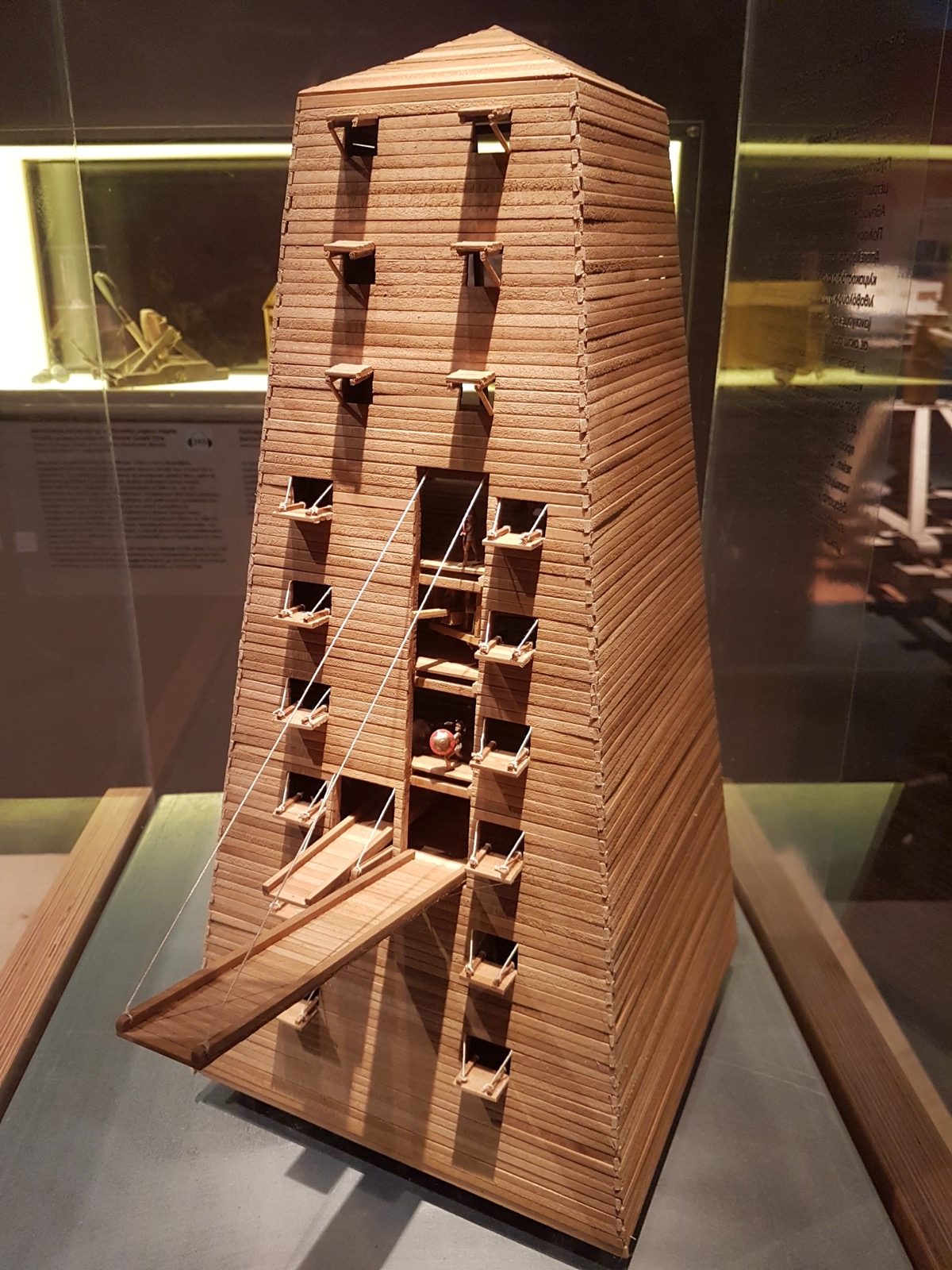
The Architect Rhodes Fired, Then Begged Back
Rhodes kept its own salaried city architect, Diognetus, on permanent retainer for exactly this kind of emergency. Shortly before Demetrius arrived, a rival architect from Aradus named Callias showed the city a small working model of a crane he claimed could hook an enemy Helepolis and swing it bodily over the wall. The demonstration impressed the Rhodians enough that they stripped Diognetus of his salary and handed it to Callias.
When Demetrius's actual siege tower showed up, Callias admitted his crane could not be built at full size. A mechanism that worked as a tabletop model did not scale up to a nine-story machine, a distinction Vitruvius uses the whole episode to illustrate. With the real Helepolis now bearing down on the city, the humiliated Rhodians turned back to Diognetus. He refused them at first, and only agreed to help, in Vitruvius's account, after "the comely virgins and youths, accompanied by the priests" came in person to plead with him, and even then only on condition that the machine become his personal property if his plan worked.
Two Ancient Accounts, Two Different Failures
What Diognetus actually did, per Vitruvius, was low-tech and specific. He ordered a hole cut through the city wall directly opposite where the Helepolis was expected to advance, and had the Rhodians funnel "water, filth, and mud" through it overnight until the ground beyond turned into a swamp. When the tower rolled forward the next day, it sank into the mire it could not see coming and stuck fast, and Demetrius, in Vitruvius's telling, called off the assault to keep from losing the machine outright.
A separate, and more commonly repeated, account of the siege gives a different sequence of events. In this version, generally traced back to Diodorus Siculus, Rhodian defenders under fire managed to pry loose some of the iron plates armoring the tower as it approached, and Demetrius, worried its now-exposed wooden frame would catch fire before he could recover it, ordered the Helepolis withdrawn. Modern popular accounts of the siege usually pick one version and run with it, without trying to reconcile the two, and this article does the same, presenting them here as two separate ancient traditions. No surviving source explains whether both things happened on the same day, or whether later writers were simply drawing on different eyewitness traditions.
A Failed War Machine Becomes a Wonder
The siege ended not in a final assault but in a negotiated peace, pushed along by Rhodes' allies Ptolemy and the Aetolian League. Demetrius agreed to withdraw without leaving a garrison, Rhodes kept its autonomy, and both sides swore to remain allies against everyone except the Ptolemies. As a guarantee, Demetrius selected 100 hostages from the city's prominent families, though the terms specifically barred him from choosing anyone currently holding public office. Diognetus, for his trouble, moved the captured Helepolis inside the city walls, set it up as a public trophy, and had it inscribed with a line Vitruvius records: "Diognetus presented this to the people out of the spoils of war."
That trophy did not survive intact for long. Within a few years, the Rhodians melted down the Helepolis's iron armor plating and combined the proceeds with money raised selling off the rest of Demetrius's abandoned siege train to fund a colossal bronze statue of their patron sun god, Helios, standing over the harbor. Ancient writers later counted that statue, the Colossus of Rhodes, among the Seven Wonders of the World, built in part from the wreck of a machine that never breached a wall. Wooden siege towers kept reappearing on battlefields for centuries afterward. Defenders inside Kenilworth Castle in 1266 watched several fail against the castle's water defenses, not its walls, while the tower Russian engineers built for the 1552 siege of Kazan did what the Helepolis never managed.