.JPG)
A tsar without a reliable army
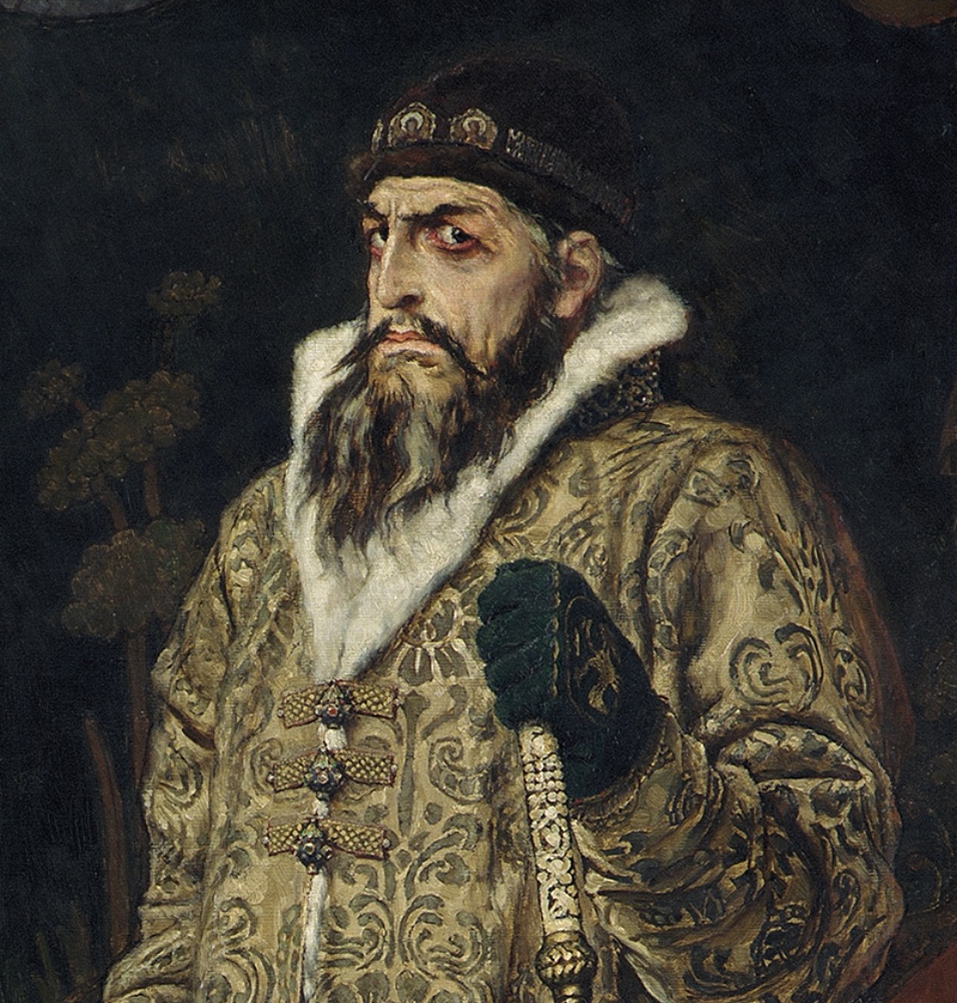
A note on the name first, because it colors everything else. The Russian is Ivan Grozny, from groza, "thunderstorm". Vladimir Dal's 19th-century dictionary glossed grozny as "courageous, magnificent, magisterial and keeping enemies in fear, but people in obedience", which is fearsome and formidable rather than wicked. "Terrible" was an accurate translation when it was coined, in the older English sense of terror-inspiring; it is modern English that drifted, not the Russian. The epithet is also not attested in Ivan's own lifetime. As Edward L. Keenan noted, it surfaces in the 18th century and became standard through Karamzin.
When Ivan IV was crowned in 1547, the first Russian ruler to formally take the title "Tsar", his military was still built around a medieval system: boyars and gentry landholders who owed cavalry service in exchange for their estates, mustered unevenly and armed however they could afford. There was no permanent, professional force the crown could call on year-round, and no infantry arm capable of the sustained siege warfare that campaigns against the fortified Tatar khanates would require.
That gap shaped nearly everything that follows: the creation of a standing infantry corps, the annexation of two Volga khanates, a private army built to police his own nobility, and a long war for the Baltic that outran what Russia could actually sustain.
The streltsy: Russia's first standing army
In 1550, Ivan IV decreed the formation of the streltsy ("shooters"), Russia's first permanent, government-paid military corps. The Encyclopedia of Russian History puts the initial force at around 3,000 men organized into six units of 500, each broken into companies of 100 under noble-appointed officers. The 1 October 1550 decree itself is narrower, referring to one thousand service people stationed in Moscow and the surrounding districts, so the two figures are usually read as the Moscow garrison versus the corps as a whole. They were armed with arquebuses (pishchal, a matchlock firearm) as their primary weapon, backed by the berdysh, a long-handled axe that doubled as a firing rest for the heavy arquebus, and sabres for close combat.
Unlike the boyar levies, streltsy were paid a state salary (roughly four rubles a year plus grain in the 1550s) and, later, land grants, though chronic underfunding pushed many into farming and trading on the side. Their battlefield job was straightforward: soften enemy lines with volley fire before cavalry charged, and anchor the grinding, technical work of siege warfare that horsemen could not do. By around 1571 their recruitment, pay, and equipment were centrally administered through a dedicated government office, the Streletsky Prikaz. The corps proved its worth immediately: its first major combat test was the siege of Kazan in 1552. It would remain the backbone of Russian infantry for a century and a half, growing to roughly 50,000 men by 1680, until Peter the Great broke it up after the revolt of 1698.
Kazan and Astrakhan: taking the Volga
The Khanate of Kazan, a Muslim successor state to the Golden Horde, had raided and traded with Muscovy for a century by the time Ivan decided to settle the question permanently. On June 16, 1552, a Russian force estimated at roughly 150,000 (infantry, cavalry, streltsy, artillery, and allied Cossacks) marched out of Moscow via Kolomna. The siege proper began on August 22, 1552, with Russian guns opening a sustained bombardment of the walls from August 29.
The engineering behind the siege was as decisive as the numbers. Military engineer Ivan Vyrodkov built a 12-metre wooden siege tower on-site capable of mounting ten heavy cannon and fifty lighter guns, letting Russian gunners concentrate fire on chosen sections of Kazan's wooden walls. Sappers dug mining galleries under the fortifications and detonated charges that both breached the walls and destroyed the city's underground water supply. Kazan was stormed and fell on October 2, 1552, ending the khanate. The storming was followed by a large-scale massacre of the city's Tatar inhabitants and the destruction of most Tatar buildings, including its mosques. Organized resistance across the former khanate continued until 1556, after which the territory was brought under direct Russian administration, with restrictions on where Tatar, Chuvash and Mari populations could settle and which trades they could practice.
Astrakhan followed by a shorter, less bloody route. A first Russian campaign in 1554 defeated Khan Yamghurchi and installed a client ruler, Dervish Ali; when Dervish Ali switched allegiance toward the Ottomans in 1556, Ivan sent a second force that annexed the khanate outright, on September 25, 1556, with little fighting. Together the two conquests put the entire length of the Volga and its trade route to the Caspian Sea under Russian control, one of the most consequential territorial gains of Ivan's reign, and one achieved as much by combined-arms siegecraft as by numbers.
The Oprichnina: a private army turned on the nobility
In January 1565, Ivan announced he was dividing his realm in two. One part, the oprichnina ("that which is set apart"), came under his direct personal rule and control; the rest, the zemshchina, remained nominally governed by the boyar aristocracy in Moscow. Ivan moved his court to a fortified estate at Alexandrovskaya Sloboda, northeast of Moscow, and from there ran a personal military and police force, the oprichniki, that answered to him alone.
The oprichniki numbered around 6,000, with an inner circle of 300 acting as the tsar's personal bodyguard. Their emblems were a dog's head and a broom tied to the saddle, meant to signal that they would sniff out treason and sweep traitors away. In practice they functioned as both a private guard regiment and a secret police: confiscating boyar estates, exiling or executing suspected opponents, and, in the winter of 1570, carrying out a punitive campaign against the city of Novgorod over an alleged (and almost certainly fabricated) plot to defect to Lithuania. Death-toll estimates for the Novgorod massacre vary wildly. The First Pskov Chronicle puts the number of victims at 60,000. The Soviet-era historian Ruslan Skrynnikov, working from Malyuta Skuratov's own report and the monastery commemoration lists known as sinodiki, counted 1,505 named dead and put the real figure at roughly 2,000 to 3,000; other modern estimates run considerably higher than his. That spread is itself the finding: it measures how thin and unreliable the surviving records are. Pairing genuine military reform with sustained brutality is what makes a reign like this hard to summarize in one direction, much as it is with Richard the Lionheart. Older chronicles could be more blunt about such things: the 4,500 beheadings Charlemagne's annals recorded have survived every attempt to explain them away. Death tolls from reprisal killings don't always hold up to scrutiny either: the 335 Italians killed in the 1944 Ardeatine massacre were five more than the ten-to-one reprisal ratio Adolf Hitler had authorized, a miscount discovered only after the extra five were already dead.
The Oprichnina's military credibility collapsed the following year. In 1571 the Crimean Khan Devlet I Giray raided south Russia and burned Moscow itself, and the oprichnina's own regiments failed to defend the capital. When Devlet Giray returned in 1572 with a much larger force, Ivan fielded a combined army of oprichnina and zemshchina troops together under Prince Mikhail Vorotynsky, which crushed the Crimean horde at the Battle of Molodi that summer, a victory serious enough to end Crimean-Ottoman ambitions of pushing north into Russia for a generation. Weeks later, Ivan formally abolished the Oprichnina; afterward, simply speaking the word aloud became a punishable offense.
The Livonian War: a 25-year campaign that emptied the treasury
In 1558, Ivan invaded Livonia (roughly modern Estonia and Latvia), hoping to seize a foothold on the Baltic Sea while the Livonian Order was weak. The opening years went well: Russian forces took Narva and Dorpat and besieged Reval, and local Estonian and Latvian peasants, long subject to the German landowning nobility, in places received the Russians as liberators rather than resisting them. That last reading comes largely from Russian and Soviet accounts of the campaign and is worth treating with that caveat.
The war dragged on for a quarter-century and drew in Poland-Lithuania, Denmark-Norway, and Sweden, all with their own claims on Livonia. The turning point came in 1578, when a combined Polish-Lithuanian and Swedish force inflicted Ivan's first serious defeat of the war at the Battle of Wenden; Swedish troops under Pontus De la Gardie then cleared most of Russian-held Estonia and captured Narva itself in 1581. Exhausted and unable to sustain the fight on multiple fronts, Russia signed the Truce of Yam-Zapolsky with Poland-Lithuania on January 15, 1582, surrendering its Lithuanian conquests and renouncing all claims to Livonia; a separate settlement ceded Estonia and the Gulf of Finland coast to Sweden. Ivan ended the war having spent his kingdom's resources for twenty-five years and gained no Baltic coastline at all. A different army chief headed off exactly that kind of drawn-out overcommitment three and a half centuries later, when Matthew Ridgway's 1954 cost survey helped talk Eisenhower out of sending U.S. troops to relieve the French at Dien Bien Phu.
The death of his heir, and what the evidence actually supports
On November 19, 1581, in the middle of the Livonian collapse, Ivan's eldest surviving son and heir, Ivan Ivanovich, died at Alexandrovskaya Sloboda, the same fortified estate the tsar had run the oprichnina from. Historians generally believe Ivan struck him with his staff in a fit of rage and that the blow killed him. It is worth being precise about how thin the ground under that consensus is.
The only contemporary source for the killing is Antonio Possevino, the papal legate who had just brokered the Truce of Yam-Zapolsky, writing in his Moscovia of 1586. Paul Bushkovitch has shown that the relevant chapter was composed several years after the event, sits awkwardly with the rest of the book, and that Possevino's own unpublished letters back to Rome treat the story as rumour he did not credit. Russian chronicles record the death without giving a cause. The 1963 exhumation settled nothing either way: the remains carried elevated mercury, arsenic and lead, all consistent with period medicine, and the skull was too degraded by groundwater to confirm or rule out a head wound.
Ilya Repin's painting of the scene is not evidence of anything except how the 19th century imagined it. He painted it in 1883-85 from Karamzin's narrative, and its own title dates the blow to November 16, three days off the recorded death date. Militarily the consequence is the part that is not in dispute: the throne passed instead to the incapable Fyodor, and the dynasty ran out of viable heirs within a generation.
In his own words
Ivan's letters to the boyar-turned-defector Prince Andrei Kurbsky, written after Kurbsky fled to Lithuania in 1564, are among the few places his own reasoning for centralizing military and political power survives in his own voice. Defending unchecked tsarist authority against boyar objection, Ivan wrote that "the Russian autocracy, the autocrats themselves have from the beginning ruled all their dominions, and not the boyars and not the grandees", the same logic that justified bypassing the boyar-led levies with a tsar-controlled corps like the streltsy, and later the oprichnina itself. Of Kurbsky's defection to the enemy camp, Ivan wrote that he had, "traitorously, like a dog," gone over "to the enemies of Christianity", the same dog imagery the oprichniki would soon wear on their saddles as a symbol of hunting down traitors.