
An Emphatic and Immediate No
By the spring of 1954, the French garrison at Dien Bien Phu had been under siege for weeks, and Washington was debating whether to save it. On March 31, Admiral Arthur Radford, chairman of the Joint Chiefs of Staff, met privately with the other three service chiefs and asked, on his own authority, whether the Joint Chiefs should recommend that the United States offer the French an immediate package of naval and air support at Dien Bien Phu. Army Chief of Staff Matthew Ridgway's answer, recorded two days later in a memo he wrote to Radford and the other chiefs and later declassified as part of the State Department's official historical record, was blunt on both counts he was asked to weigh. On the question of whether the Joint Chiefs had any business recommending it at all, he wrote that doing so "outside the proper scope of authority of the JCS" would drag the military into politics it wasn't charged with practicing. On the military merits, he wrote that "the United States capability for effective intervention in the Dien Bien Phu operation was altogether disproportionate to the liability it would incur," and that the battle's outcome, however it went, "would not in itself decisively affect the military situation there." His answer, in his own words: "an emphatic and immediate 'No.'"
Radford kept pushing the question up the chain. On April 1, he asked Ridgway a harder hypothetical: if France formally requested that U.S. armed forces relieve the Dien Bien Phu garrison, what would the Joint Chiefs recommend? Ridgway's memo records his answer as "likewise an emphatic 'No,' and for substantially the same reasons." The next morning, in a Joint Chiefs executive session, the question came a third time, this time framed as coming directly from the Secretary of Defense: if France asked Washington to commit Air Force and Navy units to combat, what should the Joint Chiefs' position be? Ridgway recommended denying the request. Three separate versions of the same question, three days apart, got the same one-word answer from the Army's senior officer.
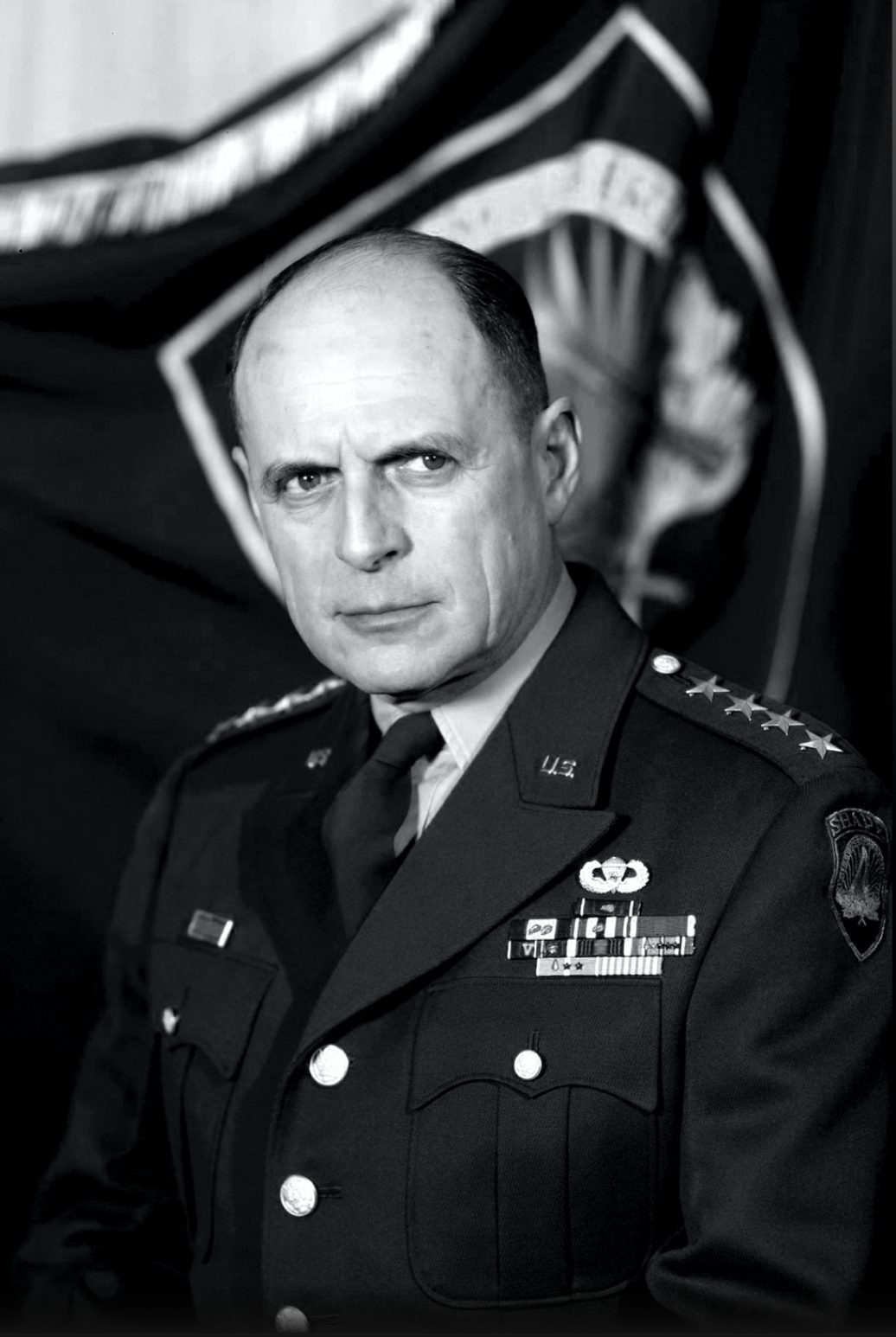
The Team He Sent to Find Out What It Would Really Cost
Saying no to the Joint Chiefs wasn't enough for Ridgway. Without waiting to see whether his written opposition would hold, he sent a team of Army specialists, engineers, medical officers, signal and communications experts, and officers who had led troops in combat, to Indochina with instructions to work out what a large-scale American military operation there would actually require on the ground. The team wasn't asked for an opinion on whether to intervene. It was asked to build a logistics estimate, the kind of unglamorous accounting that answers questions politicians and admirals arguing over air power rarely bother to ask: how many men, how many roads, how much money.
The answer it brought back was stark. According to Ridgway's own later account, the survey found that intervention would eventually require more ground troops than had fought in the entire Korean War, fought from bases that would have to be built from nothing, one to six thousand miles from the nearest American supply base, with roads, harbors, docks, staging areas, and warehouses constructed at what the team judged would be enormous cost. Jungle terrain would strip away the mechanized, mobile advantage American forces had relied on in Korea and Europe. Neither the French nor South Vietnam's population, the team concluded, could be counted on for meaningful support in a drawn-out fight. Draft calls, Ridgway wrote, would have to quadruple toward 100,000 men a month, and defense spending could climb toward $40 billion a year, sums that turned an abstract debate about air support into a specific, priced-out national commitment. Ridgway handed the completed report to Army Secretary Robert Stevens, who forwarded it up through channels to the White House. For weeks, nothing came back.
Seven Divisions, Twelve If China Comes In
The push for intervention Ridgway was fighting wasn't a fringe position. Radford and Secretary of State John Foster Dulles were promoting a plan, later given the name Operation Vulture, to save Dien Bien Phu with concentrated air power alone, and Radford was willing to consider using tactical atomic weapons to do it. Vice President Richard Nixon and Dulles both pressed Eisenhower to approve it. Ridgway's rebuttal leaned on the same logistics work his survey team had produced: he argued that saving the French garrison with ground troops, the option air-power advocates wanted to avoid discussing, would take on the order of seven American divisions, and that if China entered the war the way it had in Korea, the requirement would roughly double to about twelve divisions.
That comparison to Korea wasn't incidental. Ridgway had commanded UN forces there until April 1952, not quite two years before the Dien Bien Phu debate, and had watched a limited war escalate once Chinese troops crossed the border. He had no intention of underestimating how a second Asian land war might unfold. He viewed Radford's confidence in air power alone as a bet that Indochina would play out differently than Korea had, a bet he wasn't willing to make with American ground troops as the fallback if it went wrong.
Ten Days After the Surrender
The French garrison at Dien Bien Phu surrendered on May 7, 1954, after a siege that had lasted nearly two months. Ten days later, on May 17, Ridgway went to Acting Secretary of Defense Robert Anderson, with Army Secretary Stevens present, and said his conscience obliged him to offer an opinion nobody had formally asked for on what U.S. intervention would still cost, even after Dien Bien Phu itself was already lost. He told Anderson he had asked Lieutenant General James Gavin, his operations and training officer, to prepare a short, factual logistics briefing on Indochina, and that he'd already told a member of Eisenhower's staff it was ready whenever the President wanted to see it.
Anderson had Ridgway put his views in writing, addressed to the Secretary of Defense and signed by Stevens. A few days after that, Ridgway was asked to deliver the logistics briefing to Eisenhower directly, and he did it himself rather than send a subordinate. By his own account, Eisenhower said little during the briefing and asked several questions, and Ridgway came away convinced that a president with his own military background grasped exactly what the numbers meant.
Trainers, Not Divisions
Eisenhower sided with Ridgway. He authorized sending a relatively small number of American personnel to train South Vietnamese forces, and he overruled the push to commit U.S. combat troops. J. Lawton Collins, who had been Army Chief of Staff before Ridgway and would later serve as Eisenhower's special envoy to Saigon, wrote afterward that intervention "was scotched on the recommendation of Matthew B. Ridgway," adding that although he'd had no part in the decision himself, he agreed with it completely.
The war Ridgway's logistics estimate helped keep American ground troops out of in 1954 arrived anyway, just later than anyone briefed that spring could have specified. U.S. Marines waded ashore at Da Nang on March 8, 1965, the first large American ground combat unit committed to Vietnam, nearly eleven years after Ridgway carried his survey's numbers to the White House. Congress had already handed the next president the legal room to escalate that far, voting for a war-powers resolution in 1964 after a second reported North Vietnamese attack that the National Security Agency's declassified history later concluded almost certainly never happened. By 1965, the target list for the resulting air war over North Vietnam was being set not by the Joint Chiefs Ridgway had once chaired arguments inside, but at a weekly White House lunch that excluded uniformed officers almost entirely until late 1967, the kind of civilian-controlled military planning Ridgway's 1954 survey had been built to inform rather than bypass.
A Farewell Letter Wilson Called "Not Very Important"
Ridgway's willingness to put unwelcome logistics in front of his superiors didn't end with Vietnam, and it didn't do his career any favors. He also broke publicly with Eisenhower's "New Look" defense strategy, which leaned on the threat of nuclear "massive retaliation" to deter conventional aggression at lower cost, arguing it was both militarily too rigid and, in his own description, morally "repugnant to the ideals of a Christian nation." When his two-year term as Army Chief of Staff ended on June 30, 1955, Ridgway wasn't asked to serve a second term, and unlike his predecessors, he wasn't offered another post, the customary consolation for a retiring service chief.
He left anyway with a final written argument. Ridgway wrote a twelve-page farewell letter to Defense Secretary Charles Wilson laying out, in what colleagues described as moderate language, his objections to the administration's defense policy. Wilson marked the letter confidential, but a junior officer, without Ridgway's knowledge, passed it to the New York Times, which published it on July 14, 1955, to considerable public attention. Asked about it by reporters, Wilson dismissed the document as "not very important." History gave Ridgway's own assessment more weight than his defense secretary did: the war he'd spent 1954 trying to keep American divisions out of eventually produced its own tangle of disputed memory, including the story of antiwar protesters spitting on returning veterans, a scene that decades of archive searches by historians have never actually confirmed happened as popularly told.