.jpg)
An Image Everyone Can Picture
Ask almost anyone to describe how Vietnam veterans were treated coming home, and a specific scene tends to come up: a soldier in uniform walking through an airport, most often San Francisco's, gets spat on by an antiwar protester, usually a woman, who calls him a "baby killer." The scene shows up in movies, political speeches, and casual conversation as settled fact about the era. What's less well known is how thin the contemporaneous record behind that scene actually is, and how much of what people believe about it traces back to a search that started from doubt, not confirmation.
The earliest systematic look at how veterans actually said they'd been received doesn't support the airport-ambush image either. A 1971 Harris Poll, commissioned by the Veterans Administration and covering a cross-section of veterans, friends, family, and employers, found that only 1 percent of veterans described their reception from friends and family as "not at all friendly," and only 3 percent called their reception from people their own age "unfriendly." That survey was taken while the war was still going on, years before the spitting story became a fixture of popular memory, and it wasn't designed to investigate spitting specifically. It simply never turned the topic up as a significant problem.
A Columnist Who Expected to Debunk It
Chicago Tribune columnist Bob Greene didn't set out to confirm the spitting story. On July 20, 1987, in a column syndicated to roughly 200 newspapers under the headline "If You're A Veteran, Were You Spat Upon?", Greene wrote that he considered the tale an urban legend, and laid out his reasoning: antiwar chants like "bring the boys home" targeted the government and generals, not the soldiers, and it was hard to picture an antiwar "hippie" actually working up the nerve to spit on a Green Beret in uniform. He asked readers to write in and tell him whether it had really happened to them.
The response overwhelmed him. Greene ran four follow-up columns and then collected the most notable letters into a 1989 book, "Homecoming: When the Soldiers Returned from Vietnam," 269 pages of veterans' own accounts with minimal editorial commentary. Historian Gary Kulik, reviewing the book in his 2009 study "War Stories: False Atrocity Tales, Swift Boaters, and Winter Soldiers," was blunt about what he found in it: some stories "rank somewhere between the impossible and the improbable," and even the more plausible-sounding ones came with no named witnesses, none, that could be checked. A Los Angeles Times review at the time reached a similar verdict, calling the book "searing but shallow" and faulting Greene for never tracking down and interviewing the letter writers to verify what they'd sent him, the same multi-decade gap between a story taking hold and someone actually checking it against the archival record that also let the wrong woman get credited as the model for the "We Can Do It!" poster for thirty years.
A Veteran Sociologist Goes Looking for the Paper Trail
Jerry Lembcke approached the question from a different angle. A Vietnam veteran himself and a sociology professor, Lembcke spent years searching for contemporaneous evidence, newspaper stories, photographs, film or audio recordings, of a protester spitting on a returning soldier during the war itself, for his 1998 book "The Spitting Image: Myth, Memory and the Legacy of Vietnam." He came away empty-handed: no report from the era matched the classic story of an antiwar demonstrator spitting on and insulting a uniformed veteran. Lembcke argued the timing itself was telling, since the stories overwhelmingly surfaced years, in many cases more than a decade, after the war ended, and he pointed to substantial documented evidence, including veterans who themselves joined the antiwar movement, of a broadly supportive relationship between GIs and the people protesting the war they'd been sent to fight. It's the same reliance on going back to the primary record, rather than the version everyone already accepted, that also drove the NSA's declassified history to conclude, decades later, that the Gulf of Tonkin's second reported attack almost certainly never happened, just in the opposite direction: there, later archival digging overturned something widely believed true in the moment, while here it failed to confirm something that only became widely believed years afterward. Words arriving long after the event they claim to record are a recurring problem; the prayer attributed to the Bois Caïman ceremony was written 33 years later.
Lembcke's book didn't end the argument. Critics noted that his negative finding, an absence of news coverage, doesn't by itself rule out incidents that a local reporter simply never wrote up, and that he didn't fully explore the possibility that people other than identifiable antiwar activists did some of the spitting. But the core empirical claim in his book, that no one has produced a contemporaneous, corroborated news account of the classic airport-ambush scenario, held up under a decade of pushback from people actively trying to find a counterexample.
The Search for a Counterexample
That pushback came to a head in 2007, when Northwestern law professor and blogger James Lindgren announced he'd found "many 1967-72" newspaper reports of spitting incidents that undercut Lembcke's research. Lembcke wrote an 18-point rebuttal, and other researchers who checked Lindgren's list found it padded with cases that didn't fit the story it was supposed to prove: two sailors attacked with a knife by men never identified as antiwar or political, reports of World War I and World War II veterans being spat on, and incidents involving spitting on police officers or flags rather than returning Vietnam soldiers. Slate's Jack Shafer, who had needled the press for years about uncritically repeating the spitting myth, reviewed the exchange and concluded that Lindgren "failed so far to produce a contemporaneous news account, or other corroborative evidence, of a protester ambushing a returning veteran with a gob of spit," which Shafer took to be the actual point Lembcke's book was making.
Shafer kept digging anyway, and a month later he found the closest thing anyone has produced to a real match: a CBS News report from December 27, 1971, in which veteran Delmar Pickett Jr. described being spat at, and missed, by one of a group of young men at Seattle's airport after one of them said something about "killers." Shafer tracked Pickett down by phone and confirmed the basic account. Even this case, the single most credible incident either side has surfaced from more than three decades of searching, falls short of the classic story: the young men at the airport were never identified as organized antiwar demonstrators, and the spit, by Pickett's own account, didn't land.
The Verified Incident Ran the Other Direction
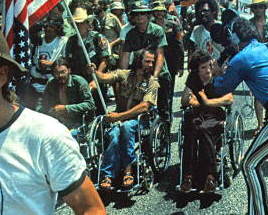
The one spitting incident from the Vietnam era that actually was filmed and documented in real time didn't fit the popular script at all. Ron Kovic, a Marine Corps veteran left paralyzed from the chest down by a combat wound and by 1972 a prominent antiwar organizer, traveled to the Republican National Convention in Miami Beach that August with a group of fellow disabled veterans. During Richard Nixon's acceptance speech, Kovic and the others shouted antiwar slogans from the convention floor; television cameras captured the disruption as security moved to remove them. In the process, Kovic, the veteran, was spat on, not by an antiwar protester, but by a delegate wearing a pro-Nixon "Four More Years" button, a supporter of the war Kovic had fought in and now opposed.
The Kovic incident inverts the roles of the standard myth so completely, a Vietnam veteran spat on by a war supporter rather than by an antiwar activist, that it rarely appears in retellings of the "spat-on veteran" story at all. It's a reminder that the surviving photographic and film record from the period documents real hostility toward veterans who'd turned against the war, from the people who still supported it, at the same moment that the specific, oft-repeated image of hippies spitting on soldiers in uniform has never turned up a matching contemporaneous account, the same gap between a specific, checkable war record and the far larger figure that eventually crowds it out in popular memory that also runs through Audie Murphy's actual Medal of Honor citation.