
Two Wartime Images, One Name That Came Later
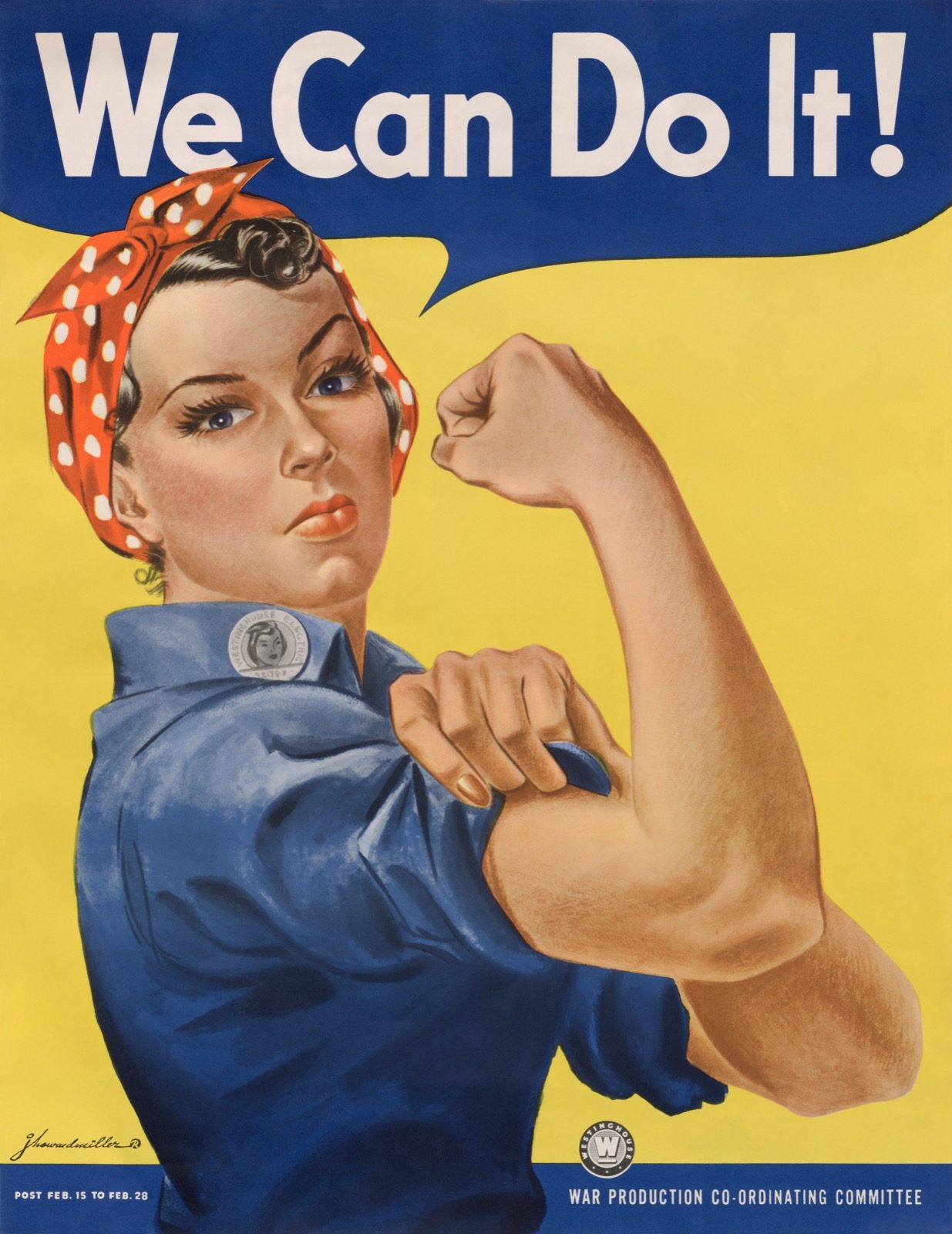
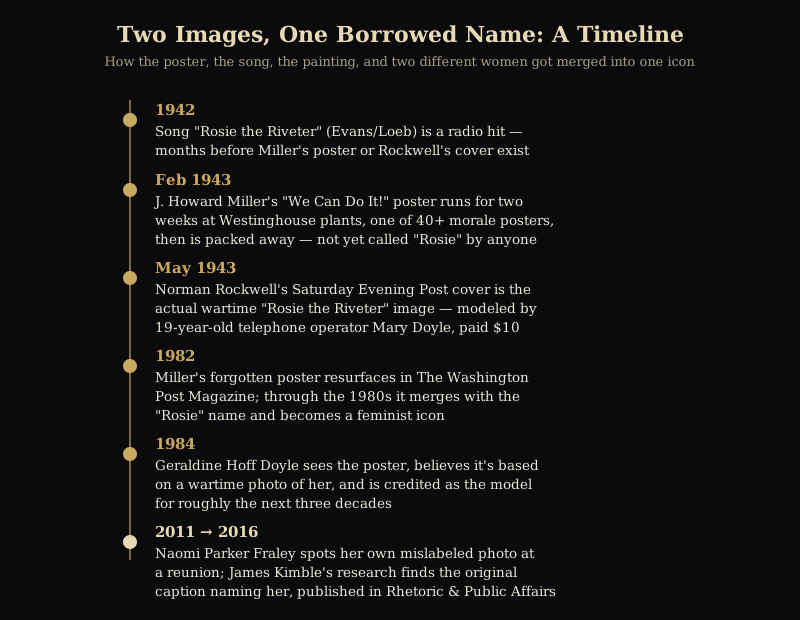
Ask most people to picture "Rosie the Riveter" and they describe the same thing: a woman in a red-and-white polka-dot bandana, sleeve rolled up, flexing her bicep under the words "We Can Do It!" That image, that pose, and that name did not start out as one thing. According to the Smithsonian's National Museum of American History, which now holds the original artwork, the poster was created in 1943 by Pittsburgh commercial artist J. Howard Miller for Westinghouse Electric's internal War Production Coordinating Committee, a company morale campaign rather than a national recruitment drive. The name "Rosie the Riveter" has a separate, slightly earlier origin: a 1942 song written by Redd Evans and John Jacob Loeb, recorded by bandleader Kay Kyser, about a fictional riveter named Rosie who worked an airplane assembly line and bought war bonds. The two would not be treated as the same character until decades after the war ended.
A third, wholly distinct image is the one that actually carried the "Rosie the Riveter" name during the war itself: Norman Rockwell's cover for the May 29, 1943, issue of The Saturday Evening Post, painted specifically to accompany the song's title. According to Rockwell's later correspondence, cited in coverage of his model's death, he wrote to apologize for exaggerating her physique well past what she actually looked like, since the painted Rosie is far brawnier than the 19-year-old telephone operator who actually sat for it. Miller's Westinghouse poster and Rockwell's Post cover ran within a few months of each other in 1943, depicted two different women in two different professions, and were not linked to one another at the time.
A Two-Week Factory Campaign, Not a National Icon
The Westinghouse poster's actual wartime life was small and administrative. Wikipedia's sourced history of the campaign (checked 13 October 2026) puts its display at only two five-day work weeks starting February 15, 1943, at Westinghouse factories in East Pittsburgh, Pennsylvania, and the Midwest, one of a documented series of more than 40 similar internal posters the company rotated through, a detail History.com's account of the campaign confirms. Its purpose, per the Smithsonian's own description of the object, was to reduce absenteeism and head off labor unrest among Westinghouse's existing workforce, not to recruit new women into war industry broadly; workers at the time likely read "We Can Do It!" as "Westinghouse employees can do it," not as an appeal to women specifically. After its two-week run, the poster was packed away and essentially forgotten for close to forty years.
That obscurity is itself the detail that makes the later fame strange: a poster almost nobody outside a handful of Midwestern factories ever saw during the war became, decades later, the single most recognizable image of the entire American home front. A modest, purpose-built wartime artifact outgrowing its original context also happened with WW1 propaganda posters, where Alfred Leete's Kitchener image began life as ordinary magazine art, no government agency had commissioned it, and still ended up the template every recruitment poster after it copied.
Rediscovered in 1982, Then Given the Wrong Face
History.com's account of the poster's second life traces its public resurfacing to the early 1980s, when The Washington Post Magazine reproduced it in an article about the National Archives' poster collection. Through the rest of the 1980s it was reappropriated as a feminist symbol, with "We" reread as "we women" rather than "we Westinghouse workers," and it went on to appear on a March 1994 Smithsonian magazine cover and, in February 1999, on a U.S. postal stamp captioned "Women Support War Effort." None of that resurgence came with any documentation of who the woman in the original artwork actually was. Miller had left no notes, and by the time the poster became famous, he had little reason to revisit a two-week internal campaign from four decades earlier.
Into that documentation gap stepped Geraldine Hoff Doyle, a Michigan factory worker. Wikipedia's sourced account of the "We Can Do It!" poster says Doyle saw a wartime photograph in 1984 and assumed it depicted her (checked 12 October 2026). The claim gained wide acceptance after the 1994 Smithsonian cover, and for roughly the next three decades, obituaries, museum placards, and news coverage repeated Doyle's name as the poster's real-life model, close to unquestioned popular fact, History.com notes, by the time she died in 2010.
The Caption Taped to the Back of a 1942 Wire Photo
The correction took a specific piece of paperwork, not a hunch. James J. Kimble, a communications professor at Seton Hall University, spent roughly five years researching the poster's origins, according to the university's account of his work. The breakthrough, per Time magazine's account written by Kimble himself, was locating an original 1942 wire-service photograph that still had its typed photographer's caption attached: "Pretty Naomi Parker looks like she might catch her nose in the turret lathe she is operating, but she knows to keep her nose out of her business." The photo was dated to Alameda Naval Air Station in California, and shows a 20-year-old machine shop worker named Naomi Parker, not Doyle, who according to Kimble's research had not yet even graduated high school when the photograph was taken.
Kimble published the finding in the academic journal Rhetoric & Public Affairs in 2016, after tracking down the by-then 93-year-old Fraley (Parker had since remarried) and interviewing her in February 2015. It is worth being precise about what that discovery does and doesn't prove: Miller himself died in 1985, and History.com's reporting notes he never publicly confirmed which specific photograph, if any, he used as reference for the painting. Kimble's identification is the strongest documented candidate, a photo whose date, location, and caption all line up with the poster far better than anything tied to Doyle, but it remains an inference from circumstantial evidence rather than Miller's own testimony, a distinction Kimble himself has been careful to preserve in his published work.
She Had Already Tried to Correct the Record Herself
Fraley did not need Kimble's research to know something was wrong. According to History.com's account, in 2011 she attended a reunion of women war workers and saw her own 1942 photograph on display, with Doyle's name printed under it where hers belonged. She raised the error at the time and in the years after, but without an academic paper trail behind her, the correction did not stick, and Doyle's name continued to circulate in mainstream coverage for several more years. It was Kimble's 2015 discovery of the original caption, and its 2016 publication, that finally gave her account the documentary backing to displace three decades of repeated misattribution. Fraley died in January 2018, at age 96, roughly two years after the record was set straight.
That gap between a firsthand correction being ignored and an academic footnote being believed shows up elsewhere in how wartime reputations get settled decades after the fact: Pancho Villa's Hollywood contract terms outlived the myths built around them only once someone tracked down the surviving paperwork, and the Lincoln quotes credited to Ulysses S. Grant's career survive or collapse depending on whether a contemporary document backs them up, not on how often a version of the story gets repeated in between.
What the Icon Compresses
Neither Doyle's nor Fraley's individual story is really what "Rosie the Riveter" was ever meant to represent, and both women's experiences sit awkwardly next to the scale of what actually happened on the home front. According to the National WWII Museum, more than six million American women from a wide range of backgrounds entered the workforce to support the war effort, taking up welding, machine operation, equipment testing, and munitions work that had almost entirely been closed to them before 1941. A single Westinghouse poster displayed for two weeks to reduce factory absenteeism, and a single Saturday Evening Post cover modeled by a telephone operator who had never riveted anything, both became stand-ins for that much larger, largely undocumented workforce, which is part of why the question of exactly whose face belonged on the poster mattered enough for one of those women to spend years trying to correct it.