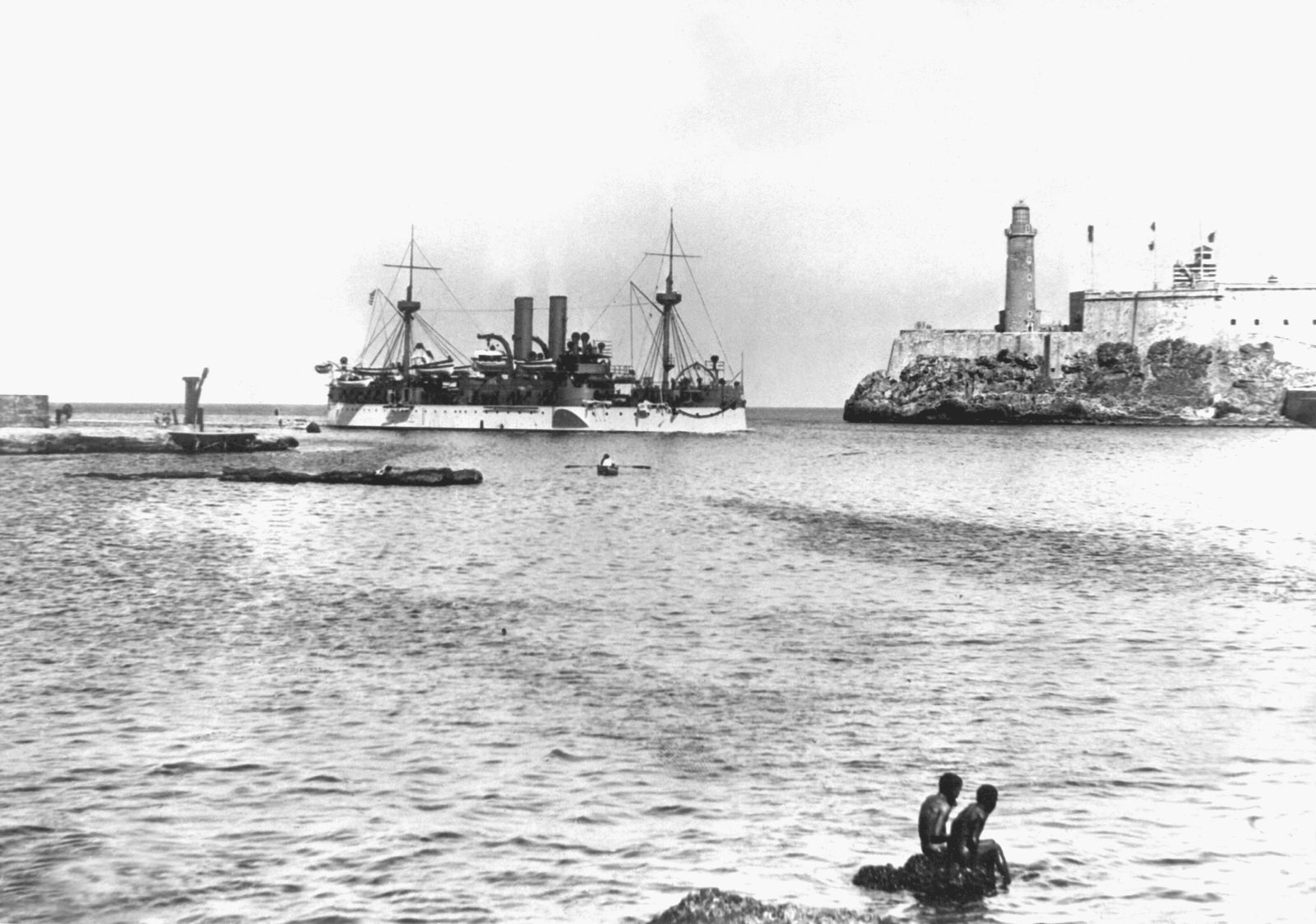

A Battleship in Havana Harbor
Cuba's rebellion against Spanish colonial rule had been underway since February 1895, and American newspapers filled with accounts of Spain's "reconcentration" policy, which forced hundreds of thousands of rural Cubans into fortified towns under General Valeriano Weyler, inflaming U.S. public sympathy for the rebels. Amid that tension, the second-class battleship USS Maine arrived in Havana harbor on January 25, 1898, on what the Navy characterized as a routine, friendly visit meant to protect American citizens and property, not a provocation. Spanish officials in Havana treated Captain Charles Sigsbee and his officers courteously enough that Sigsbee and the American consul had already recommended the Navy send a replacement battleship once Maine's assignment ended.
That routine ended just before 9:40 p.m. on February 15, 1898, when an explosion tore through Maine's forward section and sank the ship at its anchorage within minutes. Of the 355 officers and men aboard, 266 died, 252 in the blast itself and 14 more of their injuries afterward; Sigsbee, whose quarters were toward the stern, survived. Rather than fuel the outrage that followed, Sigsbee's own telegram to the Secretary of the Navy that night urged restraint, "Public opinion should be suspended until further report," he wrote, then added a line crediting the sympathy and assistance of the Spanish officers who had come to the ship's aid, a note of caution that reads nothing like the instant, settled blame later attached to the disaster, and a contrast to how fast an account of who fired first hardened into legend after a different harbor incident opened a war nearly four decades earlier.
Two Navy Boards Blamed a Mine, and Disagreed on Where
The Navy convened a court of inquiry under Captain William T. Sampson within days of the sinking, and it reported on March 21, 1898, that Maine had been "destroyed by the explosion of a submarine mine, which caused the partial explosion of two or more of her forward magazines," while explicitly declining to name who was responsible. Spain ran its own parallel inquiry, and its commission's report, filed about a week later, reached the opposite conclusion, it noted the absence of a water column, shoreline shock, or dead fish that a mine detonation should have produced, and argued the physical evidence better fit an internal accident. That Spanish investigation had a documented limitation the U.S. Navy's own history office records: American authorities restricted the commission's access to the wreck and to Maine's surviving crew, so Spain's investigators were never able to examine the ship's interior directly. Congress did not wait for the disagreement to resolve. A joint resolution recognizing Cuban independence passed on April 20, Spain severed diplomatic relations the next day, and Congress approved a formal declaration of war on April 25, backdated to April 21, roughly ten weeks after the explosion, not the instantaneous reaction popular memory often suggests.
The mine finding did not stay settled even within the Navy. In 1911, Congress funded a second court of inquiry under Rear Admiral Charles Vreeland, which built a cofferdam around the wreck so investigators could examine the bent hull plates directly rather than relying on divers' reports. The Vreeland board again concluded an external mine had caused the explosion, but it placed the blast at a different point along the hull than Sampson's board had, and inferred from the damage pattern a charge smaller than the mines Spain is known to have kept in its Havana harbor defenses at the time, the same kind of institutional finger-pointing that surfaced again decades later, when a Navy court of inquiry investigating a different sinking had to untangle why a distress call from that cruiser went unanswered by three separate radio stations.
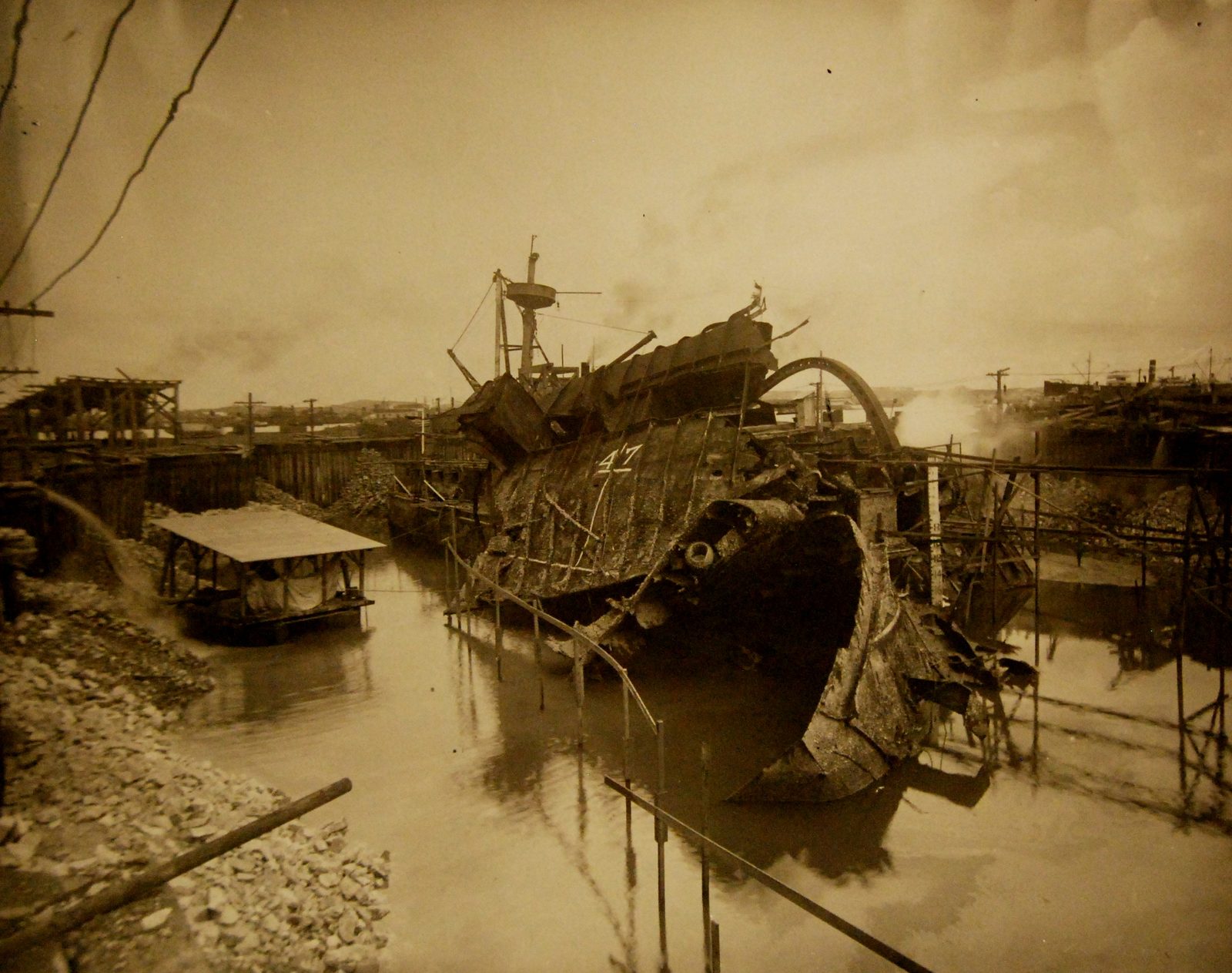
,_raising_her_wreck_in_Havana_Harbor,_Cuba,_June_18,_1911_(21272081074).jpg)
Rickover's Coal Fire, and a Question Still Open
The dispute went quiet for roughly six decades until Admiral Hyman Rickover, better known as the father of the U.S. nuclear submarine program, commissioned his own review in the 1970s using naval engineering knowledge developed after two world wars. Published in 1976 as "How the Battleship Maine Was Destroyed," Rickover's investigation concluded no mine was involved at all: spontaneous combustion in a coal bunker next to one of the ship's ammunition magazines generated enough heat to pass through a single quarter-inch steel bulkhead and ignite the magazine's contents, a known hazard of coal-fired warships of the era that Rickover argued the original 1898 court had never seriously examined.
Rickover's account did not end the argument either. In 1998, on the explosion's centennial, National Geographic commissioned the naval engineering firm Advanced Marine Enterprises to reexamine the wreck data using computer modeling unavailable to any earlier investigation. The firm's report found that a depression in the harbor floor beneath where Maine sank was, in its own words, "more readily explained by a mine explosion than by magazine explosions alone," and treated an inward-bent hull plate as evidence a mine was "more probable." But the firm was careful about how far that finding went, describing it as evidence that "strengthened the case" for a mine rather than proof, and stopping short of overturning Rickover's conclusion outright. More than a century after the explosion, no investigation, Spanish, American, or independent, has produced a finding the others have accepted as final.
The Quote Nobody Can Actually Document
Popular retellings of the war's origins often skip past the ten weeks of diplomacy between the explosion and the declaration of war and land instead on a single, vivid anecdote: publisher William Randolph Hearst, competing with Joseph Pulitzer for readers, allegedly cabled illustrator Frederic Remington in Cuba in January 1897, "You furnish the pictures, and I'll furnish the war," after Remington asked to come home because he saw no fighting worth covering. It's a tidy explanation for why the American press pushed the country toward war more than a year before Maine ever sank. It is also unsupported by any surviving document.
The story traces to one source: journalist James Creelman's 1901 memoir "On the Great Highway," published four years after the alleged exchange. Creelman was in Europe when the cable was supposedly sent and never explained how he learned its contents. No telegram between Hearst and Remington confirming the exchange has ever surfaced in Hearst's papers or anywhere else, despite research by historians looking for one, and Hearst himself denied it outright in a 1907 letter, calling the story "clotted nonsense"; his eldest son later recalled his father telling him directly, "I never sent any such cable." Whatever mix of press sensationalism, public anger over Spain's reconcentration policy, and the unresolved Maine investigation actually pushed Washington toward war in the spring of 1898, the evidence indicates it wasn't one publisher's telegram, because no evidence indicates that telegram was ever sent.
What the War Actually Decided
The fighting itself was brief. American forces had already destroyed Spain's Pacific fleet at Manila Bay on May 1, 1898, and went on to defeat Spanish forces in Cuba by early July, including the assault on San Juan Hill on July 1 and the destruction of Spain's Caribbean fleet off Santiago two days later. Spain requested peace terms in August, and the Treaty of Paris, signed December 10, 1898, ended the war on terms that reordered Spain's entire overseas empire in a single document: Spain renounced its claim to Cuba outright, ceded Puerto Rico and Guam to the United States, and transferred the Philippines for a $20 million payment. It closed the final chapter of a longer Spanish colonial retreat that had begun three-quarters of a century earlier on the other side of the Atlantic, when a campaign across the Andes broke Spanish rule over most of mainland South America. By the start of 1899, the empire that had once stretched across most of the Western Hemisphere held territory only in a handful of small island and African possessions.