
A Redesign That Left One Compromise Standing
On May 31 and June 1, 1916, three British battlecruisers, Indefatigable, Queen Mary, and Invincible, blew up at the Battle of Jutland after German shells reached their ammunition magazines, killing well over 3,000 men between them; Invincible alone had only 6 survivors. The Admiralty's investigation attributed the losses to thin deck and turret armor combined with unsafe cordite-handling practices that let a magazine fire spread and detonate each ship's ammunition stores.
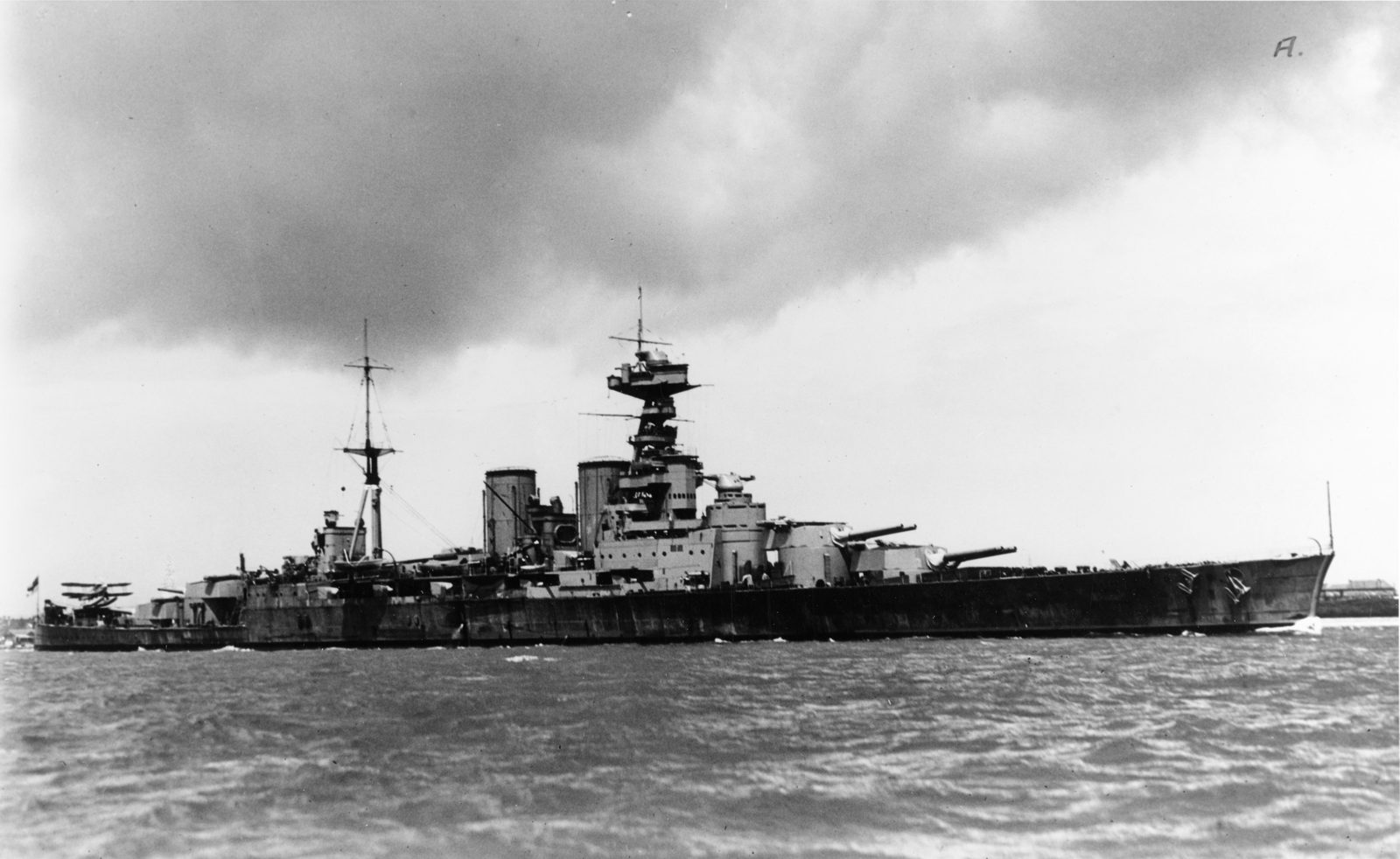
HMS Hood's keel was laid at John Brown & Company in Clydebank on September 1, 1916, three months after Jutland, and the design was revised before construction proceeded far: belt armor increased from 8 inches to 12, and roughly 5,000 additional tons of armor went into the ship overall. But the revision was a compromise, not a rebuild. Deck armor over the magazines, only 1 to 3 inches depending on location, remained comparatively thin, protection naval historians and the Royal Navy's postwar analysis would later call the design's Achilles' heel. Hood was launched on August 22, 1918, and completed in 1920, by then the largest warship in the world and, for two decades, the proud public symbol of British sea power.
The Admiral Who Tried to Outmaneuver a Known Weakness
On May 24, 1941, Hood and the new battleship Prince of Wales intercepted Bismarck and the cruiser Prinz Eugen in the Denmark Strait. According to Midshipman Ted Briggs, who was stationed on Hood's compass platform that morning, Vice Admiral Lancelot Holland altered course twice to close the range as fast as possible, and his reasons, in Briggs's account written after the war, were to get into decisive gun range and "to protect Hood's suspect deck armour by making a flatter trajectory for shells." The weakness built into the ship 25 years earlier wasn't a mystery to the men commanding her; it was something the admiral was actively maneuvering around in real time.
At 5:52 a.m., Hood opened fire at a range of about 25,000 yards. Bismarck's first salvo fell short and its second went over; the third scored a hit near Hood's mainmast that started a fire among the ready-use ammunition lockers, which Captain Ralph Kerr chose to let burn rather than risk flooding the space. As the range closed to roughly 16,500 yards, Holland ordered a turn to port to bring Hood's rear turrets into action, a turn that briefly exposed more of the ship's deck to Bismarck's plunging fire. During that turn, Bismarck's fifth salvo struck. Briggs, still on the compass platform, recalled no explosion he could identify as such, only a sheet of flame around the front of the structure that knocked the crew off their feet. The ship listed to starboard, briefly righted, then began listing to port and kept going. Roughly three minutes after the fifth salvo hit, Hood was gone, a magazine detonation that collapsed the battlecruiser even more quickly than the single bomb that would destroy USS Arizona at Pearl Harbor later that same year.
Three Survivors, and a Rescue Three and a Half Hours Later
Of the 1,418 officers and men aboard, 1,415 were lost. Only three survived: Midshipman William Dundas, Able Seaman Robert Tilburn, and Ted Briggs. Briggs later wrote that he went out through the starboard door of the compass platform, was dragged underwater as the ship went down, and then found himself shot back to the surface, something he attributed, along with the other two survivors, to a boiler exploding underwater and the men being caught in the resulting air bubbles. Tilburn had been on the boat deck, where a wire from the ship's aerials wrapped around his legs; he freed himself by cutting it away with a knife underwater.
The three men found each other on separate floating rafts and paddled together, holding on to one another until their hands went numb from cold. Prince of Wales initially reported Hood sunk with little hope of survivors, but Vice Admiral Sir Frederic Wake-Walker refused to accept that and sent two of the destroyers that had escorted Hood back to search the area. About three and a half hours after the sinking, the destroyer HMS Electra found the three men and brought them aboard.

The Royal Navy's Own Ship Designer Didn't Believe the Verdict
A first Board of Inquiry convened within days of the sinking and reported by early June 1941, concluding that a Bismarck 15-inch shell had struck in or near Hood's 4-inch or 15-inch magazines, causing them to explode and destroy the after part of the ship, most likely the 4-inch magazine first. The Royal Navy's chief ship designer, Director of Naval Construction Sir Stanley Goodall, wasn't convinced. In a memo dated July 2, 1941, Goodall laid out a geometric problem with that finding: witnesses placed the explosion's center at the base of the mainmast, but the aft magazines sat 64 to 180 feet further astern, and he could not reconcile how a magazine explosion in that location would send flame and wreckage up around the mainmast instead of venting through the hatches directly above the magazines themselves, near X and Y turrets. Goodall proposed an alternative: on the upper deck, near the mainmast, Hood carried eight torpedo warheads in armored boxes, together holding roughly 4,000 pounds of TNT, and argued that if a shell had detonated one of those warheads instead, the blast pattern would match what witnesses actually described.
Goodall's objection was among the complaints that the first board hadn't seriously weighed alternative explanations, and a second board convened that August, examined the case more thoroughly, and, by around September 1941, reached the same conclusion as the first: a magazine explosion, not a torpedo warhead. On the other side of the world, separate U.S. Navy courts of inquiry would later investigate a different fleet commander's two encounters with Pacific typhoons, the second of them recommending he be relieved of command, a recommendation the Navy accepted on paper and then simply didn't act on.
What a 2001 Dive and a 2019 Study Finally Confirmed
The dispute stood unresolved for six decades, a Navy verdict left open to question far longer than the wartime court-martial verdict against USS Indianapolis's captain, which took 54 years and an act of Congress to fully overturn. In 2001, shipwreck hunter David Mearns and Blue Water Recoveries located Hood's wreck on the seabed for a Channel 4 documentary marking the battle's 60th anniversary, and Ted Briggs, by then the last of the three survivors still living, joined the expedition and returned to the site to lay a memorial plaque for his lost shipmates. The wreck evidence weighed against Goodall's torpedo theory and toward the boards' original magazine-explosion finding, though the section of the ship where the initial detonation occurred had been too thoroughly destroyed to settle the question outright from the wreck alone.
In 2019, naval historians William Garzke, Robert Dulin, and William Jurens, the same Jurens whose 1998 technical reanalysis had already leaned toward the magazine explanation, published "Battleship Bismarck: A Design and Operational History," concluding that a 380-millimeter shell from Bismarck most likely penetrated Hood's deck armor and detonated in the aft 4-inch magazine, igniting its cordite, which in turn set off the adjacent 15-inch magazine. It was, in the end, the deck armor Admiral Holland had tried to maneuver around at Jutland's cost 25 years earlier, and Hood's chief designer had questioned within weeks of the disaster, that the most rigorous modern analysis says actually failed.