_underway_after_she_lost_her_bow_in_June_1945_(80-G-325746).jpg)
A Fleet Running Low on Fuel, and a Storm No One Diagnosed
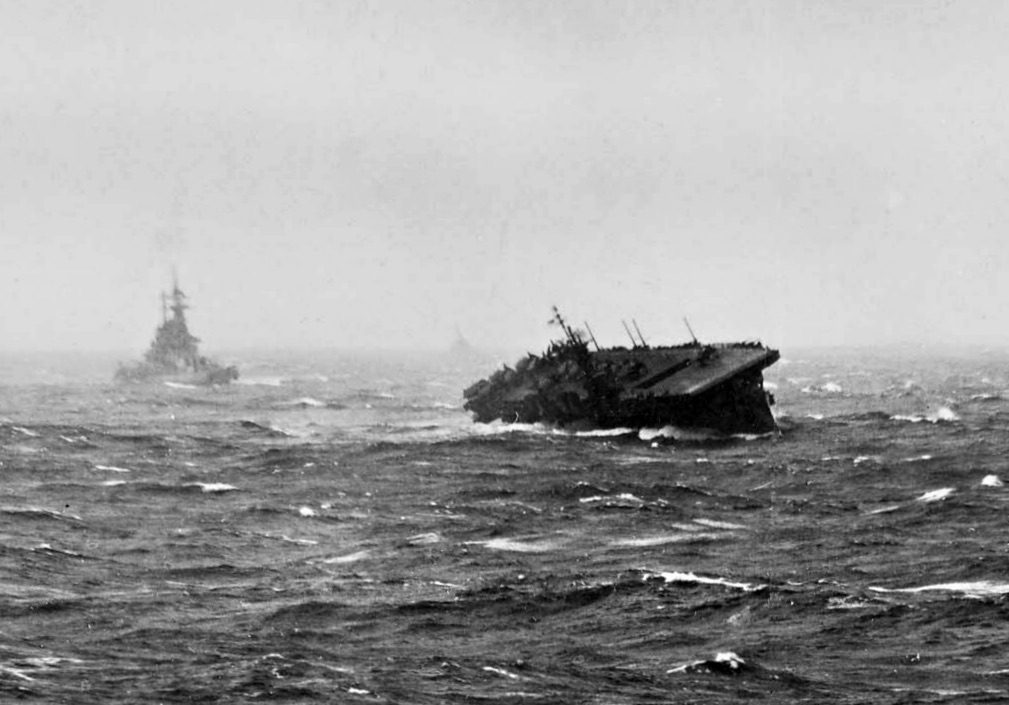
By December 17, 1944, Halsey's Third Fleet, seven fleet carriers, six light carriers, eight battleships, several cruisers, and about fifty destroyers, was trying to refuel at sea east of the Philippines after weeks of continuous air strikes supporting the Leyte campaign. A tropical disturbance had been noted in the area, but the weather forecasters aboard Halsey's staff and on the carriers repeatedly misread the storm's track and intensity, and no one on the fleet staff correctly diagnosed that a typhoon, not an ordinary squall, was closing on them. As seas built through the day, refueling became increasingly hazardous, with fuel hoses parting and ships nearly colliding as they tried to hold position alongside the oilers.
At 12:51 p.m., Halsey ordered fueling stopped and told ships that hadn't managed to take on fuel to ballast down with seawater instead, to add weight low in the hull for stability. Several ships delayed, hoping the seas would calm enough to finish refueling, a delay that would prove fatal for one of the three destroyers that sank the next day. Halsey also tried repeatedly to maneuver the fleet clear of the weather, but for a stretch the fleet and the storm were traveling the same direction at nearly the same speed, which made conditions seem to be slowly improving when the fleet had actually settled into the typhoon's path. It wasn't until roughly 4:00 a.m. on December 18 that it became clear the fleet had sailed into a serious storm, and not until around 10:00 a.m. that anyone recognized it as a typhoon.
_and_battleship_in_typhoon_1944.jpeg)
Three Destroyers, 790 Dead
Halsey didn't give ships permission to break formation and ride out the storm independently on their own best headings until 11:49 a.m., by which point some commanding officers had already done so on their own initiative. The destroyers USS Spence, USS Hull, and USS Monaghan, all light on fuel and, in Hull and Monaghan's case, also carrying hundreds of extra tons of wartime weapons and equipment that made them top-heavy, capsized and sank in gusts the Navy's history estimated at 100 to 110 knots. Of the roughly 775 men aboard those three ships, only 91 were pulled alive from the water. Counting three more men lost aboard the light carrier USS Monterey, which caught fire when a plane broke loose on its hangar deck, the storm killed 790 sailors and destroyed or swept overboard 146 aircraft fleet-wide. Twenty-seven ships suffered damage, eleven of them serious enough to need major repair.
The destroyer escort USS Tabberer, herself damaged and rolling 60 degrees, spent the evening of December 18 conducting her own box search for survivors rather than following Halsey's standing order for all ships to regroup toward Ulithi, an order her commanding officer, Lieutenant Commander Henry L. Plage, either never received or chose to disregard. Over the following 51 hours, Tabberer's crew pulled 55 survivors from the water, 41 from Hull and 14 from Spence, fighting off sharks with rifle fire while swimmers went overboard on lines to bring exhausted men to the ship's side. Halsey personally awarded Plage the Legion of Merit on December 29, 1944, eleven days after a search-and-rescue decision made in defiance of the admiral's own orders had saved more men than any other single ship in the fleet.
A Court That Found Fault and Stopped There
A Court of Inquiry convened aboard the destroyer tender USS Cascade at Ulithi on December 26, 1944, with Fleet Admiral Chester Nimitz present and Vice Admiral John Hoover presiding. Jim Marks, Hull's captain, testified before the court and his own surviving crew that he had tried every combination of rudder and engine to control the ship's rolling, without success: "It was apparent that no matter what was done, the ship was being blown bodily before the wind and sea." Halsey's chief meteorologist, Commander George Kosco, was called before the court twice to account for badly underestimating the storm's strength.
The court released its finding on January 3, 1945: "Preponderance of responsibility falls on Commander Third Fleet, Admiral William F. Halsey." The court described his errors as "errors in judgment committed under stress of war operations and stemming from a commendable desire to meet military requirements," language that assigned blame without recommending any punishment. The commanding officers of the three lost destroyers were separately faulted for having maneuvered too long trying to hold formation rather than turning to save their ships sooner. Nimitz, in his own after-action report, called the storm's toll "a more crippling blow to the Third Fleet than it might be expected to suffer in anything less than a major action." Halsey kept his command. In January 1945 he rotated it to Admiral Raymond Spruance under the Navy's standard practice of alternating fleet commanders, the same ships becoming the Fifth Fleet under a different name, and got it back that May.
Five and a Half Months Later, the Same Mistake
On June 3, 1945, Task Group 38.1, built around the carriers USS Hornet and USS Bennington, was operating east of Okinawa alongside a separate refueling group after two weeks of strikes against Japanese airfields. A tropical disturbance had been spotted east of the Philippines, but confused sighting reports, communication delays, and contradictory forecasts again left Third Fleet without an accurate fix on the storm's location, the same failure that had preceded Cobra five and a half months earlier. On June 5, the storm, smaller and more tightly wound than Cobra but no less dangerous for it, overtook Task Group 38.1, and the fleet passed through the eye at around 7:00 a.m. Sustained winds of roughly 70 knots (about 80 miles per hour), gusting to 100 knots (about 115 miles per hour), tore into nearly every ship in the group.
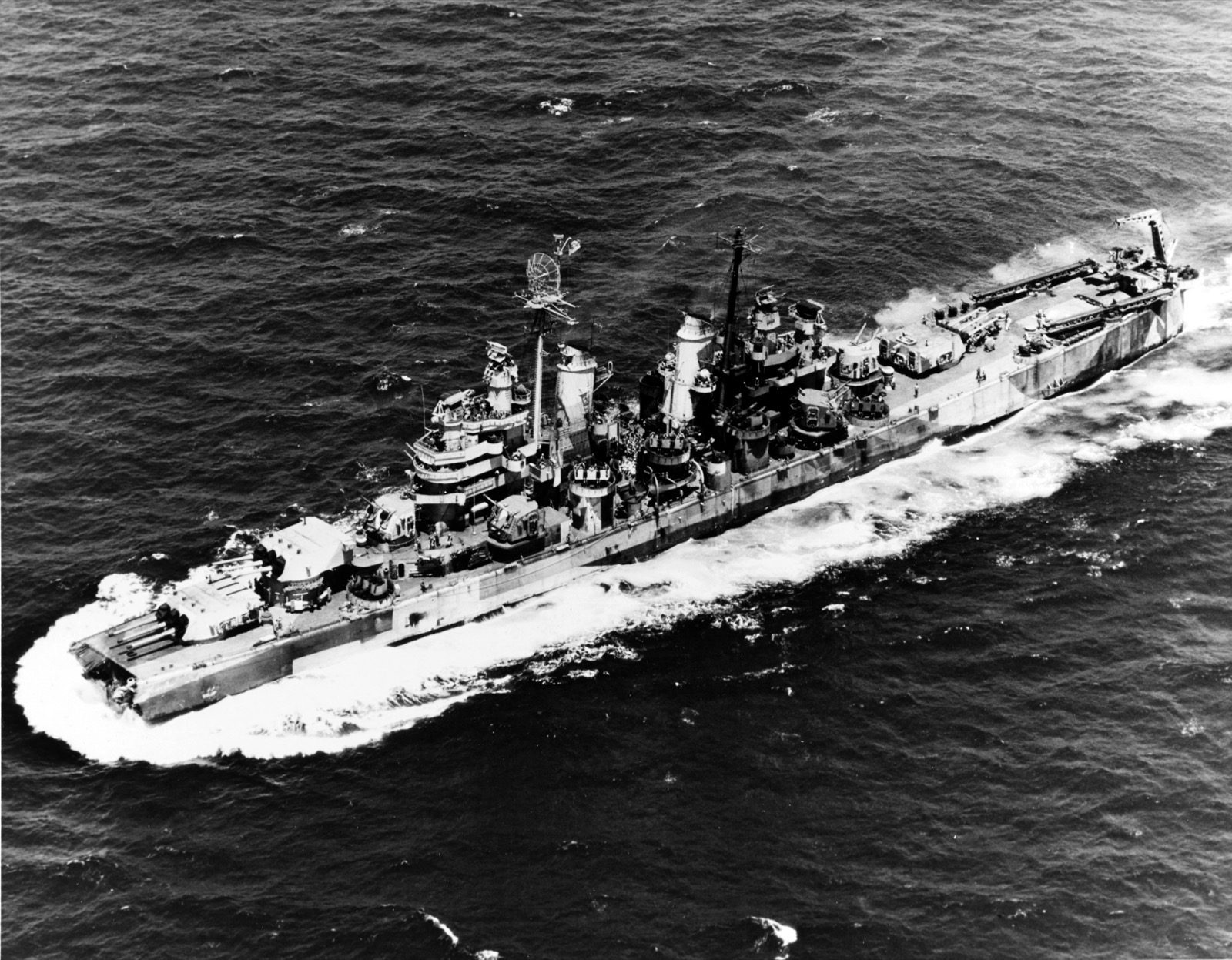
The heavy cruiser USS Pittsburgh lost her entire bow, more than 100 feet of it, sheared away by the seas. Two other cruisers suffered frame damage, every fleet carrier present suffered flight deck damage, and the carrier USS Belleau Wood lost an elevator outright. In the separate refueling group, the escort carriers USS Windham Bay and USS Salamaua each lost part of their flight decks and the oiler USS Millicoma suffered severe damage above decks. One officer and five enlisted men were lost or killed, with four more seriously injured, and the storm wrecked 43 aircraft outright and washed another 33 overboard, 76 aircraft in total, according to the Navy's official casualty accounting.
The Bow the Crew Called "USS McKeesport"
Pittsburgh's severed bow didn't sink. It stayed afloat, capsized, and drifting, and the fleet tug USS Munsee, later joined by her sister ship USS Patana, spent six days, June 6 through June 11, towing the more than 100-foot section toward Guam for salvage. Sailors on the operation nicknamed the wreckage "USS McKeesport," after a real Pittsburgh suburb, a joke that stuck well enough to survive in the Naval History and Heritage Command's own photo captions eight decades later. Once at Guam, Navy repair crews fitted the shortened cruiser with a temporary "stub" bow, similar to emergency repairs used on other torpedoed cruisers earlier in the war, finishing the work in about two weeks using the extensive salvage facilities the Navy had built up near the combat zone.
A Second Court Recommends What the First Wouldn't
On June 15, 1945, Halsey, Vice Admiral John McCain, and Rear Admiral Donald Beary appeared before a second Court of Inquiry aboard the battleship USS New Mexico in San Pedro Bay, Leyte Gulf, presided over by the same Vice Admiral John Hoover who had run the Cobra inquiry five and a half months earlier. The court again placed primary responsibility on Halsey, faulting a course change it called "extremely ill advised" for steering part of the fleet into the storm's path a second time, and this time it went further than the first court had: it recommended Halsey be relieved of his command.
Fleet Admiral Ernest King, Chief of Naval Operations, agreed with the court's finding of responsibility but declined to act on its recommended punishment. Nimitz, weighing the same decision, argued against removing Halsey given his record of service earlier in the war. Halsey kept his command through the end of the war, was present aboard USS Missouri for Japan's formal surrender on September 2, 1945, and was promoted to five-star Fleet Admiral that December, one rank Nimitz and King had already held for a year.
Halsey's public image as an aggressive, fight-hungry commander survived both inquiries essentially intact, a persona that outlasted the official record in a way another wartime reputation didn't: the newspapers and propaganda offices on both sides of a different general-turned-legend spent decades building a myth that modern historians have had to dismantle piece by piece, using the same kind of official record that never touched how the public remembered Halsey at all. The pattern of a Navy court of inquiry assigning blame on paper while consequences quietly evaporated afterward wasn't unique to Halsey, either: a different court investigating a different Pacific disaster reprimanded one officer, court-martialed another, and then walked both punishments back within about a year, all with far less public attention than the original findings had drawn.