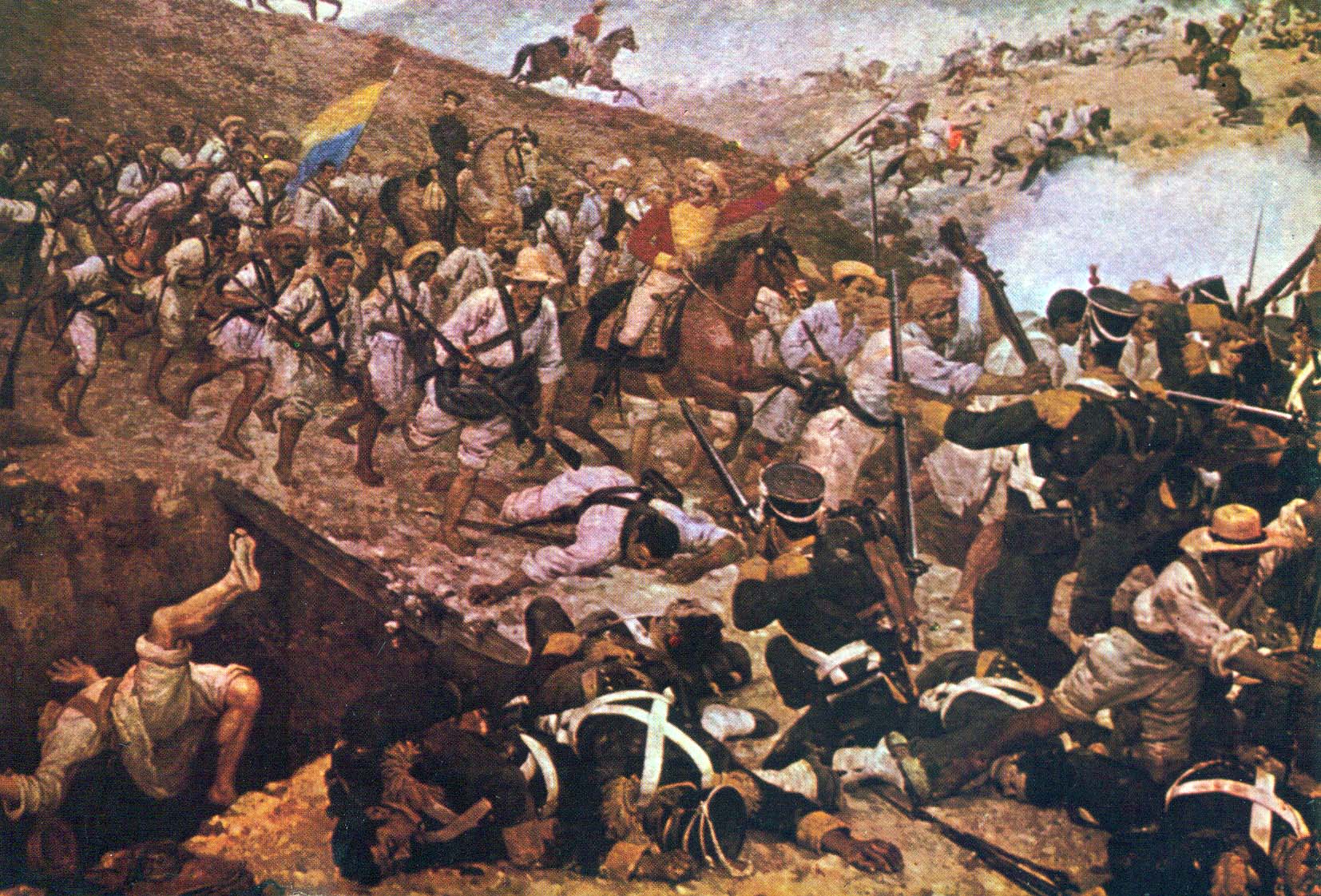

A Rehearsal in Command: The Admirable Campaign of 1813
Six years before Boyacá, Bolívar had already shown he could move an army fast and hit above its weight. Between May 14 and August 6, 1813, he led a small invasion force out of New Granada and across the Andes into Venezuela, organized as a vanguard division under Atanasio Girardot and a rearguard under José Félix Ribas, in what became known as the Admirable Campaign (Campaña Admirable).
Fighting through the provinces of Mérida, Trujillo, and Barinas, the patriots won a string of engagements against Spanish royalist forces, including Niquitao on July 2, Los Horcones on July 22, and Taguanes on July 31, before taking Valencia on August 2 and entering Caracas on August 6, 1813. Residents had already hailed him as El Libertador when he passed through Mérida that May, and Caracas made it official that October, when the municipality formally conferred the title he carried for the rest of his life: "The Liberator."
The campaign restored a short-lived Venezuelan republic, but the win did not last. Royalist and irregular llanero forces under José Tomás Boves crushed that republic within a year, and Bolívar fled into exile, first to New Granada, then to Jamaica and Haiti. The lesson he carried into 1819 was that speed and audacity could win a campaign, but holding a republic required something more than a fast march and a lucky run of battles. Haiti's own revolution is remembered through the Bois Caïman ceremony, which the country has only recently made a holiday.
Into the Flooded Llanos of Casanare
By 1819 Bolívar commanded a mixed force based out of Angostura (now Ciudad Bolívar) on the Orinoco, including foreign volunteers of the British Legion. On May 25, 1819, he set out from Mantecal with about 2,500 troops, aiming not at Venezuela's Spanish-held heartland but at New Granada, modern Colombia, where royalist forces under Colonel José María Barreiro were comparatively exposed.
The march itself, before a single shot was fired, nearly broke the army. Crossing the seasonally flooded llanos of Casanare during the rainy season meant days of wading through waist-deep water and swollen rivers; a considerable number of horses and pack mules drowned in the flooding, taking food and equipment with them. The column crossed the Arauca River on June 4 and reached Tame on June 12, where Bolívar's force joined with New Granadan troops under Francisco de Paula Santander.
Over Pisba: A Route the Spanish Called Impassable
The obvious way from Casanare into New Granada ran through the La Salina pass. Santander argued for something riskier: the Páramo de Pisba, a barely used route at altitudes above 3,900 meters (roughly 13,000 feet) that Barreiro's own command had dismissed as unusable in the rainy season and left essentially undefended.
That judgment was reasonable, and it very nearly proved correct against Bolívar too. His troops, drawn mostly from hot lowland plains, had no cold-weather clothing and no acclimatization to altitude. Crossing the páramo in freezing rain and fog, with too little vegetation to burn for fires, cost the army an estimated 100 dead from exposure, and roughly 500 more soldiers were hospitalized or lost to desertion once the column reached the town of Socha on the far side. According to biographer Marie Arana, Bolívar reported back to his vice president in Angostura: "The harshness of the peaks we have crossed would be staggering to anyone who hasn't experienced it. There's hardly a day or night it doesn't rain… Our only comfort is the thought that we've seen the worst, and that we are nearing the end of the journey."
Barreiro received word of the crossing on June 25 but doubted an army could actually be attempting it in that weather; he did not confirm the patriots had come over Pisba until July 6, by which point Bolívar's battered force was already down into the highlands of Boyacá province, ahead of any troops he could send to intercept it.
Boyacá: Two Hours That Decided New Granada
The two armies sparred for weeks before the decisive clash: an inconclusive fight at the Gámeza bridge on July 11, and a much bloodier engagement at Pantano de Vargas on July 25, where a charge by just fourteen lancers under Colonel Juan José Rondón broke a Spanish position and arguably saved the patriot army from disaster. Bolívar took Tunja on August 5.
On August 7, 1819, near a bridge over the Boyacá River, roughly 2,850 patriot troops caught Barreiro's approximately 2,670-man division strung out on the road to Bogotá. Santander's division blocked and engaged the Spanish vanguard at the bridge while Bolívar and General José Antonio Anzoátegui hit the separated rearguard half a mile back. The fighting was over in about two hours. Patriot losses were light, thirteen killed and fifty-three wounded, while the Spanish division was effectively destroyed: roughly 250 killed or wounded and some 1,600 men, including Barreiro himself, taken prisoner.
With the only field army defending the capital gone, the Spanish viceroy fled Santa Fe de Bogotá, and Bolívar entered the city unopposed on August 10. New Granada's independence was secured, and in December 1819 the Congress of Angostura used the victory to proclaim the union of Venezuela and New Granada as the Republic of Colombia, known to history as Gran Colombia.
What Bolívar Actually Won
Boyacá made Bolívar's later campaigns possible, but it is worth being precise about what came after, because the popular image of one unbroken march of liberation across the continent is not accurate. Venezuela's own independence was not secured until Bolívar's victory at Carabobo in June 1821. Ecuador's decisive battle, Pichincha, fought on May 24, 1822, was won not by Bolívar in person but by his lieutenant Antonio José de Sucre. Bolívar entered Peru in 1823 and defeated royalist forces at Junín in August 1824, his last battle in personal command, but the war's final, continent-deciding victory at Ayacucho that December was again Sucre's, not Bolívar's. Bolivia, the last territory to break from Spain, declared independence in August 1825 and was named after Bolívar, who never fought a battle on its soil. Even the entry into Peru followed a private meeting at Guayaquil with José de San Martín, one still argued over through a letter a 2023 study calls fake.
The republic he built at such cost did not hold either. Gran Colombia split into Venezuela, Colombia, and Ecuador by 1830, the year Bolívar died of tuberculosis, largely stripped of power. Months before his death he wrote to General Juan José Flores a line historians treat as authentic, drawn from his collected letters, and now among his most quoted: "He who serves a revolution plows in the sea." It is a fitting coda to a military record defined less by permanent conquest than by a handful of campaigns, Boyacá chief among them, where a willingness to accept horrific losses turned a nearly impossible march into a strategic surprise the other side never saw coming.