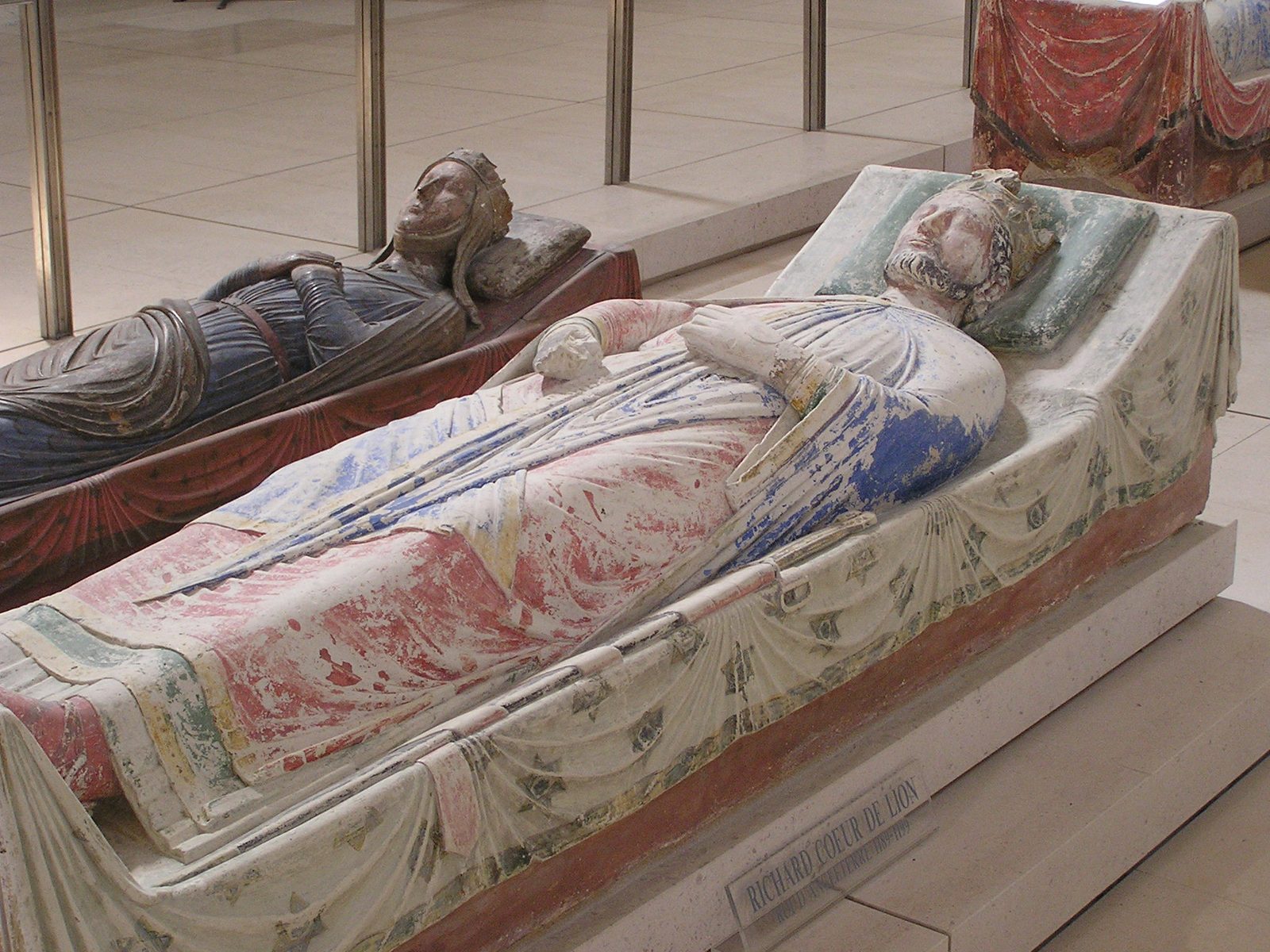

A King Who Spent Six Months on His Own Throne
Richard became king of England in 1189 after the death of his father, Henry II, but England was never really where he lived or governed. Raised largely at his mother Eleanor of Aquitaine's court in Poitiers, Richard was, by native language, a speaker of Old French and Occitan (the language of Aquitaine); English royal and court business in this period was conducted in Anglo-Norman French or Latin, and historians researching his upbringing have found no evidence he ever learned to speak English at all, since he would have had almost no practical reason to, per English History Net's biography of Richard I.
Of his roughly ten-year reign, Richard is generally reckoned to have spent only about six months physically in England, according to Historic UK. Most of the rest went to the Third Crusade (1189-1192), his subsequent captivity in the Holy Roman Empire, and, after his release, years of campaigning in France to defend his continental territories against King Philip II. England functioned largely as a source of revenue to fund those wars: Richard sold off crown lands, offices, and titles almost as soon as he took the throne, reportedly telling councillors who objected that he would sell London itself if he could find a buyer, an attitude the contemporary chronicler William of Newburgh criticized directly, writing that Richard was "more zealous for money than was fitting." His mother Eleanor and a series of appointed justiciars ran the kingdom's actual administration in his near-permanent absence, a sharp contrast with a hands-on ruler-builder like Peter the Great, who spent decades personally overseeing the navy and army he built from nothing.
Arsuf, September 7, 1191: Discipline Over Numbers
Richard's reputation as a battlefield commander is not just legend; the Battle of Arsuf is one of the best-documented demonstrations of it. Marching his roughly 25,000-strong crusader army south along the coast toward Jaffa, Richard arranged his infantry in a protective column shielding the knights and their horses, and absorbed hours of harassing fire from Saladin's mounted archers without breaking formation to give chase, a discipline that denied Saladin the scattered, exhausted targets his horse archers needed.
The plan held until the Hospitallers, forming Richard's rear guard and bearing the worst of the pressure, lost enough horses that they broke ranks and charged on their own initiative. Rather than let an uncoordinated countercharge collapse into disaster, Richard immediately converted it into a general assault, throwing the full weight of his cavalry into Saladin's now-overextended forces. Saladin's army suffered an estimated 7,000 casualties against roughly 700 crusader losses, and while Arsuf did not deliver Jerusalem, it broke the myth that Saladin's army was unbeatable in open battle and let the crusaders continue their march to Jaffa largely unmolested, as detailed in Medievalists.net's account of the battle. It is a very different kind of documented tactical discipline than the terrain-based ambush William Wallace used against a similarly outnumbering force a century later at Stirling Bridge, but both battles rest on the same underlying principle: a smaller force controlling exactly when and where the fighting actually starts.
The Massacre at Ayyadieh: What the "Lionheart" Legend Leaves Out
Two months before Arsuf, after the crusaders finally took Acre following a siege of nearly two years, Richard tried to convert roughly 2,700 to 3,000 captured Muslim soldiers into leverage. His terms to Saladin were straightforward: return the relic believed to be the True Cross, pay a large ransom, and release the Christian prisoners Saladin's forces held, and the captives from Acre would go free.
The exchange stalled. Saladin, according to the eyewitness biography by his own official Baha ad-Din ibn Shaddad, was slow-walking the handover, in part hoping a relief force might still change the military situation. Richard, suspecting delay was itself the strategy and unwilling to march his army south toward Jaffa while thousands of prisoners had to be guarded and fed, ordered the executions on August 16, 1191; they were carried out four days later, on August 20, on a hill outside Acre called Ayyadieh, in full view of Saladin's own camp. Contemporary and near-contemporary sources put the death toll at roughly 2,700, with one 15th-century chronicle claiming as many as 5,000, and Saladin's forces retaliated by executing an estimated 1,600 Christian captives of their own, according to the sourcing summarized on Wikipedia's article on the Massacre at Ayyadieh (checked 12 October 2026), which draws on Baha ad-Din's account and the crusader chronicle the *Itinerarium Peregrinorum et Gesta Regis Ricardi*.
The episode sits uneasily next to the Arsuf story precisely because both are true at once: the same command discipline that broke Saladin's cavalry in open battle also produced a calculated mass execution of bound prisoners when it served Richard's logistics. Popular retellings of the Crusades tend to keep the former and quietly drop the latter, a pattern that recurs with rulers like Ivan the Terrible, whose real military reforms are just as inseparable from his record of brutality against his own subjects. The same pattern follows Charlemagne and the 4,500 beheadings his annals recorded.
Captured in Disguise: The Ransom That Cost England Three Years of Crown Revenue
Richard's return voyage from the Holy Land went almost as badly as the Crusade itself. Shipwrecked and forced to travel overland through hostile territory, he tried to slip through the domain of Duke Leopold V of Austria in disguise, a man Richard had personally humiliated by tearing down his banner at Acre. Leopold's men recognized and captured him near Vienna in December 1192, and Richard was imprisoned first at Dürnstein Castle on the Danube and later handed over to Holy Roman Emperor Henry VI, who set his ransom at 150,000 silver marks, a sum contemporary estimates put at roughly two to three times the English crown's entire annual income, according to Britannica's account of Richard's imprisonment. It was not the first crusade to end badly: the Second Crusade attacked an ally at Damascus, and a feud ended the siege.
Raising it required an extraordinary, kingdom-wide fundraising effort under Eleanor of Aquitaine, including a special tax on income and movable property, the melting down of church plate, and contributions solicited from English monasteries and nobles. Richard was finally released on February 4, 1194, more than a year after his capture, with his mother personally delivering him from custody. He returned to England only briefly to be crowned a second time (a symbolic act meant to erase the taint of captivity) before departing again for France, where he spent the rest of his reign at war with Philip II.
Death at Châlus, 1199
Richard's death was almost incidental to the medieval warfare that defined his reign. In March 1199, while besieging the minor castle of Châlus-Chabrol over a dispute involving a rebellious vassal and a supposed buried treasure, he was struck in the shoulder by a crossbow bolt fired from the battlements. The wound itself was not immediately fatal, but it turned gangrenous, and Richard died on April 6, 1199, reportedly having pardoned the crossbowman responsible before he died, though what happened to that man afterward is recorded differently across surviving chronicles.
He left no legitimate heir, and the throne passed to his younger brother John, whose reign would go on to produce Magna Carta in 1215, a document written in direct reaction to the kind of arbitrary, revenue-hungry kingship that Richard's near-permanent absence and heavy taxation had already normalized.