,_f.280v_-_BL_Royal_MS_15_E_I.jpg)
An Ally Jerusalem Had Already Spent
Damascus and the Kingdom of Jerusalem were not strangers when the Second Crusade arrived in 1148. In early 1138, Mu'in ad-Din Unur, the Burid ruler of Damascus, had offered Jerusalem an alliance against Imad ad-Din Zengi, the Turkic warlord expanding out of Aleppo and Mosul; Jerusalem turned him down. Two years later Zengi laid siege to Damascus itself, and Unur asked again, this time offering King Fulk the city of Banias plus a monthly tribute in exchange for help. Fulk accepted, marched north, and forced Zengi to abandon the siege in April 1140. Unur then visited Fulk's court in Jerusalem, where chroniclers describe him receiving a warm welcome.
That entente lasted until greed in Jerusalem broke it. In spring 1147, an emir named Altuntash, who governed Bosra and Salkhad in Unur's name, fell out with his overlord and offered those towns to King Baldwin III instead, in exchange for either a large payment or direct rule under Jerusalem's crown. The towns sat in the Hauran, the agricultural region that fed Damascus, and a council of Jerusalem's nobility voted to accept the offer even though, as later chroniclers recorded, doing so was recognized at the time as politically foolish and certain to end the alliance with Damascus. Baldwin marched on Bosra, but Altuntash's wife, still loyal to Unur, opened the gates to a Damascene garrison before the king arrived, and Baldwin retreated under sustained harassment from Turkish light cavalry, taking heavy losses along the way.
The Bosra affair ended the entente for good. Unur, having just watched his supposed ally try to strip away the region that fed his capital, turned to the very dynasty the old alliance had existed to hold off: he married his daughter, Ismat ad-Din Khatun, to Nur al-Din Zengi, Imad ad-Din's son and successor, that same year. By the time European crusaders started arriving at Jerusalem the following spring, the city they would soon choose as their target had already spent more than a year rebuilding its defenses around a marriage alliance with the Zengids, a realignment triggered by a failed land grab from the council in Jerusalem.
The Target Nobody Seriously Debated
The crusade itself had a different origin. Zengi captured the Crusader-held County of Edessa on December 24, 1144, and Pope Eugene III called for a new crusade the following December to win it back. Kings Louis VII of France and Conrad III of Germany led the response, and both armies were mauled crossing Anatolia in late 1147: Conrad's force was reduced to roughly a tenth of its size within days of leaving Nicaea, and three-quarters of the French army was lost in an ambush near Mount Cadmus. Louis reached Antioch by ship on March 19, 1148, and Conrad reached Acre in early April; by the time Louis made his own way down to Jerusalem and found Conrad already there, both kings had armies far smaller than the ones that had set out from Europe, and Edessa itself was no longer a realistic objective.
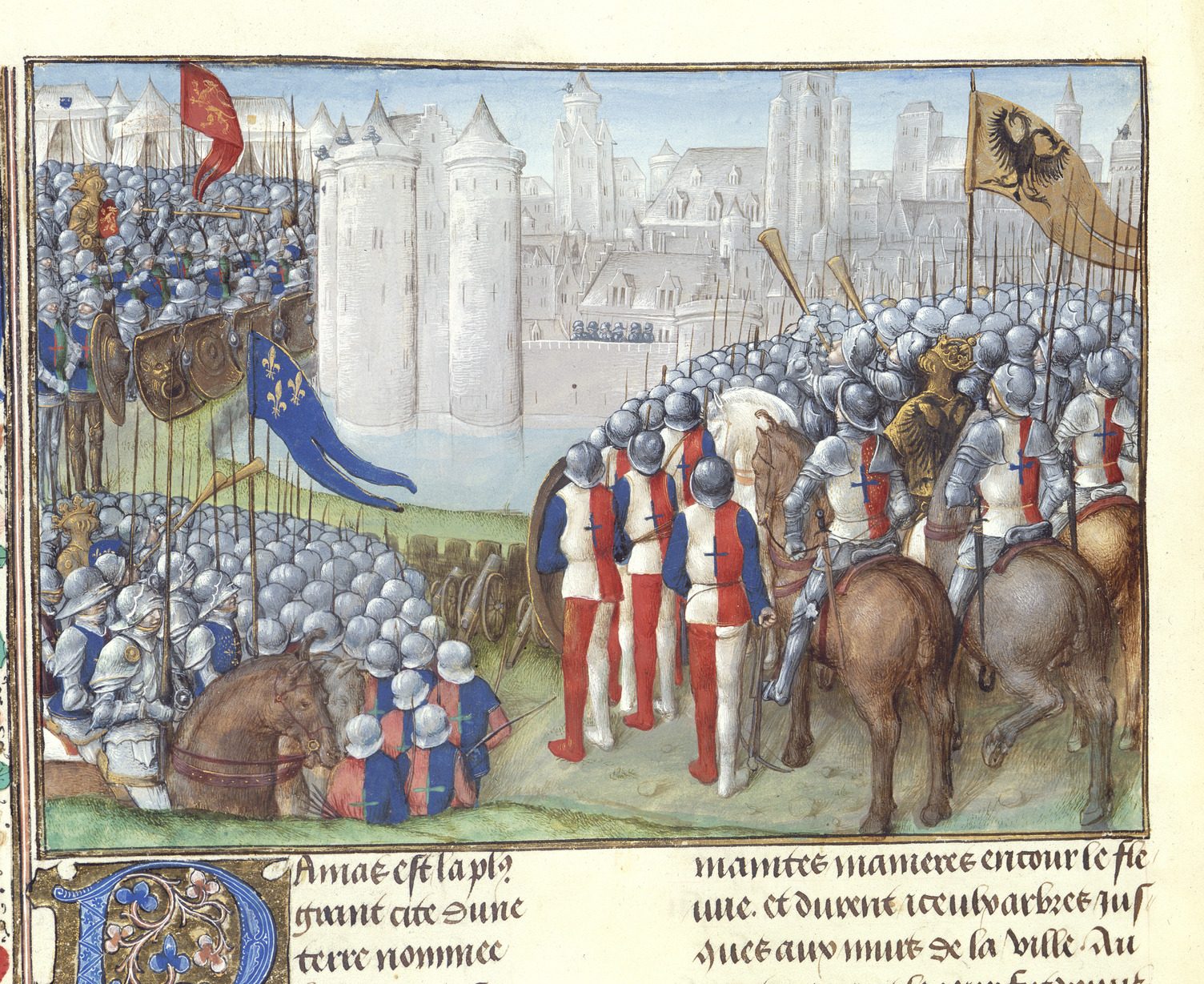
The choice of a new target was effectively settled before the wider crusader leadership ever debated it in public. A private meeting in Jerusalem in May 1148, attended by Conrad, Baldwin III, the Latin Patriarch Fulcher, and Templar representatives, settled on Damascus, and word reached Louis before the formal council convened. That council met at Palmarea near Acre on June 24, 1148, drawing together the two visiting kings, Jerusalem's queen mother Melisende and King Baldwin III, the kingdom's church hierarchy, and the leadership of the Templars and Hospitallers, a gathering the historian Jonathan Phillips has called the most important assembly the Latin East had yet seen. William of Tyre records plenty of talk that day but little actual disagreement: the decision to attack Damascus, a city that had been Jerusalem's ally within living memory of most people in that room, passed unanimously with no recorded dissent.
The army that marched north in July was smaller than contemporaries claimed. Islamic chroniclers of the period put the crusader host at 50,000 men; modern historians, working from surviving contingent lists and the size of the camps described in the sources, put the real figure closer to 20,000 combatants plus an unknown number of support personnel, still the largest crusader army fielded in the Levant in two centuries. A similar gap between a chronicler's round number and a modern historian's reconstruction shows up in accounts of much older battles: at Plataea in 479 BCE, Herodotus's figure of 300,000 Persian troops sits far above the 70,000 to 120,000 that modern historians estimate using the same kind of contingent-by-contingent reconstruction.
Four Days at the Walls, and a Camp Move With Two Explanations
Unur learned of the crusaders' decision almost as soon as it was made. He sent messengers to nearby Muslim cities asking for help, had his engineers divert water sources along the road into Damascus to slow the invaders, and posted scouts to track their approach. When the crusader army tried to make camp near Manazil al'Asakir on its approach, it found the water there already cut off and had to move eleven kilometers south to Al-Kiswah on July 23.
The attack opened on July 24 through the dense, walled orchards of the Ghouta on Damascus's western side, chosen deliberately for the food and water they offered an attacking army. Damascene militia and Turkish mercenaries fought from behind orchard walls and towers for two days; William of Tyre credits Conrad III with personally leading a charge that broke the defenders' line along the Barada River. On July 25, the fighting killed several prominent defenders, among them Yusuf al-Findalawi, a 71-year-old jurist, and Nur ad-Din Shahanshah, the emir of Baalbek and elder brother of the future sultan Saladin. Reinforcements reached the defenders from the Beqaa Valley on July 26, doubling their supply of arms according to the contemporary chronicler Ibn al-Qalanisi.
On July 27, with the western approach still contested, the crusader commanders moved their camp to the plain east of the city, near the weaker but drier Bab al-Saghir gate, a position with far less food and water than the orchards they abandoned. William of Tyre's account of why gives most of the blame to a dispute inside the crusader camp itself: the local barons of Jerusalem wanted Guy of Beirut installed as ruler if Damascus fell, while the three kings backed Thierry of Alsace, Count of Flanders, and William records that the local barons, preferring the Damascenes keep their own city over seeing it handed to Thierry, worked to see the siege collapse. A separate strand of the tradition blames bribery instead, claiming Unur paid off crusader leaders to abandon the stronger position; even that story splits internally, since William of Tyre and the Syrian chronicler Michael the Syrian both insist the coins the Templars supposedly accepted turned out to be copper rather than gold.
By July 28, Nur al-Din and his brother Saif ad-Din had reached Homs and were negotiating with Unur over Damascus's fate, an outcome Unur wanted no more than the siege itself; with a Zengid relief force now in the field, returning to the abandoned western position was no longer realistic. The local lords refused to continue, and the retreat to Jerusalem began that day, harassed by Muslim archers the entire way.

What Actually Explains the Retreat
The historian Alan Forey re-examined the siege at length in a 1984 Journal of Medieval History article and argued the popular treachery narrative obscures a more ordinary military failure: the crusaders met tougher resistance in the orchards than they had expected, lacked the siege engines and supplies for a prolonged blockade, and faced a relief army closing in from Homs, leaving the shift to a weaker position a defensible gamble rather than an inexplicable act of betrayal or incompetence. That reading lines up with the account William of Tyre wrote within a generation of the siege, which already put the internal quarrel over Damascus's future ahead of Unur's money as the real cause. A comparable pattern shows up elsewhere in crusading and conquest history, where an explanation attached to an event by the people who lived through its immediate aftermath later gets revised once historians work back through the earliest surviving sources: the Mongol withdrawal from Europe in 1242 was long credited to Ögedei Khan's death, until a closer reading of the earliest chronicle showed the retreating army hadn't yet received the news.
The failed siege cost both sides trust they didn't recover quickly. Louis and Conrad's followers blamed each other for the collapse, and a planned follow-up attack on Ascalon was abandoned for lack of confidence between the two camps; Conrad sailed home by way of Constantinople to shore up his alliance with Byzantium instead, and Bernard of Clairvaux, who had preached the crusade, spent his remaining years trying to distance himself from its failure. Unur did not live to see how the realignment he had engineered played out: he died on August 28, 1149, thirteen months after the siege, and his weaker successor, Mujir ad-Din Abaq, briefly resumed paying tribute to the crusaders rather than lean fully on the Zengids. That arrangement did not hold. In 1154, with reported support from local residents, Nur al-Din entered Damascus and absorbed it into a Zengid Syria that stretched from Edessa to the Hauran, the buffer state the old Jerusalem-Damascus alliance had once been built to preserve now gone for good.