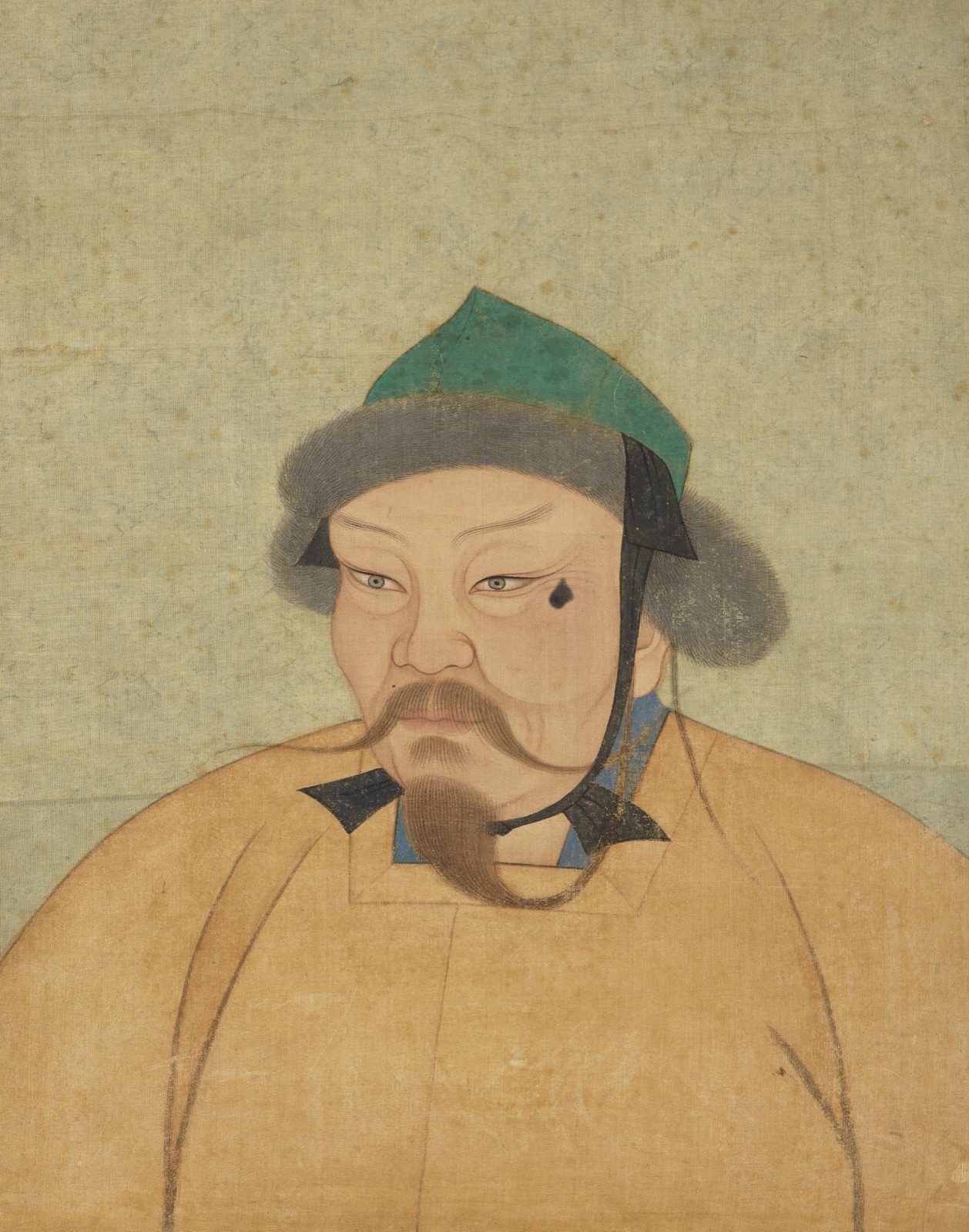

The Third Son Who Loved a Drink
Born around 1186, Ögedei was the third of Genghis Khan's four sons by his wife Börte, and he fought at his father's side during the Mongol campaign against the Khwarazmian Empire from 1219 to 1225. When Genghis Khan died in 1227, the throne did not pass to Ögedei immediately. His youngest brother Tolui governed as regent for two years until a kurultai, a general assembly of Mongol chiefs, formally elected Ögedei as khagan in 1229. Once in power, he built the empire's first true capital at Karakorum starting in 1235, finished off the Jurchen Jin dynasty of northern China in February 1234, and, according to the Secret History of the Mongols and later Persian sources, expanded his father's rudimentary courier network into the full postal relay system known as the Yam, the string of way stations that let messengers and officials cross the empire on fresh horses.
None of that stopped Ögedei from becoming, in the words of the Persian historian Juvaini writing around 1260 in his Tarikh-i Jahan-gusha, a ruler "wise and valorous" but also a committed drinker. The most repeated anecdote about him, recorded independently in both Juvaini's history and the Secret History of the Mongols, has his older brother Chagatai growing worried enough about the drinking to station an official at Ögedei's table with orders to serve him only half his usual number of cups each day. Ögedei went along with the restriction to the letter and ordered a new set of cups made, each one twice the size of the old.
The Night of December 10, 1241
Ögedei went hunting on December 7, 1241, returned to camp on December 10, and sat down that evening to a feast attended by a courtier named Abd al-Rahman. He drank through the night and died the following morning, December 11, at around 55 years old. The immediate rumor mill produced a poisoning story: the Franciscan friar John of Plano Carpini, who traveled through Mongol territory a few years later, wrote that Ögedei had been poisoned by a mistress belonging to one of his sons.
Rashid al-Din, a high-ranking minister at the Ilkhanate court writing decades afterward with access to a now-lost Mongol court chronicle called the Altan Debter, gives a more specific and less sensational version. In his account it was Tolui's widow's sister and her son, not any mistress, who served as Ögedei's cupbearers that night, and when accusations of foul play surfaced afterward, a Mongol nobleman shut them down on the spot: "What foolish words are these? [Ibaqa Beki's] son was the steward who always held the cup, and Khan was always drinking to excess. Why should we slander Khan by saying that he died at the hands of others?" Stephen Pow's 2012 graduate thesis on the episode notes a further problem with Carpini's version: the friar's account of Ögedei's death also garbles it together with a different, unrelated event, the execution of a woman named Fatima on witchcraft charges under Ögedei's son Güyük several years later, which raises real doubts about how carefully Carpini's informants were reporting the events of 1241 in the first place.
The Explanation Everyone Reaches For
The version of events that shows up in most general histories of the Mongol Empire runs like this: news of Ögedei's death reached Batu Khan in Hungary around March 1242, and Batu, needing to protect his standing in the succession fight, ordered an immediate withdrawal from Europe. Carpini went further and framed the khan's death as an act of divine providence, God intervening to spare Christendom. Historian Greg S. Rogers, in a 1996 survey of the scholarship for East European Quarterly, identified this as the single most common account and labeled it the "political theory," noting that it is also the explanation that requires the least primary-source support, since most historians who repeat it are citing earlier secondary summaries rather than checking the surviving chronicles themselves.
What the Minister's Own Source Says Happened
Rashid al-Din's account, drawn from Mongol court records relayed to him personally by the Ilkhanate minister Bolad, describes the Mongol commander Kadan giving up his pursuit of the fleeing Hungarian king Béla IV at the Adriatic port of Trogir and turning back into the territory of the Vlachs. At that specific point in the retreat, Rashid al-Din states plainly, "the news of Khan's death had not yet reached them." That detail lines up with an independent European account from the chronicler Thomas of Split describing the withdrawal at the end of March 1242, right as Batu's forces were pulling back through Transylvania toward the Danube on a parallel track.
The stronger evidence against the political theory is what Batu did next. He never traveled to Mongolia after the European campaign. He stayed based on the Volga River, building the state that would become the Golden Horde, and when a kurultai to choose Ögedei's successor was finally organized the following year, Batu refused to attend, citing gout, a medical excuse Rashid al-Din explicitly calls just that, an excuse. His repeated refusals delayed the succession for years; Ögedei's son Güyük was not enthroned as the next khagan until 1246, five years after his father's death, with Ögedei's widow Töregene ruling as regent in the interim.
Could the News Even Have Traveled That Fast?
Pow's thesis tests the political theory against the one kind of evidence almost no earlier historian had bothered to check: how long it actually took people to travel the same route a few years later, using the Mongol Empire's relay stations and guides. Benedict the Pole, interpreter for the friar Carpini, recorded that the trip from a Mongol camp on the Dnieper River to Batu's own camp on the Volga, riding with appointed Mongol guides and switching horses along the way, took more than five weeks by itself, and Hungary sits well to the west of the Dnieper. Carpini's onward journey went further: he left Batu's Volga camp on April 8 and did not reach Güyük's camp near Karakorum until July 22, roughly three and a half months, and Carpini says his Mongol guides pushed the pace deliberately hard to get him there in time for the enthronement ceremony. A few years after that, William of Rubruck was told by his guide at the Volga that the trip to Mongolia would take about four months; leaving in September and changing horses two or three times a day, his party reached Möngke Khan's camp at the very end of December.
Ögedei died on December 11, 1241, and the withdrawal from Hungary began in late March 1242, a gap of roughly three and a half months to cover a longer distance than the Volga-to-Karakorum leg alone, the one stretch of that same journey that took Carpini three and a half months at deliberately forced speed, with the additional crossing from Hungary to the Volga still unaccounted for. Set against journeys other travelers actually logged on comparable ground only a few years later, the timeline the political theory requires looks, at best, extremely tight.
The Climate Scientists Don't Agree Either
A separate, more recent argument over the withdrawal has played out entirely within climate science, and it hasn't been resolved either. In 2016, dendrochronologists Ulf Büntgen and Nicola Di Cosmo published tree-ring reconstructions drawn from five independent sites, northern Scandinavia, the Polar Urals, the Romanian Carpathians, the Austrian Alps, and the Russian Altai, showing warm, dry summers from 1238 to 1241 followed by a cold, wet start to 1242. Their argument was that the resulting marshy ground across the Hungarian plain cut into pasture for the Mongols' horse herds and reduced their cavalry's mobility, contributing to the decision to leave.
In 2017, a team led by geographer Zsolt Pinke published a rebuttal in the same journal, titled "Climate of Doubt," arguing that environmental, archaeological, and historical evidence did not support that conclusion, and presenting evidence that the abundant spring rain of 1242 likely improved rather than worsened the Mongols' food and pasture supply. Büntgen and Di Cosmo published a formal reply defending their original findings, countering that Pinke's team's critique operated at too general a level to account for the specific conditions of the 1242 campaign and did not bring any new climatic data of its own to the argument. Weather has decided the fate of military campaigns before without any such dispute over the basic facts, but here, two teams working from broadly the same tree-ring chronologies for the same fifteen months of weather reached opposing conclusions about what that weather actually did.
Pow's own thesis, after working through and rejecting all four of the standard explanations, including the pasture theory in its earlier form, argues instead that Europe's dense network of stone fortifications made further westward conquest strategically unattractive to an empire built around open-steppe cavalry warfare, a conclusion built from patiently checking what the primary sources actually say rather than accepting a widely repeated story at face value, not unlike how a mistranslated pre-metric measurement in Napoleon's autopsy record kept a shorter-than-average myth alive for two centuries. Modern scholarship on the 1242 withdrawal, running from Greg Rogers's 1996 four-theory framework to a live 2017 journal exchange over tree-ring data, has produced four competing theories and no settled answer.