
A Three-Year Career, a Hundred Ships, a Reputation for Cruelty
Edward Low was born in Westminster, England, around 1690, into poverty severe enough that he was pickpocketing city streets as a boy, according to the colonial-era history The Pirates of the New England Coast, 1630-1730 by George Francis Dow and John Henry Edmonds. He later crossed to Boston, worked as a ship rigger, and lost his wife in childbirth in late 1719. Two years after that, in December 1721, he was part of a merchant sloop's crew loading logwood in the Bay of Honduras. He and a dozen other crewmen fell out with the ship's captain, shot at him, and took the vessel over. His career as a pirate started there. New England had a colonial legal history of its own, including the one-witness trial of John Sassamon's accused killers that started King Philip's War.
It lasted roughly three years. In that time, Low and his crews captured at least a hundred ships, most of which they burned rather than kept. His reputation for violence outran even the usual pirate press coverage: near Rhode Island in 1723, his men reportedly cut the heart out of one captured captain's chest and forced a crew member to eat it, then cut the ears off a second captain and made another crew member eat those. By late July that year, Low had captured a large Virginia ship, the Merry Christmas, made it his flagship, taken the title of Admiral, and hoisted a black flag with a red skeleton on it.
The Account That Ends Without an Ending
The closest thing to a contemporary biography of Low is the second edition of A General History of the Pyrates, published in London in 1724 under the name Captain Charles Johnson, a pen name some historians attribute to Daniel Defoe. Its chapter on Low doesn't end with his death. It ends with the author admitting he had run out of information.
The chapter ends by describing a January 1724 encounter off West Africa as the last confirmed report, then admitting: “...what became of him afterwards, I can't tell. We have had no News concerning him come to England, since this I have now mentioned; but I have heard that he talk'd of going to Brazil; and if so, it is likely we may too soon hear of some Exploit or other; tho' the best Information we could receive, would be, that he and all his Crew were at the Bottom of the Sea.”
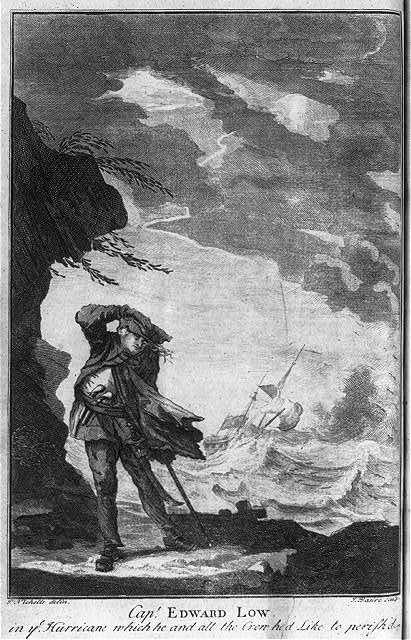
That's the entire ending: no mutiny, no capture, no trial. Just an admission that the record had run dry, followed by two unconfirmed rumors, that Low had sailed for Brazil, and that his ship might simply have gone down at sea. A 1734 engraving, now held by the Library of Congress, illustrated that second rumor directly, showing Low's ship caught in a hurricane with the whole crew close to perishing. Every more specific version of his death, including the one now repeated across most pirate websites, was written by someone other than the person closest to the events.
Boston Kept Hearing About Him for Two More Years
Johnson's account wasn't the last word reaching the colonies, only the last word he had access to before his book went to press. In March 1724, according to Dow and Edmonds, news reached Boston that Low had fought with other pirates, had his vessel burned, and been marooned on a deserted island. That story didn't hold either.
Two years after the trail supposedly went cold, the reports kept coming, and they didn't agree with each other. In March 1726, crewmen aboard the Royal Navy warship HMS Diamond reported recognizing Low among nine men aboard a small boat, a periagua, near the island of Roatan in the Bay of Honduras; Diamond had lost its own canoe and couldn't give chase, and Low was reportedly killed afterward by Miskito people, though even that detail is unconfirmed. That same spring, Captain William Cross of Piscataqua, New Hampshire, returned from the Bay of Honduras with a different account: Low and a fellow captain, Spriggs, had indeed been marooned, but had escaped with help from Miskito allies. Then on May 17, 1726, sailors returning to Boston from Barbados said Low had captured their ship near St. Lucia and released them, with a French warship reportedly in pursuit and possibly closing in.
Three Deaths, Invented After the Fact
The version now told as settled fact across most pirate websites, that Low murdered a sleeping crewman after an argument, was thrown into a boat by his mutinous crew, was picked up by a French vessel, and was recognized and hanged, doesn't come from Johnson's 1724 account or from anything written near the events it describes. It comes from Charles Ellms's The Pirates Own Book, published in Boston in 1837, 113 years later. In Ellms's own words: “Low's crew at last rose against him and he was thrown into a boat without provisions and abandoned to his fate. This was because Low murdered the quarter-master while he lay asleep. Not long after he was cast adrift a French vessel happened along and took him into Martinico, and after a quick trial by the authorities he received short shift on a gallows erected for his benefit.”
Dow and Edmonds, working from colonial-era sources for their own history of New England piracy, describe a similar story: a mutiny, a killed officer, capture by the French, credited to what they call a French source and said to be confirmed by a captured crewman named Jonathan Barlow. But their version has Low taken back to France to stand trial, not to Martinico (an old spelling of Martinique). Two tellings built on the same basic plot can't agree on which country supposedly hanged him.
London's Royal Museums Greenwich, which operates the National Maritime Museum, credits neither hanging story. Its stated position is that Low was never caught, and that he ended his days in Brazil, matching the one unconfirmed rumor Johnson's 1724 account actually reported.
WarCrumbs has run into this shape of problem before: the death Priscus recorded as a plain nosebleed, and the knife a chronicler added eighty years later, or the withdrawal popular history blames on a khan's sudden death, when the primary sources say the army hadn't even heard the news when it started. Even famous, heavily documented events aren't immune: two of the most quoted lines from the opening battle of the American Revolution turn out to be later additions the participants' own accounts don't support. Low's case just makes the gap unusually wide. The writer working closest to the events said he didn't know. Everyone who came after has been more certain than he ever was.