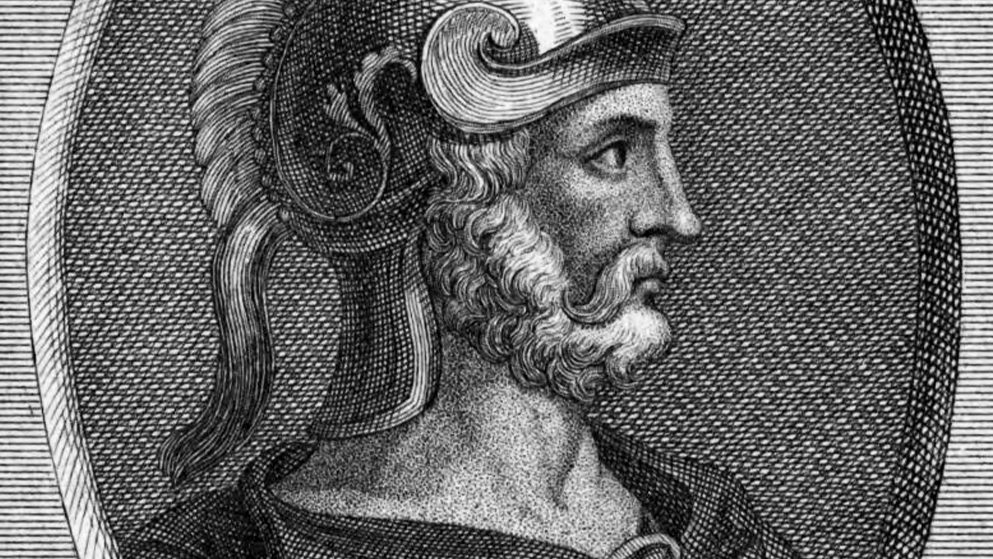
.jpg)
Undefeated on a Mountain, and It Didn't Matter
Carthage handed Hamilcar command in Sicily in 247 BCE with the war already mostly lost. Rome held nearly the whole island; only the fortress towns of Lilybaeum and Drepana, plus whatever Hamilcar could hold in the field, remained Carthaginian. He landed on the north coast and seized Mount Ercte, near modern Palermo, holding it against repeated Roman attempts to dislodge him from 247 to 244 BCE while his raiding parties struck the coast as far as southern Italy. In 244 he shifted his base to the more defensible Mount Eryx, near Trapani, and held that position for three more years. In neither place did a Roman army ever force him off the mountain.
What ended the war wasn't a defeat on land. In 241 BCE a Roman fleet destroyed Carthage's relief squadron at the Aegates Islands, severing the sea route that kept Hamilcar's army supplied and reinforced on Eryx. Carthage's government gave him authority to negotiate directly with the Roman commander, Gaius Lutatius Catulus, and the resulting Treaty of Lutatius let Hamilcar march his men off the mountain intact rather than surrender them. He had spent six years undefeated in the field and still had to sign an armistice, because the war he was fighting had already been lost somewhere he'd never set foot: the water between Sicily and Africa.
The War That Nearly Finished Carthage From the Inside
Peace with Rome didn't bring peace at home. Carthage owed years of back pay to the mercenary army that had fought under Hamilcar in Sicily, many of them veterans of his own Eryx campaign, and when the city tried to negotiate the debt down, the unpaid troops mutinied, joined by rebellious Libyan cities that had their own grievances against Carthaginian tax collectors. Polybius, writing within a lifetime of the events, called what followed a war fought outside any of the normal customs and restraints that govern conflict between organized states, and rated it more savage than any other he knew of. Rebel forces under a former slave named Spendius and a Gallic mercenary named Autaritus besieged Carthage itself and trapped a relief column Hamilcar led to break the blockade.
He escaped that trap by persuading a Numidian cavalry commander, Naravas, to defect to the Carthaginian side with roughly 2,000 horsemen, reportedly in exchange for the promise of Hamilcar's daughter in marriage; the switch let Hamilcar turn on Spendius near the Bagradas River in 240 BCE and break the siege. He finished the rebellion the following year by trapping the remaining rebel force in a mountain pass nicknamed the Saw and starving them out rather than assaulting the position. According to Polybius, the besieged mercenaries ate their prisoners first, then their own slaves, before their leaders finally came out to negotiate and were seized. Hamilcar's army then attacked the leaderless, starving remainder with the full force at his disposal, elephants included, and killed them almost to the last man. Carthage survived the Mercenary War because of him, at a cost few later writers cared to dwell on.
An Oath, and a New War Chest in Spain
In 237 BCE Hamilcar sailed from Gades, modern Cádiz, to begin building Carthaginian power back up in Iberia, taking his young sons and his son-in-law Hasdrubal along. The story of what happened before he left survives only because Hannibal told it himself, decades later, in exile at the court of King Antiochus III, trying to convince a skeptical ally that his enmity toward Rome could be trusted. Polybius records Hannibal's account: at nine years old, he was made to lay his hand on the sacrificial victim at an altar, most likely dedicated to Baal, and swear he would never be a friend of Rome. Livy's later retelling hardens the wording into a vow of permanent hostility, a stronger promise than the one Polybius says Hannibal actually swore.
Whatever the exact phrasing, the campaign that followed built the base that made the Second Punic War possible. Hamilcar's forces brought Iberia's silver mines and farmland under Carthaginian control, funded a fresh army trained far from Roman informants, and founded a new coastal capital, Akra Leuke, probably near modern Alicante. He kept expanding that base for eight years, negotiating with a wary Rome in 231 BCE by telling its envoys he only wanted the money to pay off Carthage's war indemnity, an answer Rome accepted at the time.
Two Accounts of How He Died
In the winter of 229/228 BCE, Hamilcar laid siege to Helike, a town on the coast southwest of Alicante that resisted with help from allied tribes. He never took it. Polybius, writing decades closer to the event than any other surviving source, gives a spare account: Hamilcar fell in battle against one of the region's most warlike and powerful tribes, showing what Polybius calls conspicuous and even reckless personal courage. He names no tribe and describes no retreat.
Appian, writing roughly three centuries later, tells a rougher story. In his account, the Oretani tribe sent burning ox-drawn wagons into the Carthaginian lines during the siege, panicking Hamilcar's army; in the chaos that followed he was killed, and in a second version Appian also records he drowned attempting to cross a river while the army broke apart around him. The two accounts don't just disagree on a detail. One describes a general who died fighting with distinction against a worthy enemy. The other describes a rout. No inscription, coin, or independent third source settles which version is closer to what actually happened on that riverbank.
The City That Was Never His
Since at least the fifteenth century, one popular account of Barcelona's founding has credited Hamilcar with building the city around 230 BCE during his Iberian campaign and naming it Barkenon after his own family. It's an appealing story, helped along by how close Barcelona sounds to Barca. It is also, on the evidence historians actually have, almost certainly wrong.
Wikipedia's sourced account of the city's early history lays out the problem plainly: the documented northern limit of Punic-controlled territory during Hamilcar's lifetime was the Ebro river, more than 150 kilometers south of Barcelona's site, and no archaeological or documentary evidence places a Carthaginian settlement there at all. The name predates any Barcid connection. Coins struck by the Laietani, the Iberian people who occupied the area in the third and second centuries BCE, already carried a local settlement name, Barkeno, which Rome later absorbed and relatinized as Barcino once it conquered the region. The resemblance to the Barca family name appears to be coincidence, not genealogy, much like the popular image of a five-foot-two Napoleon, which turned out to rest on a French-to-English unit conversion nobody bothered to check rather than any real shortfall in his height. Small, durable pieces of evidence have a way of outlasting the legends built on top of them: in the same corner of the Mediterranean Hamilcar and his sons fought over, a single elephant bone found beside a stash of Carthaginian catapult stones has become the first physical proof of Punic war elephants recovered anywhere in Europe, a coin and a bone doing more to settle the record than two thousand years of retelling.