
A Bone That Didn't Match Anything Local
In a rescue excavation that press accounts date to either 2019 or 2020, archaeologists working ahead of an expansion of the Provincial Hospital of Córdoba, in southern Spain, opened a dig at Colina de los Quemados, a hilltop terrace above the Guadalquivir River identified with the pre-Roman Iberian settlement that later became Roman Corduba. Beneath a layer of Late Iron Age streets, ovens, and industrial installations, sealed under the collapse of an adobe wall, they found a short, cube-shaped bone roughly 10 centimeters long, about the size of a baseball. It came from no animal native to the region, and it took years of comparative analysis before researchers could say what it actually was.
A study published in the Journal of Archaeological Science: Reports in February 2026 identified the bone as the third carpal, the os magnum, from the right forelimb of an elephant. Lead author Rafael Martínez Sánchez, an archaeologist at the University of Córdoba, told Live Science the find "could prove to be a landmark": until now, he said, "there has been no direct archaeological testimony for the use of these animals" in the wars fought here more than two thousand years ago.
What Was Buried Beside It
The bone was not the only unusual object in that layer. Archaeologists also recovered twelve carefully shaped spherical stones, each about 11 centimeters across and weighing roughly 1.4 kilograms, identified as ammunition for lithoboloi, torsion-powered stone-throwing catapults. Nearby lay a heavy arrowhead consistent with scorpio-type siege weapons and a Carthaginian coin of the "Helmet" type minted at Cartagena, on Spain's southeastern coast, between 237 and 206 BCE, the same years the Barcid family used the city as its Iberian base of operations.
Individually, none of these finds would prove much. Together, catapult ammunition, a siege arrowhead, and a Carthaginian coin sealed beneath a collapsed wall, they read as the residue of a specific military episode, one the excavators connect to the Second Punic War (218-201 BCE), when Iberia served as one of the main theaters in the struggle between Rome and Carthage for control of the western Mediterranean.
An Elephant, Not Yet a Species
Confirming the bone belonged to an elephant took more work than finding it. Researchers radiocarbon-dated the bone's mineral fraction and placed it in the late 4th to 3rd century BCE, a range that rules out both a modern zoo animal and a much older fossil specimen, and overlaps with, though isn't confined to, the years the Second Punic War was fought. Comparative anatomical work against samples from Asian elephants (Elephas maximus) and a steppe mammoth confirmed the bone's proboscidean origin, and its dimensions exceeded those of the modern female Asian elephants used for comparison, consistent with a larger animal.
What the bone can't yet settle is which kind of elephant this was. DNA and protein analysis came back inconclusive, a common outcome for bone this old and poorly preserved, so the species itself, and with it the animal's likely origin, remains formally unconfirmed. Classical sources describe Carthage's war elephants as African, typically captured and trained through networks that reached back to Hellenistic Egypt and North Africa, and the researchers lean toward that identification without being able to confirm it outright. As Martínez Sánchez told the Spanish newspaper El País back in 2023, when the bone was still an open question rather than a published finding, "It could be the first of Hannibal's elephants to be discovered. We can't know for sure, but it was certainly a sizable beast." The uncertainty fits a broader pattern of forensic science being pointed at old wars to settle questions texts alone never could, the same approach a 2025 radar scan took toward the long-vanished Amber Room, without yet reaching a firm conclusion either.
Not One of Hannibal's Own
That 2023 hedge turned out to be more literal than it first sounded. In the finished study, the research team is explicit that this bone is not connected to the elephants Hannibal himself led over the Alps into Italy in 218 BCE, a herd that had already dwindled to a single survivor named Surus by the following spring and had no elephants left at all by the time of Cannae in 216 BCE. It is, instead, an unidentified individual animal from somewhere else in the same seventeen-year war, tied to Iberia rather than to the famous march Hannibal himself led. The team describes it as the first elephant bone remnant of that chronology recovered anywhere in Iberia and, as far as they know, anywhere in Europe.
That distinction matters because it shows how thin the physical record for these animals really is. Ancient historians describe Carthaginian commanders keeping dozens, and at times far more, of elephants stationed across Iberia at various points in the war, animals that appear constantly in texts, on coinage, and in later art, but almost never in the archaeological record itself. A single carpal bone, recovered by chance under a collapsed wall ahead of hospital construction, is now one of the only physical objects tying that entire tradition to anything that actually happened on the ground.
The Episode Texts Already Told in Detail: Zama
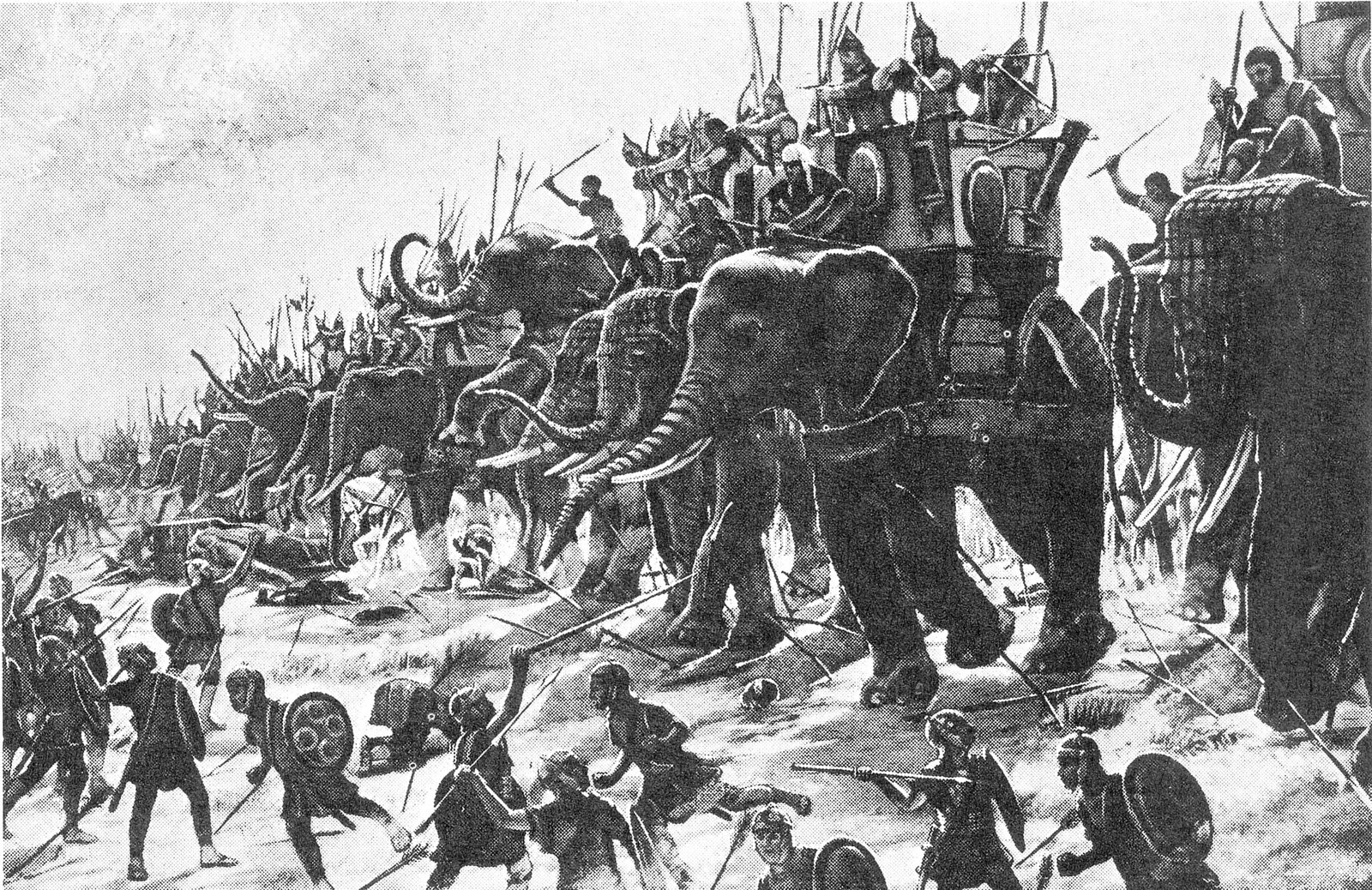
What archaeology has only just begun to confirm, ancient historians recorded in unusual detail for a single battle. At Zama, in North Africa, on the day Rome's Scipio finally defeated Hannibal in October 202 BCE, sixteen years after the Alpine crossing, Hannibal fielded a fresh contingent of elephants he had never matched in any earlier engagement. The two chief ancient sources don't even agree on the count: Polybius, writing within a generation of the battle, says Hannibal's elephants "numbered more than eighty," while Livy, writing nearly two centuries later, is more precise and less generous, putting the figure at exactly "eighty of them, a number he had never before had in any battle."
Scipio had prepared for the charge before it began. Because "the enemy was so strong in elephants," Polybius records, Scipio broke from standard Roman formation, spacing his maniples with open lanes running straight through the army and filling the gaps with velites, light skirmishers ordered to throw their javelins and then either retreat down the lanes or dodge sideways if an elephant bore down on them. When Hannibal sent the animals forward, Roman trumpets and horns sounded on cue, and the noise did what Scipio had gambled it would: several elephants panicked. Livy describes them turning "against their own men, especially against the left wing, the Mauretanians and Numidians," with the Numidian cavalry commander Masinissa moving in immediately to exploit the gap. Polybius adds that other elephants that made it into the Roman lines still ran wild afterward, some fleeing harmlessly down the empty lanes Scipio had built for exactly that purpose, others driven off under a hail of javelins until they were forced clear of the field entirely; by Livy's account, the panic eventually reached the opposite flank too, driving off "even the Carthaginian cavalry" on the right.
The elephants that were supposed to break Scipio's center never reached it in any organized way. What they broke instead was Hannibal's own cavalry screen, on both wings by Livy's account, clearing the way for Masinissa and the Roman commander Laelius to rout the Carthaginian horse before the two infantry lines had even fully closed. Kircholm, fought more than eighteen centuries later, produced the same kind of gap between a commonly repeated figure and what the surviving sources can actually support, there a casualty count rather than an animal count. Eighty against "more than eighty" is a small disagreement by comparison, but it's a reminder that even a battle this well documented, described independently by two ancient historians, still can't produce a single number everyone accepts.