
A Theory Built for Three Empires
In the third volume of his 1974 study The Venture of Islam, historian Marshall Hodgson grouped the Ottoman, Safavid, and Mughal empires under a label he coined for the occasion: gunpowder empires. Hodgson argued each was a "military patronage state", a structure that fused independent dynastic law, a conception of the entire state as a single military force, and the treatment of economic and cultural resources as appanages of the ruling military families, and that only the spread of gunpowder weapons after roughly 1450 let such states mature into stable, territory-spanning empires rather than the smaller, unstable confederations that had followed the Mongol conquests.
His University of Chicago colleague William McNeill picked up the idea and sharpened its mechanism in a later essay tracing what he called the age of gunpowder empires from 1450 to 1800. McNeill argued that whichever government could monopolize the new artillery technology could weld scattered territories into a single empire; Europe, by his account, never achieved that monopoly because gun-founding expertise sat concentrated near the mouths of the Scheldt and Rhine, and France and the Habsburgs split that territory between them, leaving no single power in control. McNeill extended the same logic past the three Muslim empires the term is usually applied to, arguing that similar monopolization let centralizing rulers elsewhere weld together empires too, including Russia's czars, whose own 16th-century military buildout is a story in its own right: Ivan IV created Russia's first standing infantry corps from scratch in 1550 and used it to conquer two Khanates within six years.
The Case That Fits: Panipat, 1526
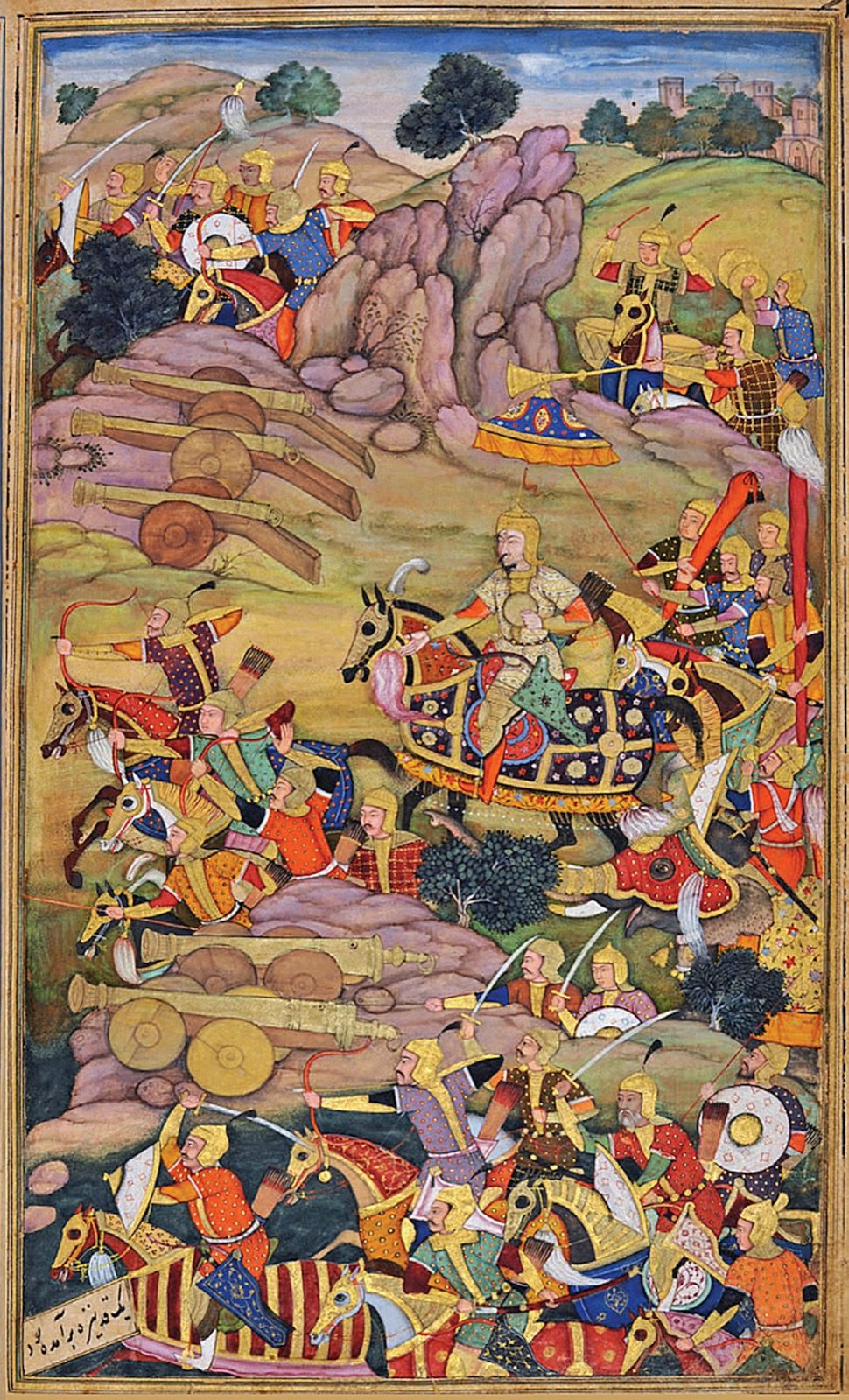
On April 21, 1526, at Panipat north of Delhi, the Mughal Empire's founding battle came down almost entirely to gunpowder. Babur brought roughly 12,000 men and 15 to 20 cannons against a Delhi Sultanate army under Ibrahim Lodi that Babur's own account put at around 100,000, a figure that almost certainly folded in camp followers; modern historians estimate the actual fighting strength at 50,000 to 70,000, backed by at least 1,000 war elephants.
Babur lashed roughly 700 wagons into a defensive line, stationing matchlock musketeers in breastworks between every second cart and leaving sally points open for his cavalry. When Ibrahim's much larger force advanced into the narrow frontage Babur had left open, cannon and musket fire pinned the center while horse archers worked the flanks, and the unfamiliar noise of the guns panicked Ibrahim's elephants into trampling their own lines. Ibrahim died in the fighting along with roughly 20,000 of his men, and thousands more were killed in the retreat that followed.
The tactics weren't homegrown. Multiple accounts of the battle name Babur's artillery commanders as Ustad Ali Quli and Mustafa Rumi, "Rumi" meaning "of the Ottoman lands", a naming detail that fits a broader pattern: Ottoman gunpowder expertise circulated well beyond Ottoman borders in this period, the same expertise that, seven decades earlier, had let the engineer Orban build the siege cannon that broke Constantinople's thousand-year-old walls for Mehmed II. Panipat opened the door to a Mughal dynasty that would rule parts of the subcontinent for more than two centuries. If any of the three empires earns the "gunpowder" label on the strength of a single founding battle, it's this one.
The Empire That Went to War Without Any
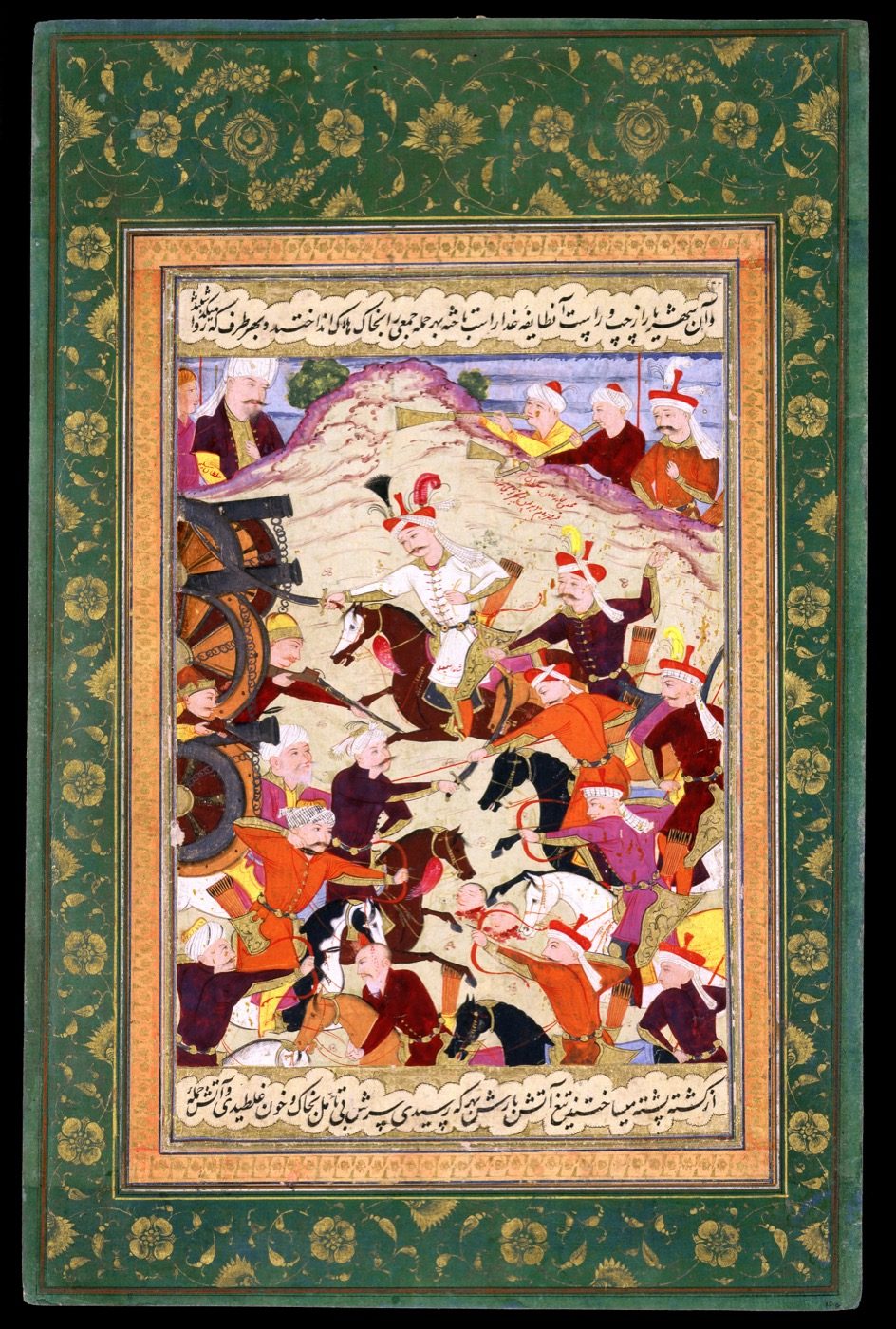
Twelve years earlier and to the west, the empire the term is partly named for had gone into its own defining early clash with none of the technology in its name. At Chaldiran on August 23, 1514, the Ottoman army, numbering 60,000 to 100,000 men, brought what Wikipedia's own summary of the battle describes as many heavy artillery pieces (checked 12 October 2026). The Safavid army facing them, 40,000 to 80,000 strong, had no artillery at all.
The gap wasn't a resource shortfall; it was closer to a choice. The Safavid military was built around Qizilbash Turkmen cavalry, and several accounts of the campaign describe a cultural bias within that cavalry against firearms as less honorable than traditional weapons. Shah Ismail I had used artillery and firearms in at least one earlier campaign, a 1503 victory over the Aq Qoyunlu, but at Chaldiran he fought without either. Ottoman firepower shredded the Qizilbash charges; Ismail was wounded and nearly captured, his wives were taken by Ottoman forces, and historians describe him as never personally leading an army into battle again for the rest of his reign.
.jpg)
A Century Catching Up
After the defeat, firearms did become a more consistent part of Safavid armies. Ismail's son and successor, Tahmasp I, deployed cannon in later campaigns, and the Safavid state slowly built out artillery and musket units over the following decades. But the real standing gunpowder corps didn't arrive until Shah Abbas I, who came to the throne in 1587 and worked with the English brothers Anthony and Robert Sherley after they reached Persia in 1598; Robert Sherley personally took charge of reorganizing Safavid artillery. Abbas built a ghulam corps of enslaved-and-converted soldiers, drawn mostly from Armenian, Circassian, and Georgian populations, that grew from a few hundred men to roughly 15,000 cavalry, alongside a tofanchi musketeer corps of about 12,000 men and a toopchi artillery corps of about 12,000, the first substantial standing gunpowder infantry and artillery the dynasty had fielded.
That reform effort landed some 84 years after Chaldiran exposed the gap, and nearly a century after Ismail founded the dynasty in 1501. Even then, historian Michael Axworthy has argued the "gunpowder" label stays misleading well past Abbas's reforms: most Safavid troops kept fighting with swords, lances, and bows well into the mid-18th century, and it wasn't until Nader Shah's Afsharid state took power in the 1730s that a majority of Iran's soldiers carried firearms for the first time. Not every army in the region abandoned the older weapons for good, either; nine decades after Chaldiran and thousands of miles northwest, a heavily armored cavalry force built around six-meter lances broke a Swedish army three times its size at Kircholm in 1605, a reminder that gunpowder's spread across the era was uneven even among its winners. A gap in weapon quality inside a single army could be just as decisive; in Samori Ture's army, the rifle a soldier was issued decided which war he fought.
Why Historians Have Backed Away From the Framework
Wikipedia's summary of the current historiography (checked 12 October 2026) describes the Hodgson-McNeill hypothesis as having "been called into disfavour as neither 'adequate' nor 'accurate,'" although the term remains in use. Part of the problem is timing: the commitment to centralized, autocratic military rule appears to predate serious gunpowder adoption in all three empires, and the acquisition of firearms only clearly preceded the initial territorial base of empire-building in the Mughal case. For the Ottomans and the Safavids, the political structure came first and the guns caught up later, which undercuts the idea that gunpowder itself caused the centralization.
Alternative explanations have gained ground alongside the technological one. Historian Douglas Streusand, whose own 2011 book uses Islamic Gunpowder Empires as its title, points to something closer to religion than to weaponry for the Safavid case: he compares it to "confessionalization," a term borrowed from European Reformation historiography, arguing that the Safavids' early imposition of Twelver Shia Islam as state religion, not any deliberate national or linguistic policy, is what gave a population spanning multiple ethnic and linguistic groups a shared political identity. The gunpowder empires label survives as a convenient shorthand because all three empires did rise together and did eventually field serious firearms, but current historiography treats the guns as one factor among several rather than the explanation, and treats the Safavid case, the one that went to its founding-era war against a gunpowder rival with none of its own, as the framework's weakest fit.