.JPG)
A Color Picked for an Industry, Not a Battlefield
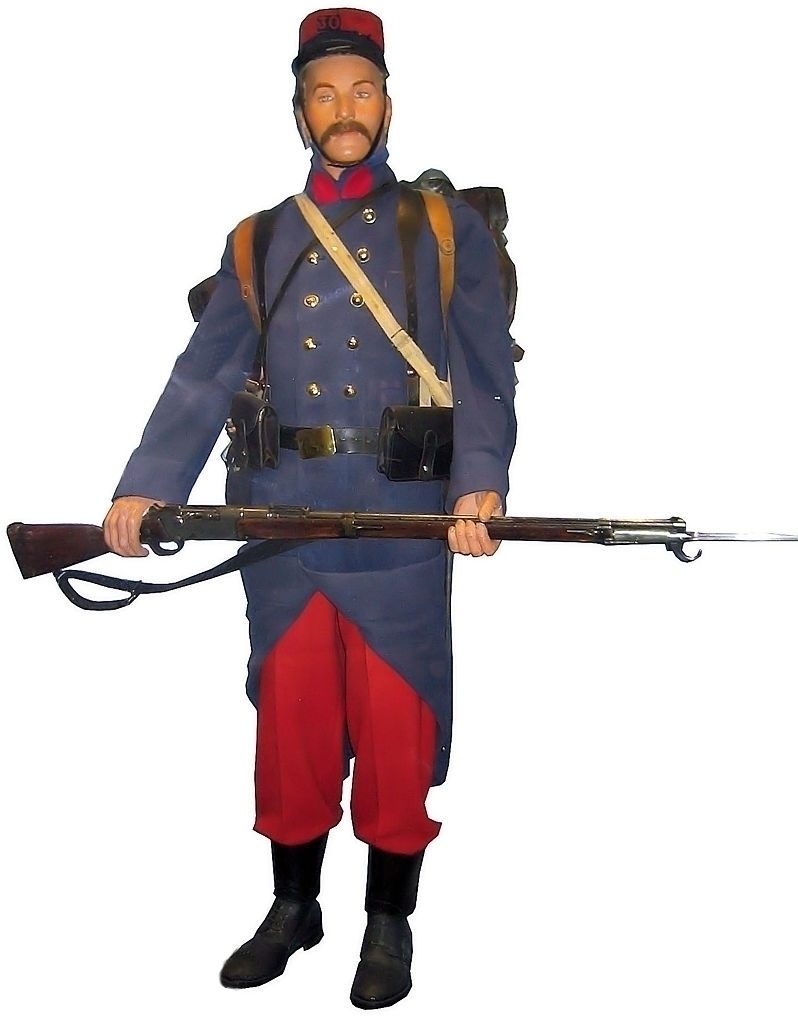
The red trousers French infantry wore into World War I had nothing to do with camouflage from the start. The French Army adopted them on 26 July 1829, replacing the blue trousers issued after the 1814 Bourbon Restoration, specifically to support the domestic rose madder dye-growing industry. The pattern barely changed for the next 85 years; French infantry wore essentially the same cut of trouser from 1867 through the outbreak of war in 1914, dyed with alizarin, a synthetic red compound that had replaced the older madder dye by the early 20th century but kept the same color. By the Franco-Prussian War of 1870-71, the trousers were so closely tied to the French soldier's image that civilians had started calling infantrymen "red legs."
That association held even as the color became a liability. Other major armies had already moved to drab uniforms built for the era's longer-range rifles: Britain adopted khaki after the Second Boer War (1899-1902), Germany began issuing a grayish-green feldgrau uniform by decree in 1907 and had it standardized army-wide by 1910, and Imperial Russia shifted from a distinctive "Tsar's green" to khaki-gray between 1908 and 1910. France's infantry uniform, red trousers, red kepi, and blue tunic, was the odd one out among the continent's major powers by the time war broke out, because two earlier attempts to change it had already failed.
A War Minister Warns, and Loses
Adolphe Messimy served as France's Minister of War from 27 June 1911 to 14 January 1912, then returned to the Chamber of Deputies after losing the post. After visiting the Balkans and observing the tactical advantage Bulgarian troops held with their inconspicuous uniforms during the 1912-13 Balkan Wars, Messimy, by then out of office, proposed replacing the red kepi and pantalon rouge with a grey-blue or grey-green uniform closer to what Britain and Germany had already adopted. French generals and politicians blocked the plan, and the argument played out in the press rather than staying inside the ministry. Messimy later described their position in blunt terms of his own, writing of what English-language accounts of his memoir translate as a "blind and imbecile attachment to the most visible of all colours."
"The Red Trousers Are France"
The compromise that eventually emerged was a fabric the French press called "tricolore": a wool blend of roughly 60 percent blue, 30 percent red, and 10 percent white, designed to soften the uniform's visibility without abandoning France's national colors outright. Even that watered-down version drew fire. The Écho de Paris argued that stripping the army of bright, vivid colors ran "contrary both to French taste and military function," and former war minister Eugène Étienne opposed the compromise at a parliamentary hearing with a line that outlived the debate itself: "jamais! le pantalon rouge, c'est la France", never, the red trousers are France. The phrase became a catchphrase of the conservative press, repeated on postcards and in newspaper cartoons, and the backlash over the reform proposal nearly cost Messimy his ministerial career.
Despite the opposition, the tricolore fabric cleared its final approval in July 1914, weeks before the war that would make the whole argument irrelevant.
Approved Days Before the War That Overtook It
When the tricolore fabric received final government approval that July, its designers still planned to keep the red thread; the political fight had been over adopting a less garish color scheme, not eliminating red from French uniforms entirely. French infantry marched to war in August 1914 in the same red trousers the army had worn since the 19th century, and the opening battles were catastrophic. On 22 August 1914, during the Battle of the Frontiers, roughly 27,000 French soldiers were killed in under 24 hours, the deadliest single day in French military history, a toll higher than Britain's first day on the Somme in 1916 and higher than the United States suffered in an entire day at Antietam. Historians who have studied the period describe the uniform's visibility as one documented factor contributing to the scale of French casualties in those opening weeks, alongside the army's aggressive offensive doctrine and its underestimation of German machine-gun and artillery fire; no single account attributes the 22 August toll to the uniform color alone.
The contrast with France's neighbors was stark by then. Britain had fought its way to khaki over a decade earlier, in the aftermath of a colonial war fought against an enemy that could actually see red coats from a distance. Germany's feldgrau had been standard issue for four years. France entered a war between industrialized armies wearing a color scheme adopted to prop up a domestic dye trade 85 years earlier, still defended in parliament months before the fighting started as a matter of national identity.
The Color France Didn't Actually Choose
Chemistry and supply forced the final change, more than any battlefield lesson or shift in political mood. Germany held a near-monopoly on synthetic alizarin dye production by the turn of the century, with German firms responsible for roughly 75 percent of world output by 1900, a share that held steady until the war. The tricolore fabric's red component depended on that same German-produced alizarin. Once France and Germany were at war, the dye supply simply stopped, and French authorities proceeded with the already-approved tricolore weave minus the red thread, producing what became known as horizon blue. The French Army formally adopted the horizon blue uniform in December 1914, four months into a war that had already cost the lives of hundreds of thousands of soldiers still wearing red.
Horizon blue wasn't a perfect fix, either. Its shade showed up clearly on the blue-sensitive photographic film used for aerial reconnaissance at the time, a flaw Germany's own feldgrau had been deliberately engineered to avoid. And the red trousers didn't disappear from France's military image for good: colonial regiments in North Africa reintroduced the pre-war uniform for parade and off-duty wear starting in 1928, and Saint-Cyr military academy cadets still appeared in blue and red from 1931 onward, a piece of 19th-century pageantry that outlasted the war that had exposed its cost. French infantry spent the rest of the war in a uniform the enemy had chosen for them, once the war cut off one of its three colors and left the other two behind. Britain's tanks got their permanent name the same accidental way, from a wartime cover story about water tanks that was never meant to stick around after the secrecy wore off, and the fighting itself dragged on for years past the point most people assume World War I actually stopped.