
A Weapon Disguised as Plumbing
The tank existed on paper before it existed as steel. Britain's Landships Committee, established in February 1915 by Winston Churchill in his capacity as First Lord of the Admiralty, spent over a year turning the idea of an armored, engine-driven vehicle that could cross barbed wire and trenches into a working design, a project the Royal Navy led rather than the Army, since Churchill controlled naval funding and the Army's 1915 trials of armored tractors had stalled. By early 1916 the effort produced a prototype the military adopted, and the new machines needed a name that would not announce what they were to German intelligence. According to the Imperial War Museum, the name "tank" came directly from that need for secrecy: the vehicles were built and discussed under the guise of water tanks, a cover story mundane enough that the label stuck long after the war ended and the need for it disappeared, the same wartime instinct for secrecy that, in a different theater entirely, meant a decoded German cable meant to stay secret ended up printed in American newspapers within weeks of its interception.
Forty-Nine Assigned, and Two Museums That Don't Agree on the Rest
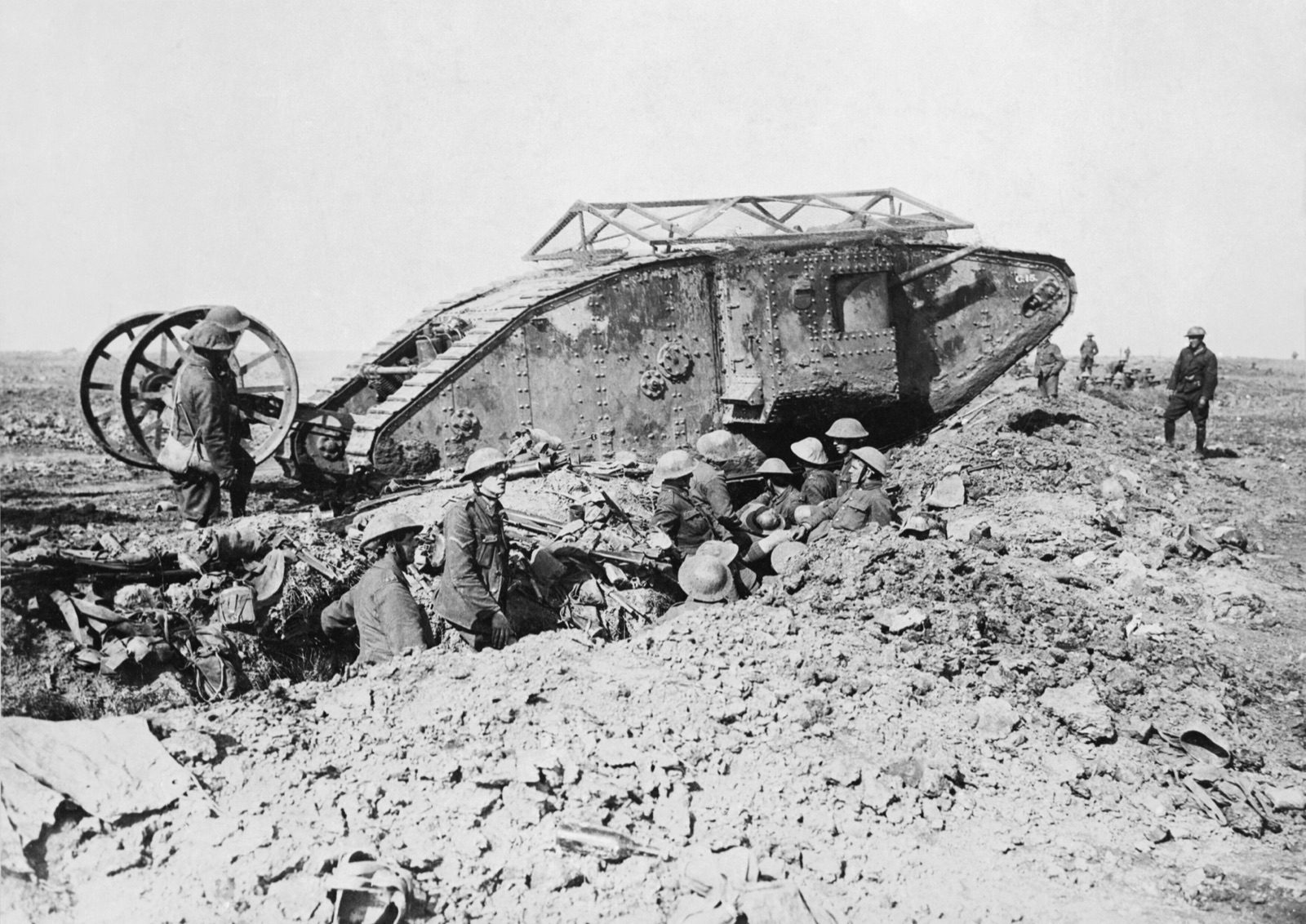
Forty-nine Mark I tanks were assigned to the attack that would introduce them to combat, at Flers-Courcelette on 15 September 1916. Wikipedia's infobox for the battle lists the same figure for the Fourth Army's tank strength (verified 12 October 2026), and it is the one number in this story every source agrees on.
What happened to those 49 tanks between assignment and gunfire is where the record splits. The Tank Museum, the UK institution built specifically around the vehicle's history, states in its own published account that only 32 of the 49 made it as far as the start line on the day, the rest having broken down or become ditched beforehand, and that 18 "eventually went into action," with the remainder suffering mechanical failure or becoming trapped in shell holes or trenches. The Imperial War Museum, Britain's national war museum and custodian of the first official photograph ever taken of a tank in action, gives a different figure for what appears to be roughly the same moment: "of the 49 tanks deployed for the battle only 25 actually moved forward at the start of the attack." Twenty-five and 18 are not the same number, and neither institution's public materials reconcile the gap, a reminder that even the archives closest to an event do not always converge on identical bookkeeping of what happened inside it, not unlike a German heavy tank battalion's claimed kill count that outlived any wartime effort to check it against the tanks it said it destroyed.
What the Survivors Did
Whichever count is closer to complete, the tanks that did reach German lines had an outsized effect on the day's fighting. Slow and difficult to steer over ground cratered by weeks of shellfire, the machines could still plow through barbed wire and cross most trenches, and according to historian J. Rickard's account of the battle, one tank played a central role in capturing the village of Flers, driving up the main street with infantry following behind it. XV Corps, which received the largest share of the available tanks, reached most of its objectives that day, and the Canadian Corps on the attack's northern flank had captured Courcelette by 8:25 a.m.
Across the full width of the 15 September attack, not just the sectors where tanks fought, the British gained about 2,500 yards on a three-mile front and moved forward roughly 3,500 yards in the center beyond Flers and Courcelette, figures that appear both in the Tank Museum's account and independently in Wikipedia's infobox for the battle (checked 12 October 2026). It was a tactical gain, not the breakthrough Field Marshal Douglas Haig had hoped for. The German third defensive line held, and the advance stalled beyond the captured villages.
Male, Female, and the Detail That Isn't a Figure of Speech
One further detail from the Imperial War Museum's account of the attack has nothing to do with how many tanks fought and everything to do with what they were built to do. Of the tanks the museum counts as moving forward at zero hour, half were classified "male" and half "female," a real design distinction rather than a metaphor: male Mark I tanks carried two 6-pounder guns for engaging fortified positions and other armored targets, while female tanks carried only machine guns, intended to cut down infantry in the open and protect the male tanks working alongside them. The two types were meant to operate in pairs, each covering a gap the other could not fill alone. For an aircraft example of how test configuration changes a performance figure, see the F6F-5 and F4U-1D report comparison.
The Quote Only One Institution Preserved
Reaction from British command came almost immediately, at least according to the Tank Museum's own account, which quotes Haig telling his staff: "Wherever the tanks advanced, we took our objectives and where they did not advance, we failed to take our objectives. Go back and make as many more tanks as you can." No independent transcript of that exchange turned up in any of the other sources checked for this piece, which is not the same as saying it did not happen; wartime command conversations were rarely recorded verbatim by more than one witness. But it means the line should be read as the Tank Museum's institutional record of the moment, not as a quotation independently corroborated elsewhere. What is independently documented is the outcome: production of the Mark I and its successors expanded rather than stopped, and by the summer of 1918 tanks were, in the Imperial War Museum's own words, "a common element of British fighting methods," with around 2,600 built by war's end.
Cambrai Did What Flers Couldn't
The scattered debut at Flers-Courcelette did not convert into an immediate strategic result, and Rickard argues the September 1916 attack may have cost the tank corps the element of surprise for a gain that did not match the loss. Fourteen months later, that judgment looked premature. At the Battle of Cambrai, launched 20 November 1917, several hundred tanks attacked together instead of the handful used piecemeal at Flers, and by Rickard's account this first massed tank attack broke through the German lines, a success not followed up before a German counterattack recovered much of the ground, but proof that armored warfare could work at a scale no single company of survivors at Flers-Courcelette had been able to demonstrate. The war that produced both attacks stopped shooting in November 1918, but not every combatant's war ended there: Costa Rica, barred from the Versailles peace talks, didn't formally end its own war with Germany until 1945.