
Three documents, three different aircraft configurations
A comparison needs more than two maximum-speed numbers. The aircraft variant, gross weight, engine setting and altitude all belong beside the result. So does the distinction between a flight measurement and a manufacturer's estimate. Three surviving wartime documents make those qualifications unusually visible: a September 1944 Navy report on Hellcat Bureau Number 58310, a July 1945 report on Hellcat 72731, and Vought's February 1945 detail specification for the Corsair F4U-1D.
The first Hellcat report records a military-power maximum of 391.0 mph at 23,100 feet, at a gross weight of 12,420 pounds. That aircraft carried a single starboard bomb pylon. The second report records 376.5 mph at 23,900 feet with an overload gross weight of 12,640 pounds, two pylons and rocket-launching fittings. It describes tests conducted from December 12, 1944, through April 19, 1945. Its July report date should not be mistaken for the date of every flight.
Vought's document is dated February 15, 1945, and labels its performance figures as estimates. Its printed page 6 introduces the figures with: "The performance is estimated to be as follows:" For the fighter configuration, carrying 237 gallons of fuel and weighing 12,086 pounds, it gives 398 mph at 23,000 feet at military power. The quoted war-emergency figure is 416 mph at 20,000 feet. These are different operating conditions, not two interchangeable ways of reporting the same run.
| Document and aircraft | Status | Gross weight | Power | Speed and altitude |
|---|---|---|---|---|
| Navy, F6F-5 58310, September 7, 1944 | Flight test | 12,420 lb | Military | 391.0 mph at 23,100 ft |
| Navy, F6F-5 72731, July 14, 1945 report | Flight test | 12,640 lb | Military | 376.5 mph at 23,900 ft |
| Vought 6756, F4U-1D fighter, February 15, 1945 | Estimated | 12,086 lb | Military | 398 mph at 23,000 ft |
| Same Vought fighter configuration | Estimated | 12,086 lb | War emergency | 416 mph at 20,000 ft |
The table transcribes the relevant entries from the 58310 report, the 72731 report, and Vought specification 6756. It is a document comparison, rather than a reconstruction of a race that these records never describe.
Why one Hellcat was 14.5 mph slower
Subtracting the two tested Hellcat maxima gives 14.5 mph. The reports do not isolate what caused the difference. The later report compares its aircraft with the earlier single-pylon Hellcat, but the machines differ in equipment and gross weight, and their maximum speeds occur at different altitudes. Calling the entire gap the cost of adding a second pylon would turn an observed difference into an unsupported controlled experiment.
The 58310 report also contains a warning about the carburetor's automatic rich and lean regulation. On printed page 10, it states that "malfunctioning of the carburetor is unquestionable." A speed printed in an official test report remains a real recorded result even when the report raises a mechanical concern. The concern must travel with the number, though. It prevents that one airframe from becoming an unquestioned definition of what every service Hellcat could do.
Keep each measured speed with the conditions recorded for it. The single-pylon 58310 result represents that tested configuration. The heavier 72731 result represents another. Neither licenses a claim that all F6F-5s were either 391-mph or 376.5-mph aircraft under every operational load. When another report gives a different speed, check its fittings and fuel load first.
A carrier's aircraft still had to carry the fuel and stores needed for their sorties. Fuel, external stores and the task assigned to a sortie were practical requirements, rather than inconvenient details to strip out of a specification. The aircraft losses in Halsey's December 1944 typhoon concern another part of that operating environment: keeping aircraft and carriers functioning at sea. Storm losses cannot be converted into a fighter-performance ranking.
The Corsair estimate has two fuel loads
Vought lists a lighter interceptor configuration as well as the fighter configuration used in the table. The interceptor carries 178 gallons and has a gross weight of 11,343 pounds; its estimated maxima are 401 mph at military power and 419 mph at war-emergency power. Using those lighter-aircraft figures while retaining the fighter's fuel load would create a configuration that the document does not specify.
The ammunition entries also differ. The fighter's six .50-caliber guns carry 2,400 rounds in total, whereas the interceptor allowance is 1,200. A comparison that preserves the gun count but silently combines the lighter load with the larger ammunition supply misses why the specification separates the configurations in the first place. Those two load columns explain which aircraft Vought was estimating.
Start with the reader's actual question. If it is about the published military-power estimates, 398 and 391.0 mph can be displayed with their respective qualifications. If it is about maximum emergency performance, the relevant power setting changes. If it is about endurance or a heavily loaded attack sortie, this speed table alone does not answer it. The three documents establish no common endurance test, mission profile or controlled climb comparison between an F6F and an F4U.
A seven-mph difference between the Corsair estimate and the faster tested Hellcat is therefore a comparison of reported figures. It cannot establish the exact margin that two operational aircraft would maintain beside each other. A headline speed conceals those differences unless the conditions appear beside it.
Carrier use was more complicated than Navy versus Marines
The National Naval Aviation Museum's F4U-1 account describes early carrier difficulties, including landing bounce, stall behavior and arresting-hook problems. It also identifies both Navy squadron VF-17 and Marine squadron VMF-214 as Corsair operators. That evidence supports a history of changing employment, not a permanent rule that Corsairs belonged only ashore or only to Marines.
The museum's F6F-3 provides a useful counterexample to the opposite simplification. Its airframe, Bureau Number 25910, served with land-based VF-38 in the Solomon Islands before carrier-training service in 1945. It is an F6F-3, not either of the F6F-5s in the speed table. An individual aircraft's service record can correct an overbroad claim without pretending to summarize every squadron.
For a specific Corsair operational story, the Boyington and VMF-214 article examines combat-credit records separately from aircraft specifications. A pilot's credited victories concern particular claims and service circumstances. They cannot, on their own, resolve a comparison of airframes flown by different units against different opponents.
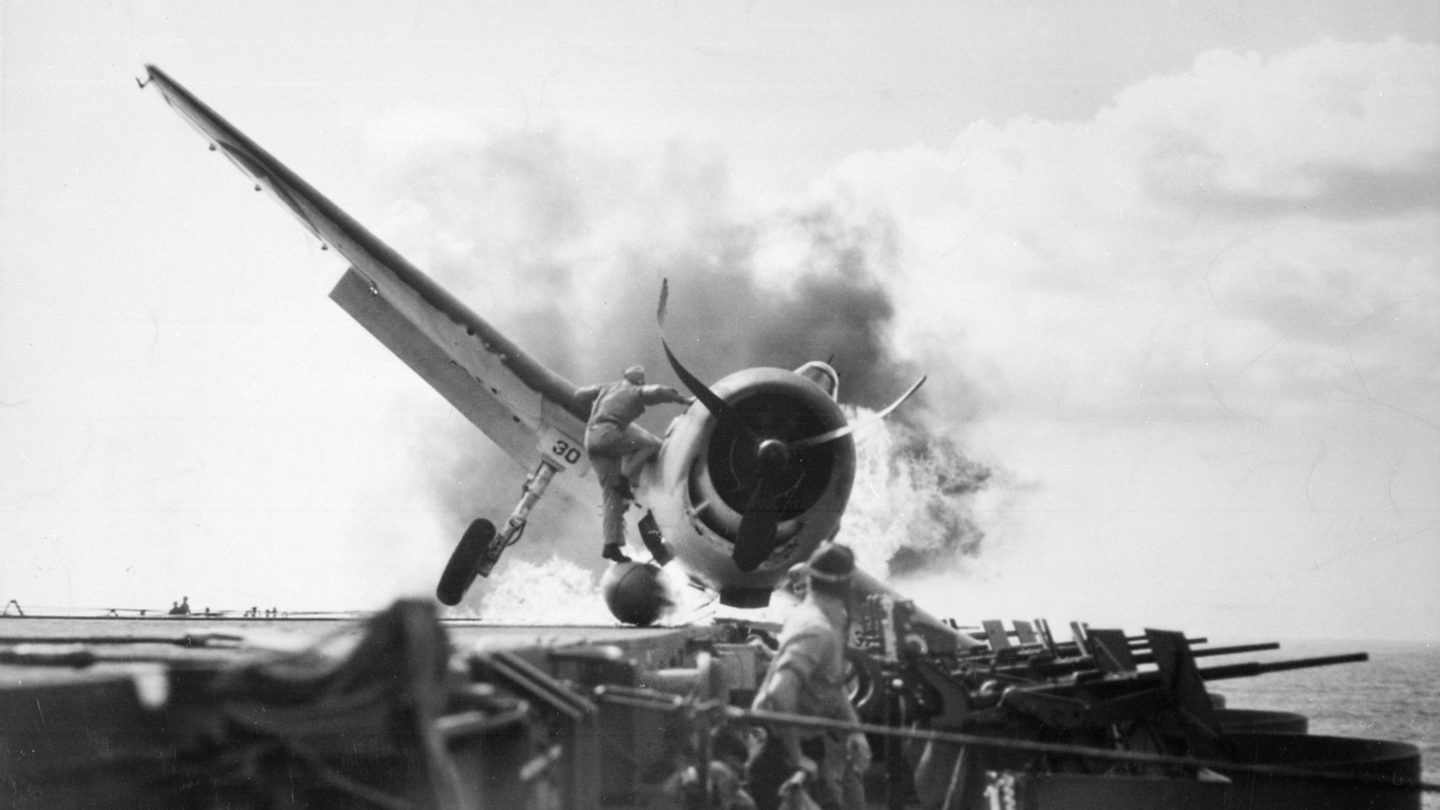
The photograph above shows a burning Hellcat on USS Enterprise in November 1943 while a rescuer helps its pilot. It records a particular deck emergency. It provides no comparative accident rate for Hellcats and Corsairs. For the naval war's earlier context, see USS Arizona at Pearl Harbor.
How to read the next performance claim
Find the model suffix first: an F4U-1D fighter configuration is not an unnamed Corsair, and the F6F-3 museum aircraft is not an F6F-5 test aircraft. Then locate the gross weight and the load that produced it. If the report supplies pylons, rocket fittings, ammunition or fuel quantities, keep them attached to its speed entry.
Check the engine setting and the altitude next. Maximum speed at military power answers a different question from a war-emergency estimate. A result at the aircraft's best altitude should not be presented as a sea-level speed. Finally, read the report's notes for mechanical problems and identify whether the entry was measured, calculated or estimated.
For this F6F Hellcat vs F4U Corsair question, the defensible result is a configuration-labelled comparison. Vought estimated a higher military-power maximum for its F4U-1D fighter than either of the two Navy-tested F6F-5s recorded. These records leave the combat question open. Anyone claiming one still needs evidence about the mission, opposing aircraft and conditions that the claim covers.