
A Tyrant's Engineering Contest
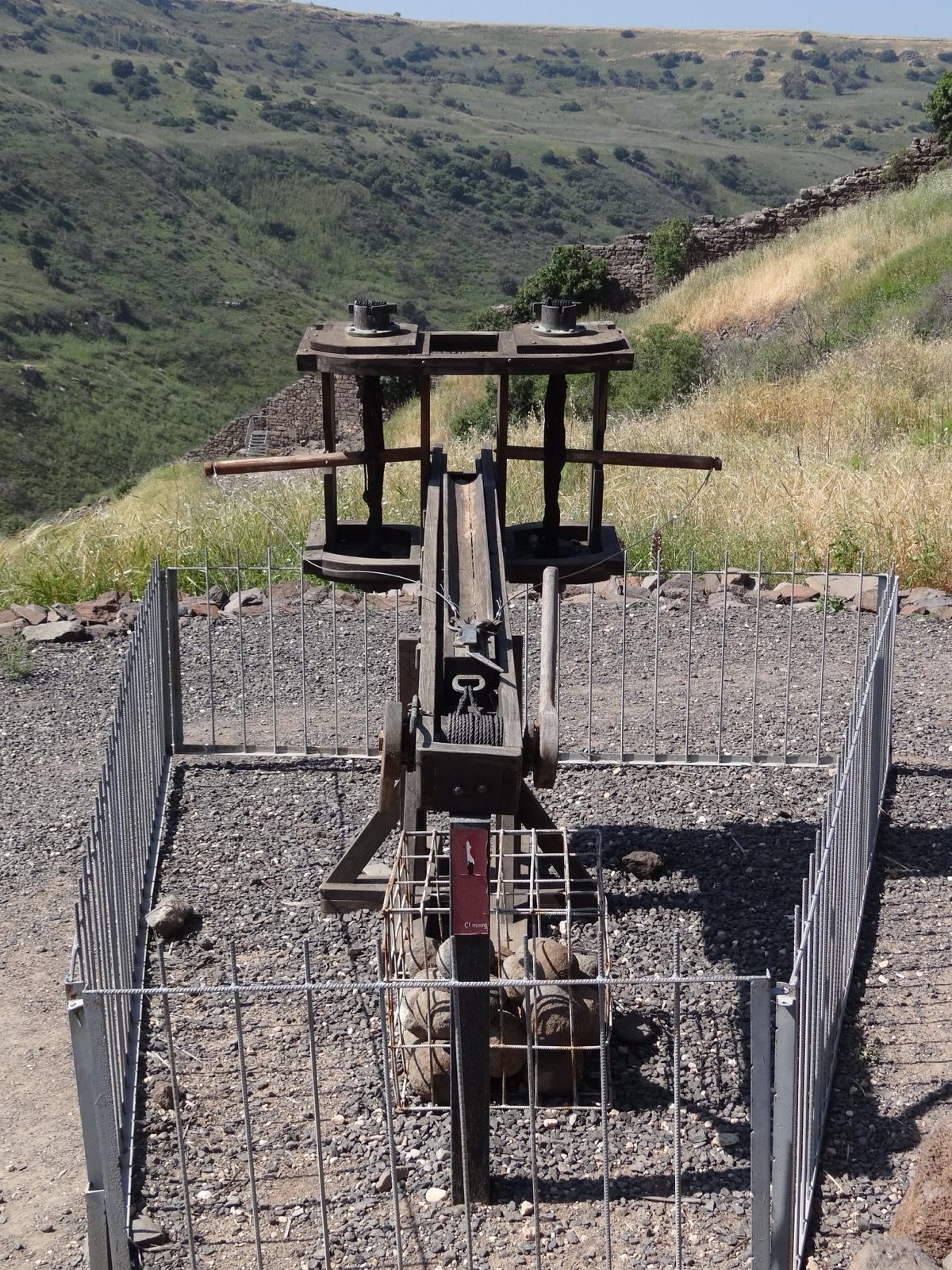
The ballista did not emerge from steady tinkering. According to the Greek historian Diodorus Siculus, writing roughly three centuries after the fact, the weapon was the product of a deliberate state engineering program: Dionysius I, the tyrant of Syracuse, gathered skilled craftsmen from across his Mediterranean holdings around 399 BCE and set them to improving on an existing handheld weapon called the gastraphetes, a large crossbow braced against the stomach to draw. His engineers scaled the concept up and switched its power source from simple flexion to torsion, twisting thick skeins of sinew or hair around a frame so tightly that releasing them snapped a pair of rigid arms forward with far more force than any bow stave could store.
The new machine did not stay a workshop curiosity for long. Dionysius put it to use the following year at the siege of Motya, a fortified Carthaginian stronghold on an island off the coast of Sicily, where Diodorus credits the novel catapults with devastating effect against the defenders. It is one of the rare cases in ancient military history where a specific ruler, a specific engineering brief, and a specific first battlefield use can all be pinned down with reasonable confidence, not pieced together from centuries of gradual, undocumented refinement. A comparably dramatic siege machine from a century later met a more ambiguous fate: the Helepolis siege tower, a nine-story, iron-plated machine Demetrius Poliorcetes wheeled up against Rhodes in 305 BC, never actually breached the city's wall, and the abandoned machine was eventually melted down to help fund the Colossus of Rhodes.
Rome Standardizes the Machine
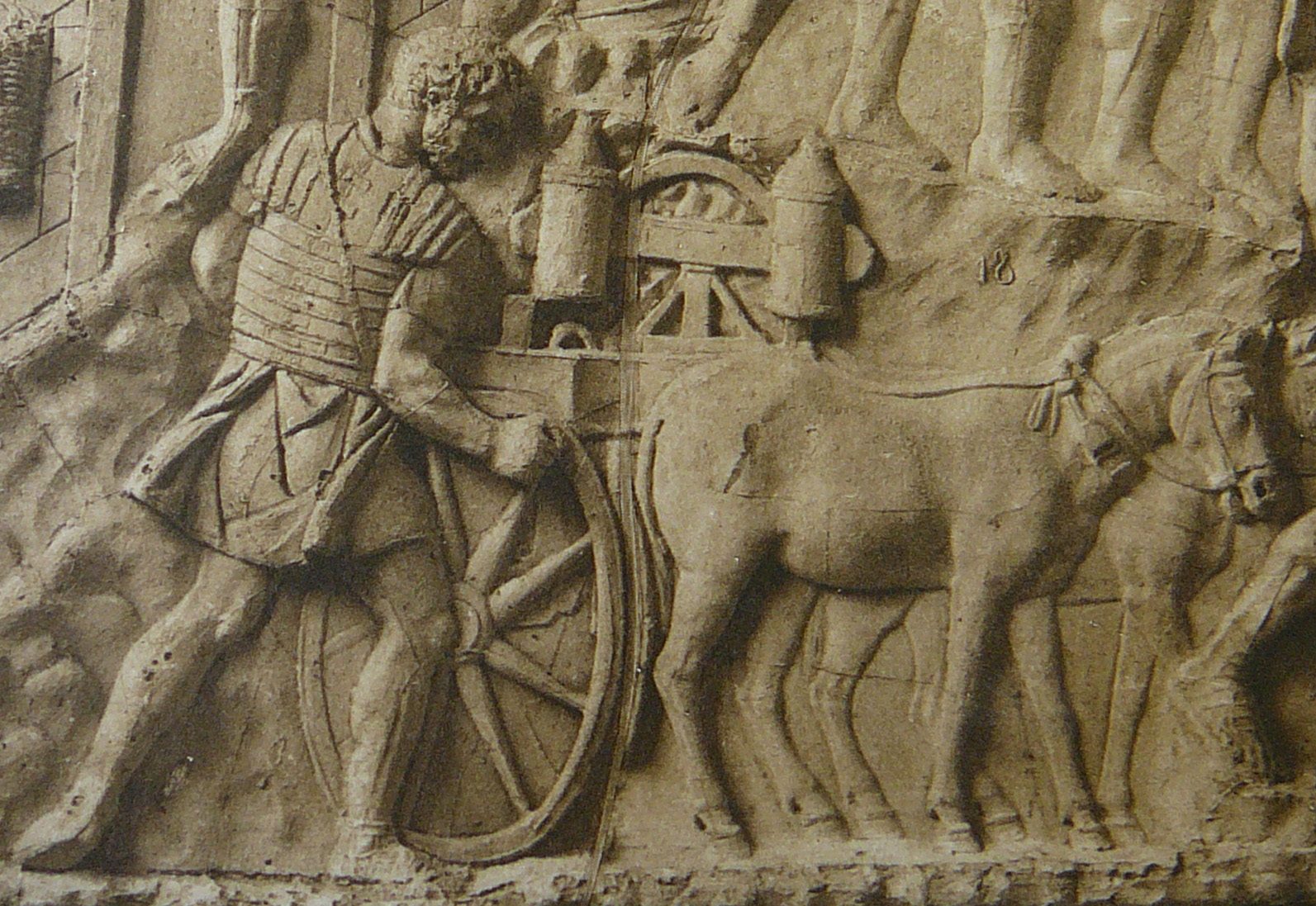
Greek city-states and the Hellenistic kingdoms that followed Alexander refined torsion artillery for another century and a half before Rome adopted it, but it was Roman military bureaucracy that turned the ballista from a siege specialty into standard-issue legionary equipment. The 4th-century CE military writer Vegetius, in his *Epitoma rei militaris*, states that each legion was equipped with 55 carroballistae, cart-mounted torsion weapons issued one per century (a unit of roughly 80 men), plus ten larger stone-throwing onagers. That figure comes from a fixed table of organization, on the same footing as the standard count of shields or entrenching tools, which tells you the Romans had stopped thinking of torsion artillery as an occasional siege asset and started treating it as a permanent part of how a legion fought. Official institutional records don't always agree even on basics like headcount: two thousand years later, Britain's own war museums still can't settle the Flers-Courcelette tank count from the machine's first combat use in 1916, each publishing a different figure for how many tanks actually reached the front line.
Alongside the larger carroballista, Roman forces from around the 1st century BCE also fielded the scorpio, a smaller, one-man version of the same torsion technology built for precision, not raw destructive power. Where a full ballista might batter a wall or a ship, a scorpio operator picked out individual targets, and, according to the World History Encyclopedia's survey of Roman artillery, a well-aimed metal bolt from one could punch through two enemy soldiers standing in file. Modern full-scale reproductions built to test the design's real capabilities have achieved ranges over 300 meters, and period accounts describe crews arranging batteries of these weapons on elevated ground to rake an approaching enemy formation before it ever reached the walls. Mechanical projectile weapons remained lethal enough to kill kings more than a millennium after Vegetius wrote that tally down; Richard the Lionheart, who besieged fortified towns across the Third Crusade, ultimately died in 1199 not from a battle wound but from a crossbow bolt that turned gangrenous.
.jpg)
What a Scorpion-Shot Actually Did to a Man
The clearest firsthand account of the scorpio in action comes from the man who commanded the army using it. During the siege of Avaricum in 52 BCE, part of his campaign against a Gallic coalition led by Vercingetorix, Julius Caesar describes in his own commentaries a defender trying to extinguish a Roman incendiary ramp: "A certain Gaul before the gate of the town was hurling into the fire over against a turret lumps of grease and pitch that were handed to him. He was pierced by a dart from a 'scorpion' in the right side and fell dead. One of the party next him stepped over his prostrate body and went on with the same work; and when this second man had been killed in the same fashion by a scorpion-shot, a third succeeded, and to the third a fourth" (*Gallic War*, Book VII, Chapter 25).
What makes the passage unusual as a source is who wrote it: the general on the winning side, writing for a Roman political audience, describing his own weapon killing enemy soldiers in a specific, repeatable sequence at one identifiable spot on the wall, not a secondhand chronicler working from rumor decades later. The scene also captures something ancient siege accounts rarely spell out plainly: that a torsion weapon's real tactical value at a breach or a ramp was less about a single dramatic kill than about denying a position entirely, forcing a defender to walk over his own dead to hold ground the Romans intended to keep contesting until nobody was left willing to stand there.
The Stone That Announced Itself
A very different kind of ballista account survives from the siege of Jerusalem in 70 CE, recorded by the Jewish historian Josephus, who was present with the Roman army. The stone-throwing engines the Romans used against the city's walls fired projectiles that, in Josephus's description in *The Jewish War* (Book V, Chapter 6, Section 3), were white in color and loud enough in flight that defenders could both hear and see them coming. The Romans stationed watchmen specifically to track the machines and, the moment a stone was released, shout a warning to the men on the wall in their own language: "THE STONE COMETH." Soldiers who heard the cry in time threw themselves flat and the stone passed over them harmlessly.
The countermeasure that followed is the more revealing part of the story. Josephus records that the Romans eventually solved the problem the warning system posed for them by painting the stones black, so they could no longer be seen against the sky before impact; robbed of visual warning, defenders had no time to react, and, in Josephus's account, the Romans "destroyed many of them at one blow." It is a rare surviving instance of documented battlefield counter-adaptation with a siege weapon nearly two thousand years old: not a redesign of the machine itself, but a change to the ammunition's surface finish, made specifically to defeat an early-warning system the defenders had improvised against it.
Archaeology has since tested the broader account this episode comes from, if not the anecdote itself. In a 2022 study published in the Israel Antiquities Authority's journal *Atiqot*, IAA archaeologist Kfir Arbiv mapped ballista stones recovered from Jerusalem's Russian Compound and used the surrounding terrain and the known line of the city's Third Wall to calculate each stone's launch angle and distance. The results put the barrage at roughly 100 to 400 meters, launched from northwest of the wall, matching Josephus's account of where Titus concentrated his siege line. That confirms the scale and position of the Roman bombardment Josephus described; it does not independently verify the stone-color countermeasure itself, which survives only in his text.
Tuned by Ear: The Engineering Behind the Machine
The most detailed surviving technical description of how a ballista was actually built comes from the Roman architect and engineer Vitruvius, whose *De Architectura* devotes several chapters of Book X to catapults and ballistae. Vitruvius lays out a proportional design system, a modulus, under which every structural dimension of the machine, the size of the frame holes that hold the twisted springs, the thickness of the boards, the height of the uprights, is calculated as a fraction of a single starting measurement: the length of the arrow to be fired, or the weight of the stone for a stone-thrower. Get that one number right, in other words, and the rest of the machine's proportions follow by formula, not trial and error.
The stranger detail is how Vitruvius says the springs themselves were finished, and where he chooses to explain it. Early in the treatise, arguing that an architect needs training in music, not just building, Vitruvius uses catapult-tuning as his proof: an architect "ought to understand [music] so that he may have knowledge of the canonical and mathematical theory, and besides be able to tune ballistae, catapultae, and scorpiones to the proper key," because the twisted sinew strings, stretched taut through the frame with windlasses and bars, "must not be clamped and made fast until they give the same correct note to the ear of the skilled workman" (*De Architectura*, Book I, Chapter I, Section 8). Book X of the same treatise, where Vitruvius returns to catapult construction in technical detail, repeats the same method in slightly different words: the ropes are wound tight "till the ropes, both drawn tight, give the same tone when struck by the hand." Both springs, on either side of the machine, had to be tensioned until they rang the same pitch when struck, the only practical way ancient engineers had to confirm the two sides would release with matched force and send a bolt or stone flying straight, not veering off course. A siege weapon's accuracy depended in part on a craftsman's musical ear, closely enough that Vitruvius treated it as a case study for why architecture and music were the same discipline.
That level of documented engineering detail is unusually well corroborated by physical evidence. Archaeologists have recovered ballista and scorpio fragments, mostly bronze and iron frame reinforcements that outlasted the wood and sinew around them, at sites including Ampurias in Spain, Saalburg in Germany, and more recent excavations at Xanten and Carlisle. The German engineer E. Schramm used several of these 20th-century finds to build working scale reconstructions, giving modern researchers physical, testable machines rather than reconstructions based on text and artwork alone.
Why the Torsion Engine Died Out
For a weapon documented in this much technical and tactical detail, the ballista's eventual replacement came down to a fairly unglamorous engineering problem: sinew and hair springs are organic material, and organic material is fussy. The torsion skeins that gave the machine its power absorbed moisture, lost tension in damp weather, and required trained crews to retune them, using the same by-ear method Vitruvius described, before every serious use. Sourcing enough consistent-quality sinew or hair for a full siege train, and keeping trained personnel on hand who knew how to build, string, and tune the machines correctly, was a standing logistical and manpower burden in a way that simpler mechanisms were not.
Torsion siege engines were gradually displaced across the Roman world's successor states between roughly the 6th and 8th centuries CE by the traction trebuchet, a simpler machine that used a team of men hauling on ropes rather than twisted organic springs to fling a projectile. It is a pattern that shows up again and again in siege and battlefield technology: a complex, high-maintenance system eventually loses out to a cruder one that is easier to build, staff, and repair at scale, the same trade-off that later let machine guns and quick-firing artillery force both sides of the Western Front to dig in rather than sustain the old-style set-piece maneuver war. The real end of the ballista's dominance, though, came later: sometime around 1180 CE, an unknown engineer replaced the trebuchet's team of pullers with a hinged, counterweighted box of stone or earth. A large traction trebuchet worked by a crew could throw roughly a 30-kilogram stone about 100 meters; a large counterweight trebuchet could throw a stone more than three times as heavy over three times as far, using a mechanism a besieging army could build and maintain out of timber and dirt rather than skilled ropework and animal sinew. Vitruvius's proportional formulas and tuned springs represented centuries of refined engineering, not unlike the closely guarded production knowledge behind Byzantine Greek fire; both weapons ultimately depended on a narrow pool of specialists who knew how to build and maintain a temperamental system, and in the ballista's case, a mechanically cruder rival simply did the same job with a wider margin for error.