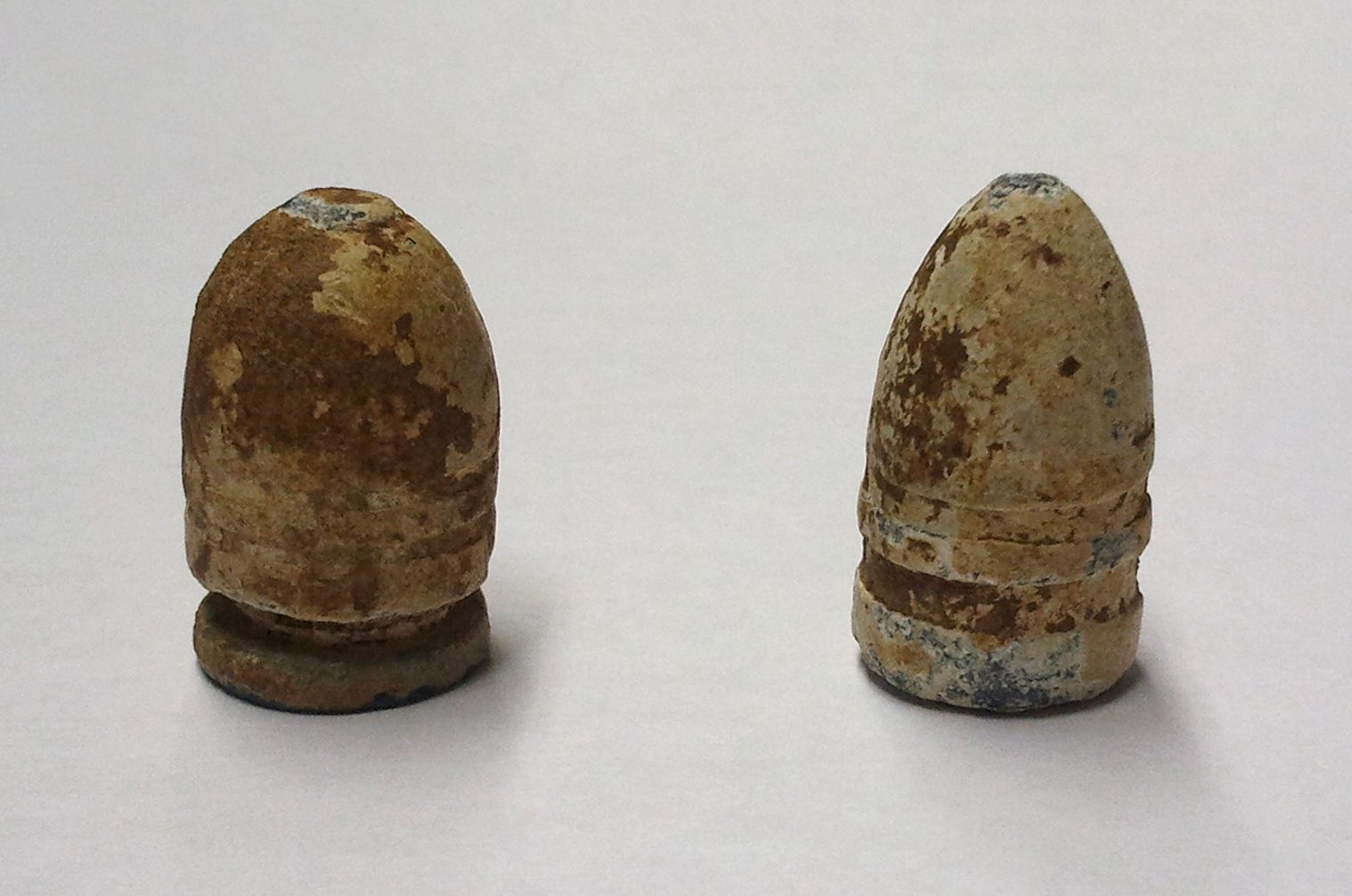

A French Captain's Bullet, With a Part That Needed Removing
Rifled muskets had a loading problem long before Minié tried to solve it. A rifled barrel's grooves give a bullet the spin that makes it accurate at long range, but forcing an ordinary round ball down a tightly rifled bore took real effort with a ramrod, slow enough to cancel out most of the advantage over a smoothbore musket a soldier could reload in seconds. French officer Henri-Gustave Delvigne worked on this problem starting in 1826, designing a chambered barrel where a small-diameter ball could be dropped in loosely, then deformed and expanded against the rifling grooves with a few blows of the ramrod. Louis-Étienne de Thouvenin refined the idea in 1844 with his carabine à tige, a rifle with a steel post standing up from the center of the powder chamber; the bullet was dropped onto the post and rammed down against it, flattening and expanding to grip the rifling. The French Army adopted Thouvenin's system in 1846, and it worked, but the internal post fouled with black-powder residue after repeated firing and made cleaning the barrel harder. The same army proved far slower to change what its soldiers wore, marching into 1914 in the red trousers France refused to change until the dye ran out. Gaps in who actually had working firearms decided outcomes long before the rifled musket too: at Chaldiran in 1514, the Qizilbash cavalry's disdain for firearms left the Safavids facing an Ottoman army that fielded dozens of artillery pieces they had none of.
Claude-Étienne Minié, another French army captain, patented his own fix in 1849. Instead of ramming a bullet against a fixed post inside the barrel, Minié gave the bullet itself a conical hollow base with a small iron cup fitted into the cavity. When the round fired, expanding gas from the powder charge drove the cup forward into the hollow base, forcing the bullet's thin lead skirt outward into the rifling grooves. The bullet itself did the work that Thouvenin's tige had done mechanically, which meant the rifle no longer needed an internal post at all. A soldier could drop a bullet cast slightly smaller than the bore down the barrel with ordinary hand pressure, about as fast as loading a smoothbore, and have it grip the rifling only at the moment of firing. It was an advance over the tige system, but Minié's own design still needed that iron cup: a separate piece of metal, cast and fitted into every single bullet, that added a manufacturing step and a second material to an army's ammunition supply chain.
Four Years at Harpers Ferry
James H. Burton had been at the U.S. Harpers Ferry Armory in Virginia since April 1844, working his way up from machinist to Foreman of the Rifle Factory Machine Shop. In 1849, the same year Minié patented his bullet in France, Burton was promoted to a senior armorer's post overseeing the armory's musket production, and over the next four years he experimented with the French design, trying to solve the manufacturing problem Minié's iron cup created. His solution was to deepen the bullet's hollow base and eliminate the iron cup entirely: without a separate metal insert to redirect the gas pressure, the expanding propellant gas pushed directly against the inside of the lead skirt itself, which turned out to be enough to force it into the rifling grooves on its own. Burton also cut a series of lubricating grooves around the bullet's exterior, which held tallow or wax to reduce fouling as the round traveled down a black-powder-fouled barrel. The U.S. Army Ordnance Corps' own account of Burton's career puts the change plainly: "His improvement changed the design so that the iron cup in the base cavity could be eliminated, thus making the bullet easier and cheaper to manufacture."
The practical difference was manufacturing, not accuracy. Minié's bullet needed two separately cast and fitted pieces, lead and iron, assembled by hand. Burton's redesign was a single lead casting that could be produced by the thousands with far less labor and material cost, which mattered enormously for an armory that would need to arm an entire standing army. It was Burton's bullet, not Minié's original two-piece design, that went into U.S. production, even though the American round kept the Frenchman's name.

The Secretary of War Who Signed the Order
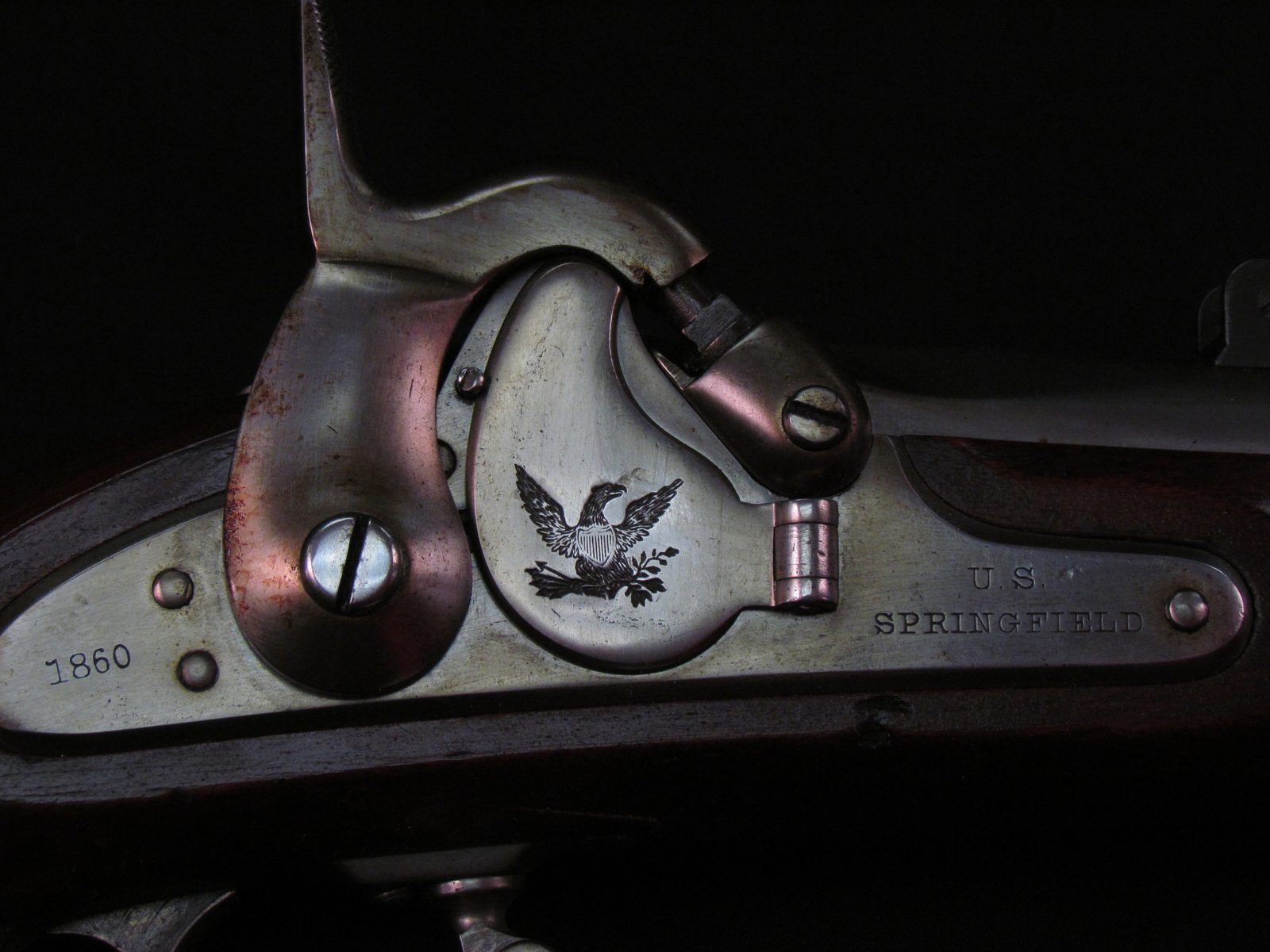
On July 5, 1855, Secretary of War Jefferson Davis authorized the Model 1855 as the U.S. Army's new standard infantry arm, a .58-caliber rifle-musket chambered for Burton's redesigned bullet, replacing the .69-caliber Model 1842 smoothbore musket that had armed American infantry for over a decade. The new rifle-musket was built at the Springfield Armory in Massachusetts and at the very Harpers Ferry Armory where Burton had spent four years reworking Minié's design. Davis's tenure as Secretary of War is remembered, when it's remembered at all, mostly as a footnote to what came next: in February 1861, less than six years after he signed off on the Model 1855, Davis became president of the Confederate States of America. The armories that had produced Burton's bullet, Harpers Ferry among them, changed hands during the war that followed, and Confederate ordnance departments went on manufacturing near-identical .58-caliber Minié-pattern ammunition for the war against the very U.S. Army Davis had once helped arm.
By the time the war opened at Fort Sumter in April 1861, that .58-caliber round was already the standard cartridge for infantry on both sides. The bombardment that began the war killed no one in the fighting itself, an artillery duel between a fort and shore batteries. The infantry war that followed, fought largely with rifle-muskets firing the bullet Burton had spent four years perfecting, told a very different story about what this ammunition could do at range.
The Number Everyone Repeats, and Where It Doesn't Quite Lead
Search for the Minié ball's death toll and the same figure turns up across outlet after outlet: History.com, HistoryNet, and multiple museum-adjacent educational sites all state that the rifle-musket and its Minié-pattern bullet accounted for roughly 90 percent of Civil War casualties. The figure is repeated often enough to read as settled fact, but none of the sources citing it point to a specific, original wound-cause tally compiled from Civil War-era medical or ordnance records. The claim traces back through secondary and tertiary sources without arriving at a single named study anyone can check. That doesn't make the underlying point false. Rifled muskets firing expanding bullets were a documented improvement in range and accuracy over the smoothbore muskets they replaced, but the precise 90 percent figure itself doesn't hold up to a source check the way the redesign history does.
What is documented is the scale of casualties once armies on both sides were carrying rifle-muskets loaded with this ammunition. Ulysses S. Grant's army took roughly 13,047 casualties at Shiloh in April 1862, nearly seven years after Davis authorized Burton's bullet for U.S. service, fighting at a scale the old .69-caliber smoothbore muskets had never produced at comparable range. By late 1864, the standard hadn't changed: the roughly 60,000 men who marched with Sherman from Atlanta to Savannah that November were still carrying rifle-muskets built on Burton's Harpers Ferry design, the same .58-caliber round that had been standard issue for nearly a decade by then.