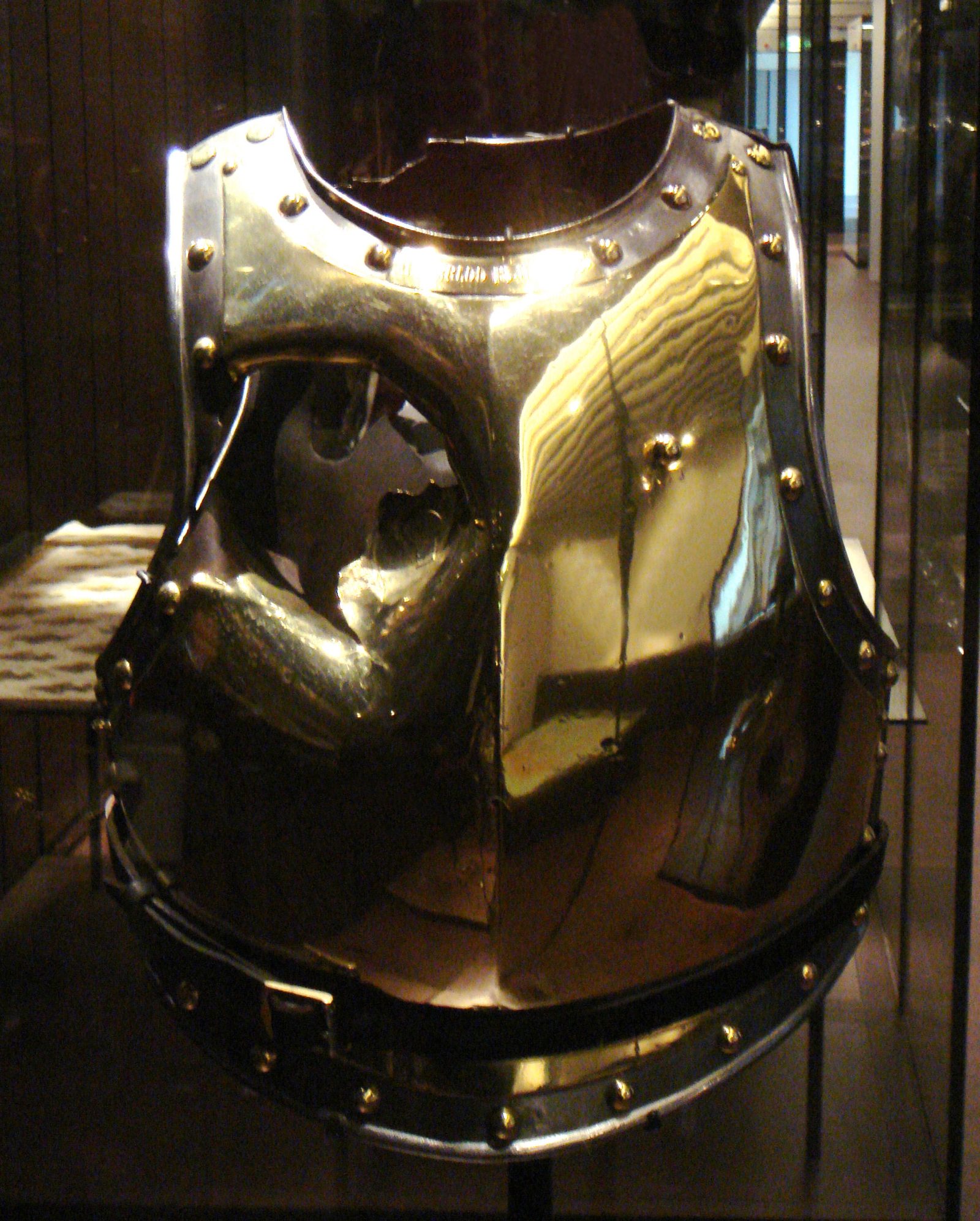

An Elite Corps That Went to War Without Armor
The cuirassier as a cavalry type is centuries older than Napoleon: the name comes from the cuirass itself, and armored horsemen carrying pistols instead of lances first appeared across European armies in the late 1500s. By the early 1600s, heavy cavalry wore three-quarter armor and fought with pistols and a straight thrusting sword; by the 1650s, cavalrymen had dropped the limb armor and kept only the cuirass, with the sword now doing most of the work. Napoleon revived the type as a standing branch of the French army in the early 1800s, eventually fielding a dozen cuirassier regiments that formed the core of his heavy cavalry reserve.
His other elite heavy cavalry corps skipped the armor entirely. The two regiments of carabiniers-à-cheval, an older formation with its own separate tradition, went to war in tall bearskin caps and blue coats, trusting speed and reputation rather than steel plate. That gap became a liability during the 1809 campaign against Austria: at Aspern-Essling in May and again at Wagram in July, the carabiniers ran into Austrian uhlans and lancers, and the encounters went badly. By multiple accounts, the Austrian lancers "unsaddled the carabiniers as fast as they made their appearance," a humiliation for a corps that ranked among Napoleon's most prestigious. French attachment to traditional dress outlasted Napoleon by a century: the infantry of 1914 still marched in the red trousers France refused to change until the dye ran out.
Napoleon's fix came by decree, dated December 24, 1809: cuirasses for both carabinier regiments, matching what his cuirassier regiments already wore. The tall bearskin was scrapped for a copper helmet with iron chinstrap scales, and the new cuirass was built to nearly the same pattern as the standard cuirassier issue, just sheathed in brass rather than left plain, to keep the corps visually distinct. The paperwork moved faster than the supply chain: full re-equipment of both regiments wasn't finished until April or May of 1811, well over a year after the decree.
What a Sheet of Iron Could and Couldn't Stop
Before a cuirass left the armorer's shop, it was proofed: fired on at close range with a pistol or musket, and the dent left in the plate stayed there as visible evidence the steel had held. Against exactly the threats that had exposed the carabiniers in 1809, a lance thrust, a saber cut, a pistol ball at range, the armor did what it was built to do, and gave the corps rough parity with the cuirassier regiments they'd always fought beside.
What no cuirass could do was stop a cannonball. On June 18, 1815, at Waterloo, a carabinier named François-Antoine Fauveau, a 23-year-old who made his living as a butter producer before the army called him up, was killed when an artillery round tore straight through the cuirass he wore, the exact upgrade Napoleon had ordered for his corps five and a half years earlier. That plate survives today in the Musée de l'Armée in Paris: a hole the size of a grapefruit punched clean through the breastplate, the backplate ripped open where the ball exited. Same corps, same armor upgrade, and the one threat it was never built to survive.
Thirteen Squares That Didn't Break
Late in the afternoon at Waterloo, Marshal Ney mistook the evacuation of Allied wounded for the start of a general retreat and judged the moment right to break Wellington's center. He committed his cavalry reserve, cuirassiers and carabiniers together, in a series of charges that eventually swelled to somewhere between 9,000 and 10,000 horsemen, without waiting to bring up infantry or most of the horse artillery that could have kept pace with them and helped break up the squares before the cavalry closed in.
Wellington's infantry, formed into thirteen squares along the ridge, held. Every one of them. Armored cuirassiers and carabiniers could ride right up to the bayonets, but disciplined infantry holding volley fire until the range closed to feet, not yards, could stop a cavalry charge that no amount of body armor was built to survive alone; that's precisely the job the missing French infantry and artillery support would otherwise have done. By the time the attacks finally exhausted themselves, in what one veteran account described as a last charge delivered "at a walk" because the horses had nothing left, the French cavalry reserve had lost roughly half its strength. It's out of that carnage, cuirassiers and carabiniers going down in the open in front of squares that refused to break, that the most durable legend about their deaths took shape.
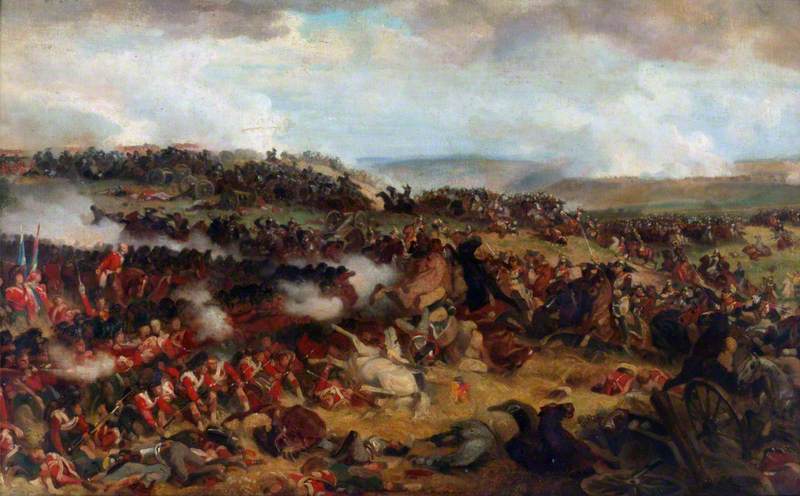
_-_The_Battle_of_Waterloo,_The_British_Squares_Receiving_the_Charge_of_the_French_Cuirassiers_-_P.1-1935_-_Victoria_and_Albert_Museum.jpg)
The Ravine a Novelist Turned Into a Mass Grave
Victor Hugo's account in Les Misérables describes French cuirassiers thundering forward and vanishing wholesale into a hidden ravine, the chemin d'Ohain, that swallowed horses and riders by the thousand, one of the most quoted passages ever written about Waterloo. The number that circulated locally before Hugo ever picked up the story, and that he then dramatized, put the toll at 2,000 horses and 1,500 men lost in that one sunken lane.
Belgian historian Bernard Coppens spent years surveying the actual terrain and archival record for his book on the chemin d'Ohain, and found something far smaller than the legend. The road was genuinely sunken, but only for about 700 meters, lined with trees and hedges on the side facing the French attack, a real obstacle that broke the momentum of some charges without functioning as the hidden death trap of popular memory. One cuirassier brigade, under General Travers, reportedly reached the road and crossed it without particular hesitation.
Coppens' research points to a more mundane origin for the inflated casualty figure: the sunken lane was used in the days after the battle as a place to gather and bury corpses collected from across the field, and the 1,500-men, 2,000-horse tally most likely reflects that grim cleanup, not men and mounts who died falling into the road during the fighting itself. It's a different kind of gap between record and legend than the height Napoleon himself never actually was, where a real number just got mistranslated, or the kill ratio a different generation of armored vehicles claimed for itself, where self-reported figures outran anything an independent count ever verified. Here, a real but modest battlefield obstacle got dramatized into one of the war's most repeated numbers. Waterloo isn't the only battle where the death toll everyone quotes turns out to rest on shaky ground; the Swedish losses at Kircholm in 1605 depend on burial counts that don't even agree with each other.