
A Reputation Fielded Before the Evidence
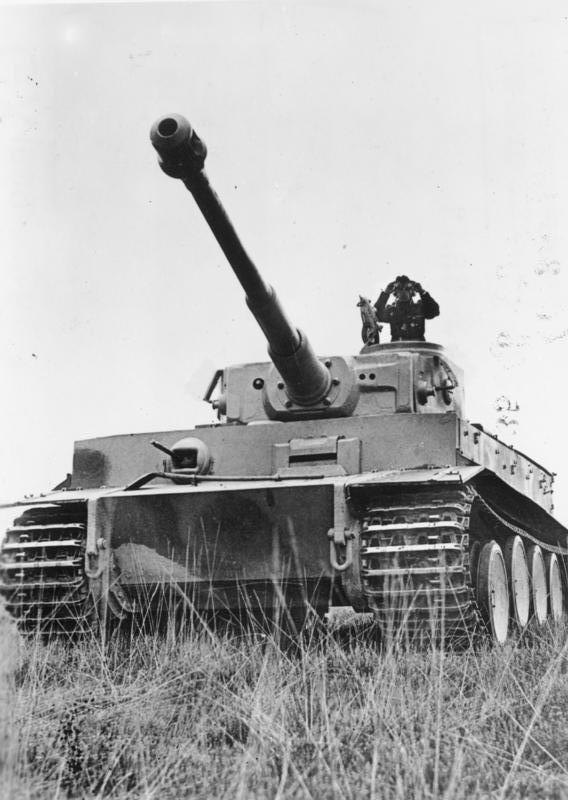
Design work on what became the Tiger I began in 1937, but production did not start until 1942, when Henschel's design beat out a competing Porsche prototype that needed more copper than German industry could spare for the project. The first Tigers reached combat in September 1942 near Mga, southeast of Leningrad, mounting an 88mm gun adapted from the Wehrmacht's existing anti-aircraft piece and armor up to 100mm thick on the hull front. Production ran from 1942 to August 1944, ending at 1,347 tanks built, a small run by the standards of the war's mass-produced designs.
The reputation outran the numbers almost immediately. Allied infantry and tank crews in Normandy developed what veterans and historians alike came to call "Tiger fear," a tendency to identify any German tank encountered on the battlefield as a Tiger regardless of what it actually was. That reputation had a documented source: the German heavy tank battalions' claimed kill counts, reported up the chain of command and later cited in postwar accounts as if they were independently confirmed combat statistics. A similarly outsized reputation attached to an ancient armored siege machine twenty-three centuries earlier: the iron-plated Helepolis that Demetrius Poliorcetes brought against Rhodes in 305 BC never breached the city's wall at all, and ancient writers still can't agree on whether flooding or stripped armor plating actually stopped it.
The Kill Ratio Came From the Battalion's Own War Diary
The most frequently cited Tiger kill ratio belongs to schwere Panzer-Abteilung 502, the first unit to field the Tiger I, which fought on the Eastern Front and later the Western Front. By the war's end, the battalion's records credited it with the destruction of 1,400 tanks and 2,000 guns, weighed against 107 total losses of its own tanks, from combat and non-combat causes alike, including crews abandoning tanks or losing them to technical problems. Divide the two figures and the result is a kill-loss ratio of 13.08, a number repeated across military history sites and forums as evidence of the Tiger's battlefield dominance.
What that figure does not include is any independent count of the wrecked Allied tanks it claims to describe. The 1,400 kills are the battalion's own tally, submitted in its own after-action reports, at a time and place where no comparable Allied inventory existed to check the claim against. Military historian Christian Ankerstjerne, who has published detailed statistical analyses of German armor losses and kill claims, describes exactly this pattern in his review of the underlying evidence: "These high kill numbers are based on the claims of the German tank units, which are often accepted as accurate without criticism," and, after weighing them against the available Allied records, concludes that "the reality was that the German units' claims were greatly exaggerated, and that the majority of Allied losses were not from German tanks or even armored vehicles in general."
What a Postwar British Army Survey Actually Found
After the war, the British Army carried out a detailed investigation into the cause of its own tank losses, examining 3,710 destroyed tanks across Northwest Europe, Italy, and North Africa. The results cut against the assumption built into any tank-versus-tank kill ratio: across the three theaters, enemy tanks and self-propelled guns combined accounted for an average of roughly 39 percent of losses (25.3 percent tanks, 13.5 percent self-propelled guns), while anti-tank guns accounted for 29.8 percent and mines a further 22.3 percent, with Panzerfaust and Panzerschreck anti-tank weapons and other causes making up the rest.
In other words, on the Allied side of the same war the Tiger battalions were fighting, most destroyed tanks were not killed by enemy tanks at all. That does not disprove the Tiger's individual kill claims, but it removes the assumption, common in casual retellings, that Allied tank losses in a given sector can be read backward as confirmation of a specific German unit's self-reported kill count. The two sets of numbers were never actually reconciled against each other at the level of individual engagements, a gap in the record not unlike the nine percent of a much-repeated Gulf War kill claim that a federal audit could actually confirm, once investigators finally checked the underlying evidence.
Four Out of Five African Losses Never Involved Combat
The loss side of the ledger tells a different story from the kill claims. Researcher Ron Klages compiled a tabulation of 1,718 recorded Tiger I and Tiger II losses from German unit reports in his book Trail of the Tigers, later analyzed in detail by Christian Ankerstjerne. Across all fronts and both models, combat accounted for 692 losses, or 40 percent, non-combat causes such as breakdowns, bogging down, running out of fuel, or being abandoned as irrecoverable accounted for 658, or 38 percent, with the remainder unknown or otherwise unclassifiable. Tank-count disputes go back to the very first time the weapon reached a battlefield: Britain's own war museums still don't agree on how many tanks actually fought at Flers-Courcelette in 1916, the weapon's combat debut, with competing tallies ranging from 18 to 32 out of 49 originally assigned.
North Africa is where that split turns lopsided. Of 31 recorded Tiger I losses in the African campaign, only 6, or 19 percent, came from combat. The other 25, or 81 percent, were non-combat losses: tanks bogged down in terrain unsuited to a 54-ton vehicle, abandoned when recovery proved impossible, or lost to mechanical failure the campaign's limited maintenance infrastructure could not fix in time.

Tiger 131: Knocked Out, Not Destroyed, and Misidentified for 70 Years
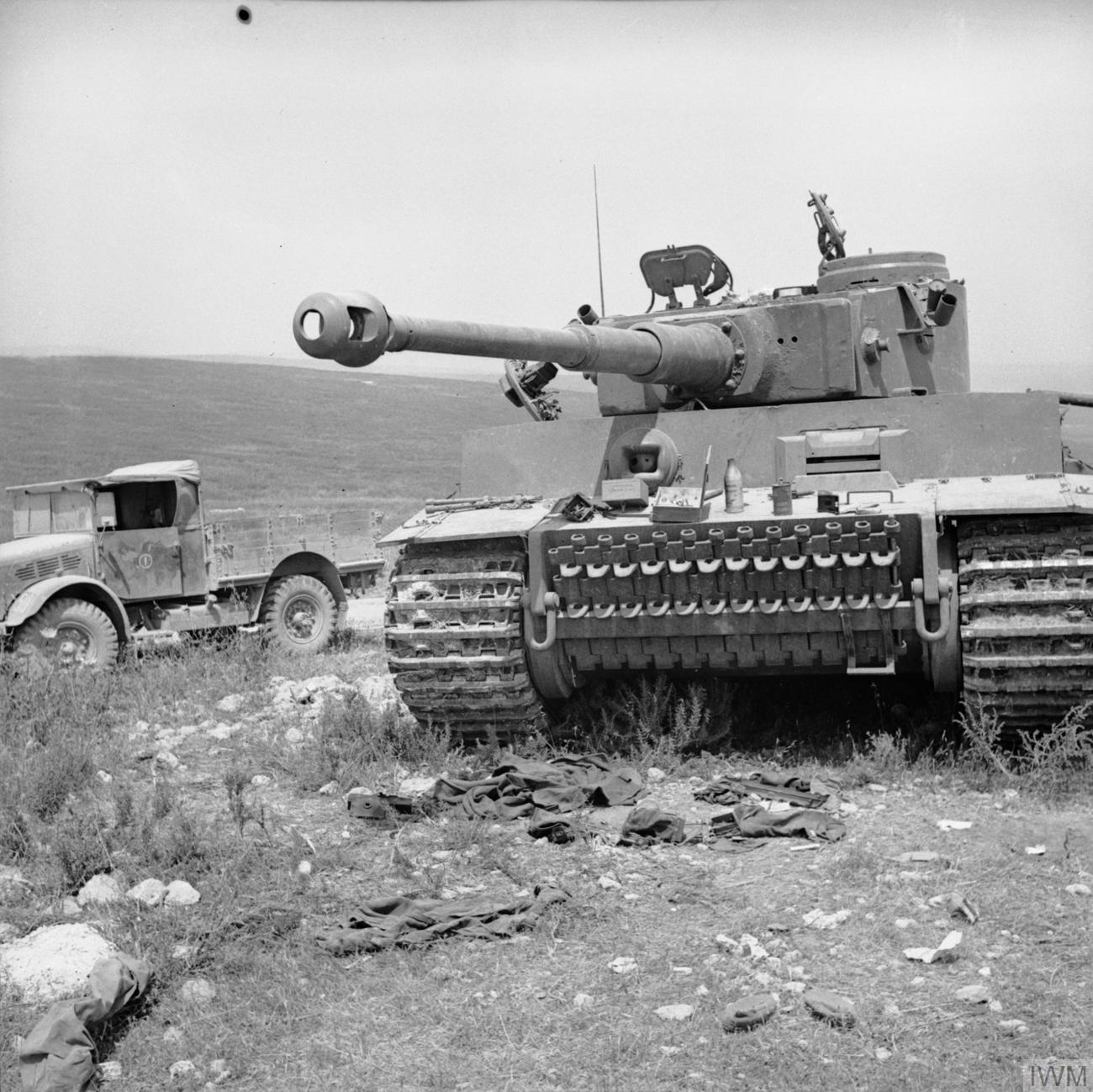
Not every African loss was a case of a Tiger breaking down and being left behind. Tiger 131, assigned to schwere Panzer-Abteilung 504 and built in Kassel in February 1943, was disabled on 24 April 1943 near a position British troops called Point 174 (Gueriat el Atach), during the opening stages of Operation Vulcan, when, in the corrected account now credited by The Tank Museum, "a shot by a Churchill from either the 142nd Regiment RAC or 48 RTR jammed the turret, forcing the Tiger crew to abandon their tank." The tank they left behind was knocked out but still largely intact and driveable, and it was inspected in Tunis weeks later by King George VI and Winston Churchill before being shipped to England.
For decades, The Tank Museum told a more detailed but different version of this story: that the tank had instead been hit by three separate shots at a different location and date, Djebel Djaffa on 21 April 1943. That account only unraveled in April 2019, when a museum visitor named Dale Oscroft recognized striking parallels to a story his own father had told him about the fighting at Point 174, and photographic and documentary evidence confirmed his father's account was the correct one. Shipped to England in October 1943 and eventually fully restored, Tiger 131 is today the only operational Tiger I tank in the world, on permanent display at The Tank Museum in Bovington, and it appeared as a functioning vehicle in the 2014 film Fury. Its history is a reminder that even a single, well-documented museum piece can carry the wrong story for seven decades, not unlike how a single 1724 book, not a courtroom record or a shipwreck, invented most of the details people now assume about Blackbeard.
Non-Combat Losses Climbed as Germany's Position Collapsed
Italy shows a version of the same pattern seen in North Africa, driven by different terrain. Of 161 recorded Tiger I losses in the Italian campaign, only 39, or 31 percent of combat-plus-non-combat losses, came from combat; Ankerstjerne's analysis specifically flags 62 losses attributed to mechanical failure, concluding that the Tiger I's weight and mechanical complexity were poorly suited to Italy's mountainous roads.
Across the war as a whole, the ratio of combat to non-combat losses shifted as Germany's military position deteriorated. In 1943, combat still accounted for about 68 percent of Tiger I losses. By 1944 that share had fallen to roughly 53 percent, and by 1945, with fuel scarce, recovery vehicles unavailable, and German forces in retreat across most fronts, it had dropped to about 32 percent. A tank that could not be recovered or refueled during a retreat was written off just as permanently as one destroyed in action, and the erosion of Germany's logistics network in the war's final two years shows up directly in these numbers.
The Five Shermans Myth Is About Platoon Size, Not the Body Count
One detail from the Tiger's reputation has a mundane explanation once traced to its source. Allied veterans' memoirs frequently repeat the claim that it took four or five Sherman tanks to destroy a single Tiger, framed as a grim ratio of Allied losses to German kills. The actual origin is organizational rather than statistical: the standard U.S. Army tank platoon of the period consisted of five Sherman tanks, and doctrine for engaging a Tiger or Panther called for one section of the platoon to draw the German tank's fire while the other maneuvered to hit it from the side or rear, since the Sherman's frontal armor and standard gun could not reliably penetrate a Tiger head-on.
Any American platoon that encountered a single Tiger therefore committed all five of its tanks to the engagement by default, simply because five tanks was what a platoon was, not because the fight consistently cost four Shermans destroyed for every Tiger killed. The number describes a unit organization chart, not a casualty count, a distinction that gets lost every time the figure is repeated as if it were a verified kill ratio rather than an artifact of how Cold War-era mutually assured destruction got its name from a Pentagon strategist's deliberate insult, only for the label to be adopted as a badge of doctrine. The rest of WarCrumbs' Weapons & Technology hub runs from the ballista to WW1-era tanks, several with the same gap between reputation and the record.