
A Four-Hour Standoff, Broken by a Fake Retreat
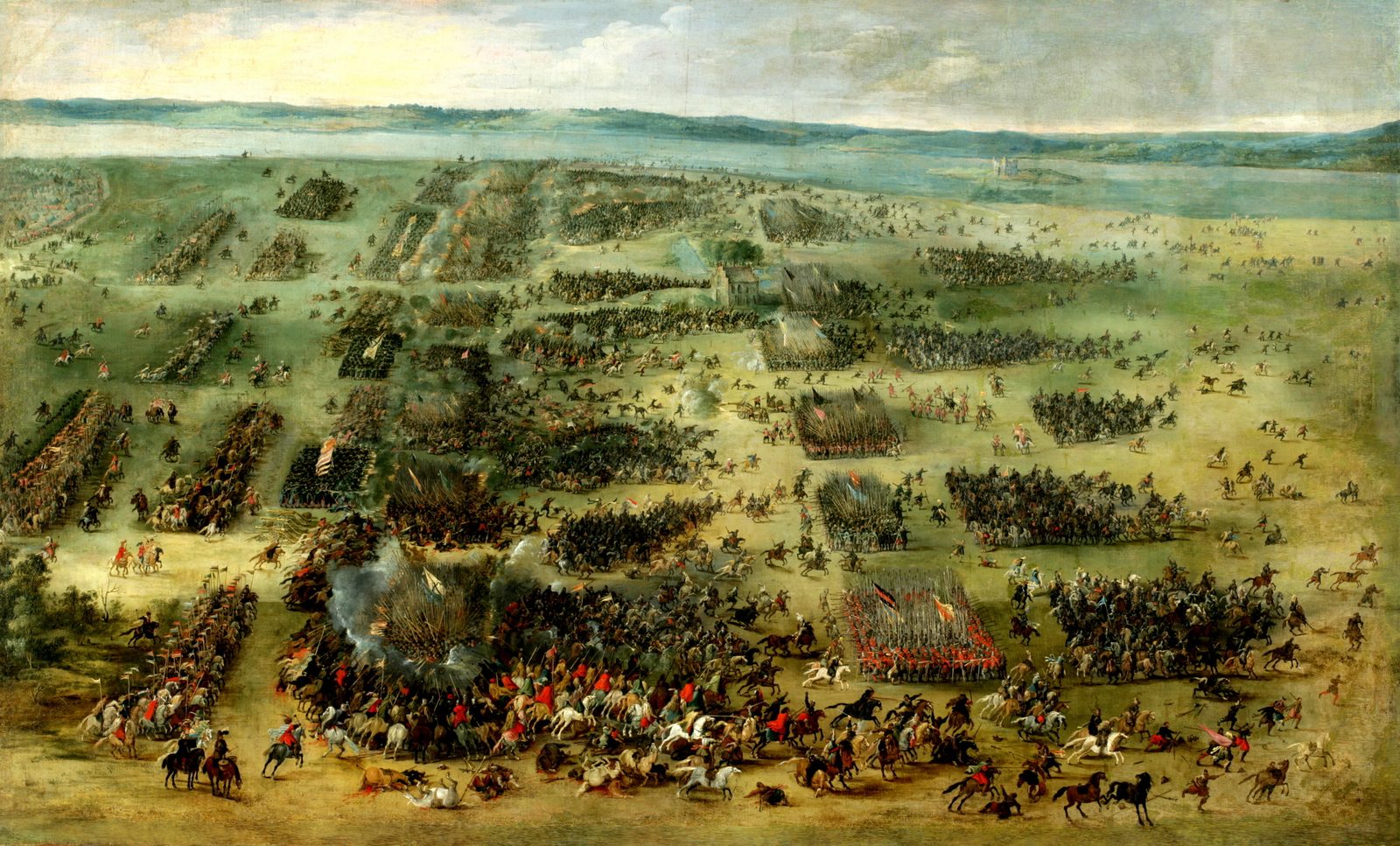
Chodkiewicz's army was outnumbered roughly three to one and knew it. His force, drawn mostly from the Grand Duchy of Lithuania with a smaller contingent of Polish Crown troops and mercenaries, numbered around 3,600 men and five cannons against Charles IX's approximately 10,800 to 10,900 troops and eleven guns, according to the strength figures in Wikipedia's summary of the battle (checked 12 October 2026). For roughly four hours on the morning of the engagement, Chodkiewicz tried to provoke the Swedish army into abandoning a strong defensive position on high ground above the battlefield, sending light cavalry forward to skirmish and probe without committing his main force to an uphill assault he could not afford to lose.
When direct provocation failed, Chodkiewicz ordered a feigned withdrawal. Commonwealth cavalry pulled back as if retreating, and Charles IX, reading the movement as a genuine collapse, ordered his infantry down off the high ground to press what looked like a won battle. It was the decision that ended it. Once the Swedish infantry left its defensive position and advanced onto open, level ground, Chodkiewicz's forces reversed course, and the battle that had been building for hours was decided in the twenty to thirty minutes that followed.
Twenty Minutes, and the Longest Lances in Europe
The charge itself fell to Chodkiewicz's hussars, roughly 1,050 to 1,450 of them by most troop-strength reconstructions of the battle, riding with the kopia, a hollow fir-wood lance with a forged steel point that ran 4.5 to 6 meters in most surviving examples and, in the single longest known original, 6.15 meters without its head. A contemporary who traveled through the Commonwealth in the 1630s and 1640s, the French military engineer Guillaume Le Vasseur de Beauplan, recorded hussar lances at 19 French royal feet, a measurement that converts to almost exactly 6.17 meters, corroborating the surviving examples rather than exaggerating them. German cavalry of the same period carried steel tube lances around 3.2 meters long, roughly half the hussars' reach, a gap most historians attribute to the hussars' original purpose of outreaching pike-armed infantry formations before the lance ever met a rider.
That reach mattered most in the charge's opening seconds, when Commonwealth mounted harquebusiers opened fire on the advancing Swedish infantry and the hussar banners struck immediately behind them. The charge broke through Georg von Mansfeld's Swedish and German reiter cavalry on the flanks first, and with the flanks collapsing, the hussars and Chodkiewicz's infantry closed on a Swedish infantry center that had no cavalry left to cover it. Within half an hour of the main clash beginning, the Swedish army that had held high ground four hours earlier was in full retreat.
The King Who Almost Didn't Leave the Field
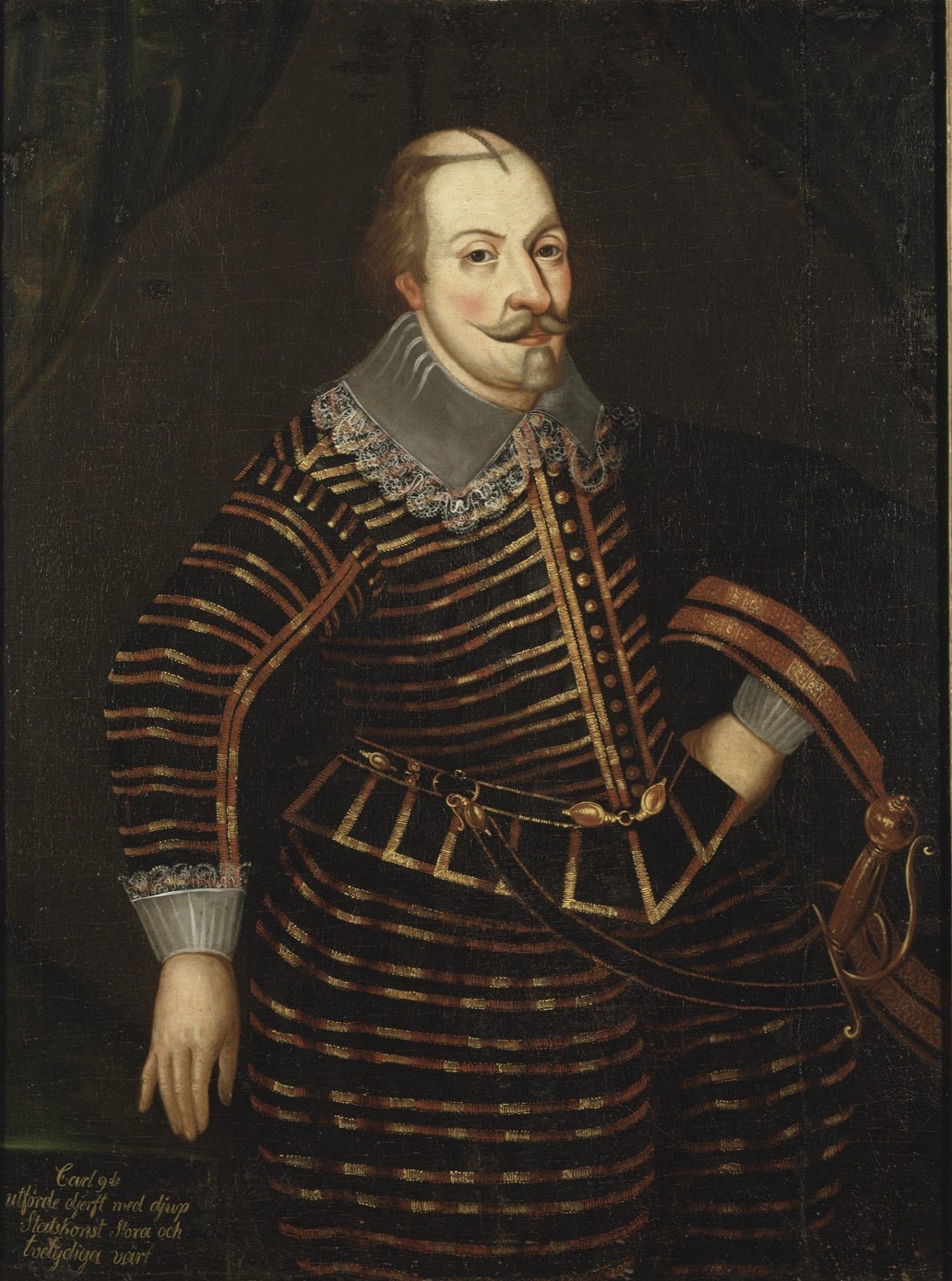
Charles IX was with his army when it broke, and the retreat nearly cost him his life. His horse was killed under him in the collapse, leaving the king exposed on foot as Commonwealth cavalry closed in. According to the Swedish House of Nobility's genealogical record of the Wrede family, the cavalry officer Henrik Wrede reached the king at that moment and gave him his own horse; Charles escaped on it, and Wrede, left behind and unable to withdraw, was surrounded and killed on the field.
The Swedish crown did not let the debt go unpaid. In 1608, Charles IX granted the Elimä district, in what is now southeastern Finland, to Wrede's widow, Gertrud von Ungern, and their sons Caspar and Carl Henrik, the origin of the noble line later registered as Wrede af Elimä. The family's coat of arms, recorded with Sweden's House of Nobility, carries a crowned brown horse in its first field specifically to commemorate the deed, a detail two independent Swedish-language sources, the Adelsvapen genealogical wiki and the House of Nobility's Riddarhuset archive, describe in near-identical terms.

A Death Toll Nobody Can Verify
Commonwealth losses at Kircholm are reported with unusual consistency across sources: Wikipedia's infobox lists 300 killed or wounded (checked 12 October 2026), a figure other tallies break down as roughly 100 dead and 200 wounded, alongside heavy losses among the hussars' trained battle horses specifically. Swedish losses are where the agreement stops. Wikipedia's infobox rounds the figure to "c. 8,000 killed, wounded, or captured" (checked 12 October 2026). A separate, frequently repeated account holds that the burghers of Riga buried 8,983 corpses after the battle, according to one contemporary report, and 8,918 according to another, figures close enough to each other to look precise and far enough apart to confirm neither burial count was an exact tally.
Neither of those burial figures isolates what most readers assume they mean, Swedish combat deaths from a single afternoon of fighting. Contemporary accounts describe the buried dead as including Commonwealth soldiers alongside Swedish ones and Swedish non-combatants killed during the days of pursuit that followed the battle proper, as retreating Swedish forces were run down over difficult terrain on their way back toward Riga. A burial count taken days later, covering multiple locations and several days of fighting and flight, is a different measurement than a battlefield casualty count taken at the close of a single engagement, even when both get cited as "Swedish losses at Kircholm" in the same sentence.
That the numbers still don't fully agree more than four centuries later is not for lack of scholarly attention. Historian Mariusz Balcerek's 2020 survey of the battle's historiography, published in Open Military Studies, works through the archaeological, epistolary, historiographic, iconographic, narrative, and normative source material generated by Kircholm and explicitly frames the battle's numbers as an active subject of reassessment rather than a settled record, comparing newer analysis against more than a century of prior literature on the engagement. The tactical outcome at Kircholm, an outnumbered force routing a much larger one, is not unique in military history: Hannibal's smaller Carthaginian army did the same to a numerically superior Roman force at Cannae in 216 BCE, and modern historians dispute the ancient sources on that battle's aftermath just as they dispute Kircholm's death toll. What is unusual about Kircholm is how directly its own casualty record shows the gap between a number everyone repeats and a number anyone can actually verify.
An Army Built on a Different Ledger
Chodkiewicz's hussars fought as a szlachta-based noble cavalry tradition, not a wage-earning force, a structural difference from the mercenary armies dominating warfare elsewhere in Europe at almost exactly the same moment. Nearly eight decades before Kircholm, unpaid German Landsknecht pikemen mutinied over withheld wages and marched on Rome instead of the enemy they had been hired to fight, sacking the city in 1527; Chodkiewicz's cavalry answered to noble obligation, not a pay ledger, so it had no equivalent breaking point built into how it was organized. A century later, Sweden itself would demonstrate that an outnumbered force winning decisively was not a one-time fluke of Kircholm specifically: at Narva in 1700, a Swedish army of roughly 8,000 to 10,000 routed a Russian force of 34,000 to 40,000 in a snowstorm, the same lopsided arithmetic Chodkiewicz had run against Sweden a century earlier, before Russia's own reforms reversed the pattern for good at Poltava in 1709.