
Hours After Isandlwana
On the morning of January 22, 1879, a Zulu army overran the main British camp at Isandlwana, ten miles from Rorke's Drift, killing more than 1,300 British and allied troops in the worst defeat a Victorian army suffered against a non-European force. Word of the disaster hadn't yet reached the small mission station at Rorke's Drift, a former trading post on the Buffalo River serving as a supply depot and field hospital, when a Zulu reserve force of roughly 3,000 to 4,000 warriors, men who had missed the fighting at Isandlwana that morning, turned toward it that afternoon. The garrison holding the post numbered just over 150, a mix of British regulars from the 24th Regiment of Foot, colonial troops, and hospital patients too sick or wounded to stand. Elsewhere in Africa, resistance to European expansion ran on a different constraint: in Samori Ture's rifle-tiered army, the rifle a man was issued decided which war he fought.
The defense that followed, commanded jointly by Lieutenant John Chard of the Royal Engineers and Lieutenant Gonville Bromhead of the 24th, lasted roughly twelve hours, through the night of January 22 into the morning of the 23rd. It's one of the most retold engagements in British military history, dramatized in the 1964 film Zulu and commemorated in regimental museums on two continents. What gets told less often is what happened to the men who fought it once the shooting stopped: an unprecedented haul of medals, followed within months by a senior British general privately calling the recognition a fraud dressed up as heroism.
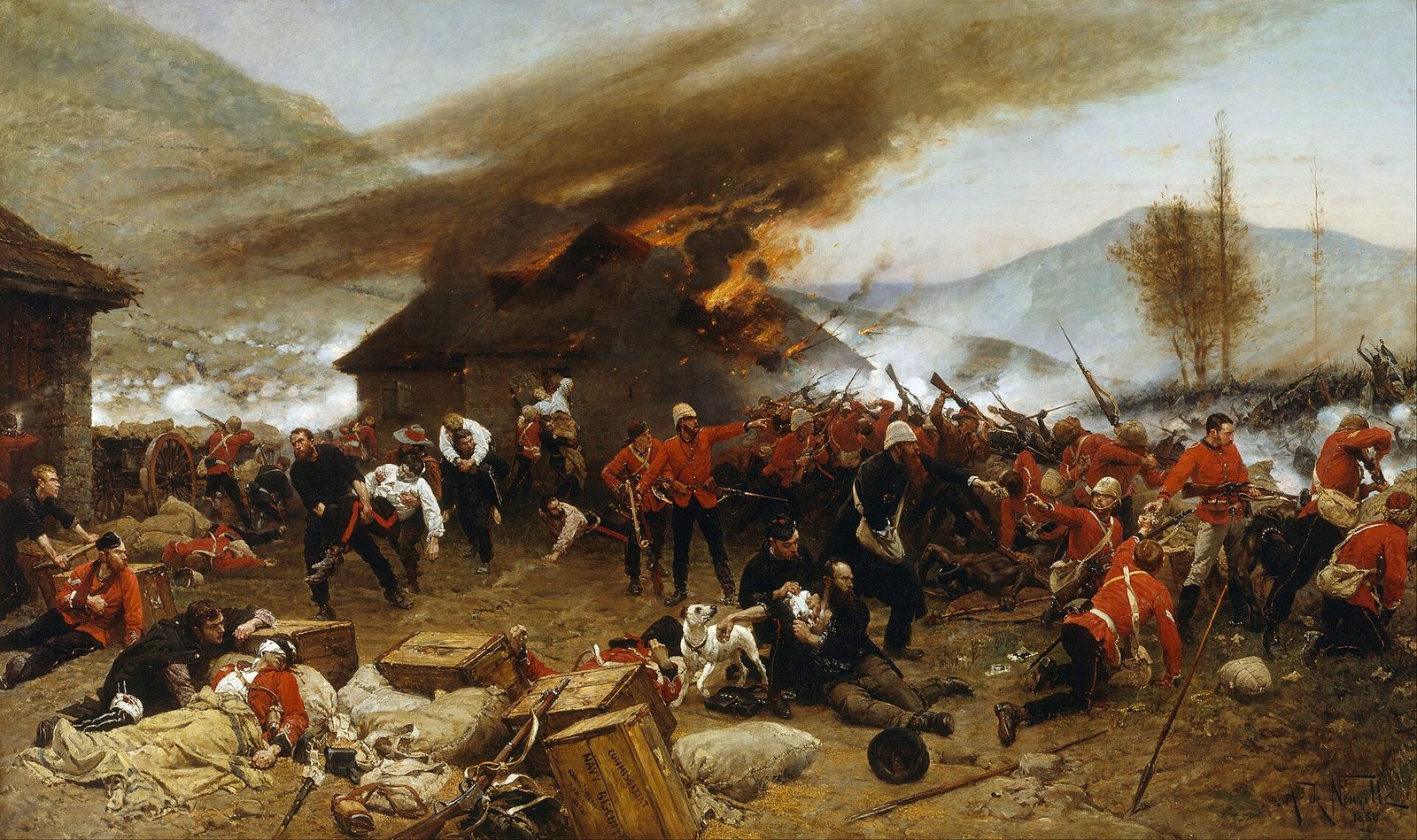
Load the Wagons, or Dig In
The defenders very nearly didn't fight at all. When word of the approaching Zulu force reached Rorke's Drift, Lieutenant Bromhead's first move was to order the post's wagons loaded for a retreat toward the nearest British column. James Dalton, a former army NCO working as acting assistant commissary, an unglamorous supply post with no formal command over either lieutenant, talked him out of it. Dalton's argument was simple and, given what had just happened ten miles away, hard to dismiss: a column of wagons crossing open country, slowed by patients who couldn't walk, would be run down exactly as the fleeing survivors of Isandlwana were being run down at that same hour. Staying and fortifying gave the garrison a wall to fight behind instead of open ground to die on.
The officers took Dalton's advice. Working parties used mealie bags and wooden biscuit boxes to link the mission's two buildings and a stone cattle kraal into a single defensible perimeter before the Zulu vanguard came into sight. When the hospital caught fire partway through the night and had to be abandoned room by room, the shortened line the garrison fell back to held until dawn. Dalton's advice, not any tactical initiative from the two lieutenants technically in command, is what put that perimeter there in the first place.
A Record That Isn't Quite the One People Cite
Eleven Victoria Crosses were gazetted for the defense of Rorke's Drift on May 2, 1879, alongside a Distinguished Conduct Medal and several other decorations. It's routinely described, on fan sites and in casual retellings alike, as the record for the most VCs ever awarded for a single action. That claim doesn't hold up. The larger total belongs to the multi-day fighting around Lucknow during the 1857 Indian Rebellion, though even there sources disagree once you start arguing over which assaults on which days count as one action: some accounts put the figure at 18 for the single assault on the Sikandar Bagh, others count well over twenty across the several days of relief operations. What Rorke's Drift can claim without dispute is narrower, and more interesting once you know it: seven of the eleven crosses went to soldiers of a single regiment, the 24th Regiment of Foot, the most Victoria Crosses any one regiment has received for one action in British military history. A round number that turns out to depend entirely on where you draw the boundary of "one action" is a familiar problem for this period: the same argument over what counts as a single battle rather than several linked ones shows up in the casualty tallies for a 1605 cavalry battle in what's now Latvia.
The General Who Missed the War
London's answer to the shock of Isandlwana was to send out its most celebrated professional soldier to take command. Sir Garnet Wolseley, a general whose earlier campaigns had made his name synonymous with military competence, so much that the phrase "all Sir Garnet" entered Victorian slang to mean everything in proper working order, was dispatched to supersede the existing commander, Lord Chelmsford, and finish the war his own way. Wolseley reached Cape Town on June 28, 1879, five months after Isandlwana and Rorke's Drift had already been fought.
He never got the chance to command in battle. Chelmsford, who by then knew his replacement was already at sea, pushed his own column into Zululand rather than wait to be relieved, and crushed the main Zulu army at Ulundi on July 4, six days after Wolseley landed and while he was still making his way up from the coast. Wolseley learned of the victory, and effectively of the end of the war he had crossed an ocean to command, from a war correspondent's telegram. The general London had sent to fix the Anglo-Zulu War arrived to find it already finished by the man he was replacing.
"Fought Like Rats"
Wolseley finally met the two Rorke's Drift lieutenants in mid-July, at a routine inspection of a British column at St Paul's Mission Station, not any ceremony arranged in their honor. He pinned John Chard's Victoria Cross on him there, in the field, and privately dismissed the man in his journal as dull and unimpressive to look at. Gonville Bromhead came off no better in Wolseley's private notes, judged similarly unremarkable.
Wolseley's contempt for the two officers wasn't really about their intelligence. It was about what he thought the eleven Victoria Crosses actually represented. In the same journal, later edited and published in full by the historian Adrian Preston, Wolseley set down his real objection in blunt terms: the defenders had simply been cornered with no way out, he argued, and survival under those conditions wasn't the same thing as the courage the medals implied. To Wolseley, a professional soldier who had built his own reputation storming into hostile territory rather than holding a fixed post, defending a wall you can't retreat from wasn't heroism so much as the absence of any other option.
Other historians have pushed back on that framing since. Some point out that Dalton's decision to fortify was itself a real tactical choice made under pressure, not the absence of one, and that the men who then held that perimeter for twelve hours against a force many times their number did so knowing the fate of the Isandlwana survivors who had tried to run. Michael Lieven, writing in the journal Albion in 1998, places the scale of the awards in a different context still: a demoralized British public, reeling from the worst defeat any Victorian army had suffered against a non-European force, needed a story of unambiguous heroism more than it needed a dispassionate accounting of who had genuinely had a choice.
The VC That Came Almost a Year Late
One name is conspicuously missing from the May 1879 gazette: James Dalton's. The man whose argument against retreating shaped the entire defense wasn't decorated alongside Chard, Bromhead, and the other nine men recognized that spring. His own actions during the fighting, defending a corner of the hospital under close-range fire and, though wounded himself, continuing to shoot at Zulu warriors attacking the position, only reached senior officers, and eventually Queen Victoria, well after the initial round of citations had already been written.
Dalton finally received his Victoria Cross on January 16, 1880, nearly a year after the battle, presented at a special parade at Fort Napier by General Hugh Clifford, himself a VC recipient. The man whose single decision, don't load the wagons, is arguably why there was a fortified perimeter to defend at all, was the last of Rorke's Drift's eleven honorees to be recognized for it. The gap between when a battlefield decision actually mattered and when the record caught up to it shows up again off the coast of Denmark in 1941, where the Royal Navy's own chief constructor filed a written dissent against an official verdict weeks after the ship went down, and again over the Pacific in January 1944, where the two kills that separated one Marine ace's official count from the higher figure most historians now use were confirmed by nothing but his own word, because the only other witness didn't survive to back him up.