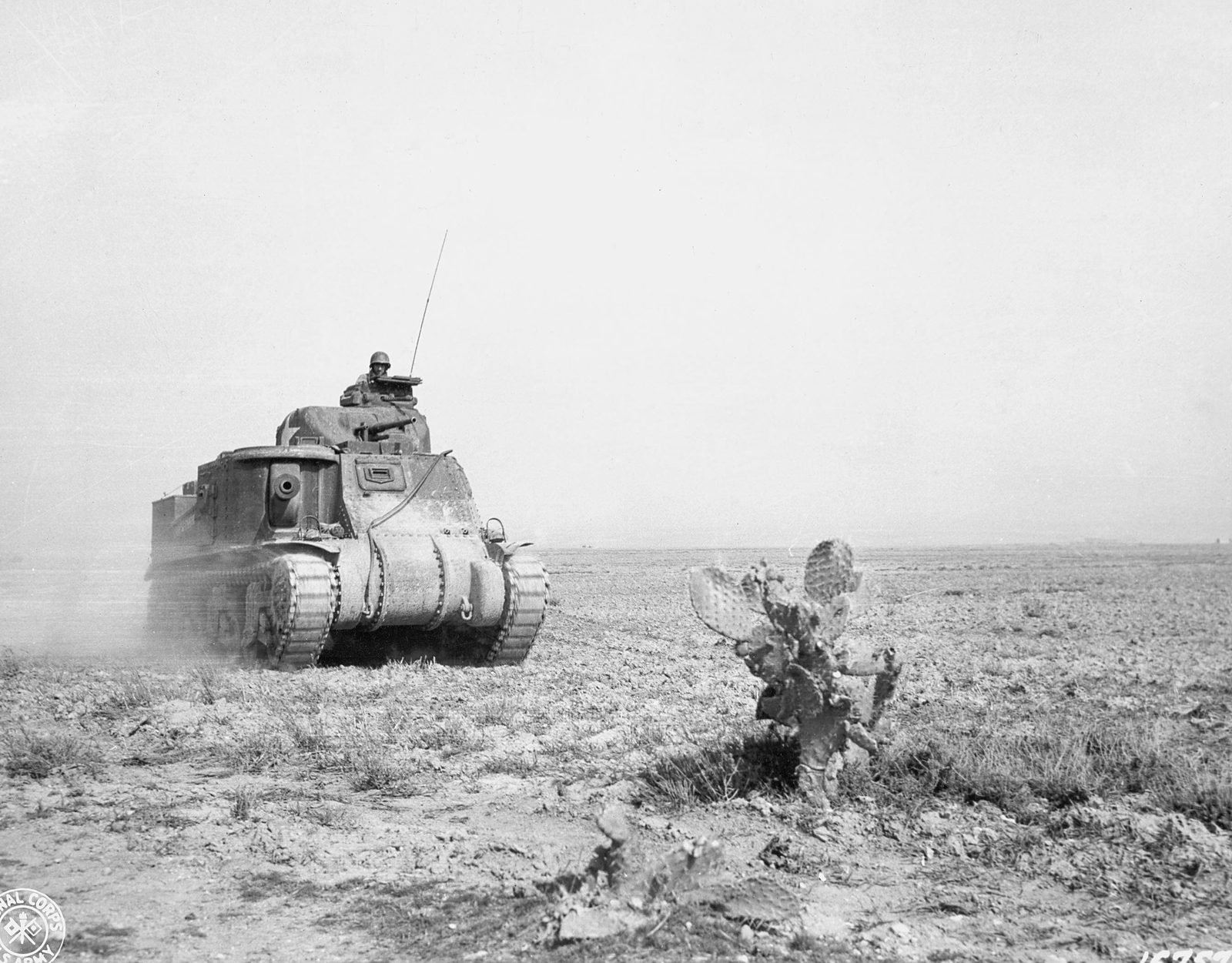

Ten Days That Cost II Corps 183 Tanks
The German 21st Panzer Division struck French positions at Faïd Pass on January 30, 1943, opening the drive that would culminate at Kasserine three weeks later. U.S. armor and artillery briefly checked the advance, then walked into a trap: when the 1st Armored Division gave chase to what looked like a retreating enemy, it ran into a screen of concealed German 88mm guns. "It was murder," recalled Edwin V. Westrate, an American forward artillery observer whose radio and landlines had been cut by shellfire. "They rolled right into the muzzles of the concealed eighty-eights and all I could do was stand by and watch tank after tank blown to bits or burst into flames or just stop, wrecked." On February 14, the main German assault opened at Sidi Bou Zid, and American battalions were pushed back more than 50 miles from their original positions over the following days.
By the time the fighting at Kasserine Pass itself ran its course, from February 19 to 24, the U.S. II Corps had lost 183 tanks, 104 half-tracks, 208 guns, and 512 trucks and other vehicles, along with 300 men killed, 3,000 wounded, and 3,000 captured; the Army needed 7,000 replacements to bring its units back to strength. British forces lost all 11 tanks in one armored engagement nearby. German losses, by contrast, totaled 989 casualties and 20 tanks. Rommel's advance stalled only when Allied reinforcements and artillery held at Djebel el Ahma and Thala, and his own supply lines ran short of fuel and ammunition; by February 24, Axis forces had withdrawn from the pass under heavy air bombardment, giving up all the ground they had taken. Omar Bradley, writing decades later, called the string of defeats "probably the worst performance of U.S. Army troops in their whole proud history."
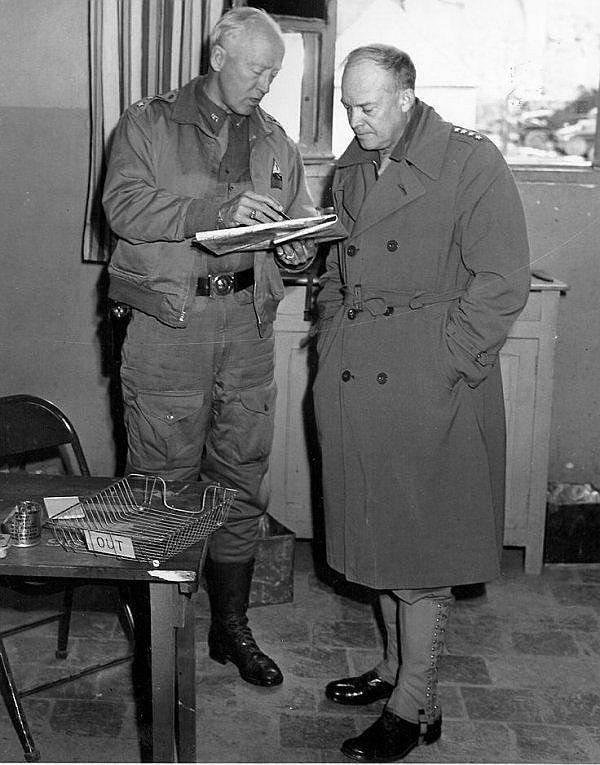

The Intelligence Chief Who Trusted Ultra Over His Own Scouts
Behind the tactical defeat at Kasserine Pass sat a specific intelligence failure, one that Wikipedia's article on the battle never mentions by name (checked 12 October 2026). Eisenhower's chief of intelligence at Allied Force Headquarters, British Brigadier Eric Mockler-Ferryman, had access to Ultra, the codebreaking program decrypting German radio traffic, and repeatedly assured Eisenhower that the intercepts showed General Hans-Jürgen von Arnim's 5th Panzer Army preparing its main blow against the British First Army and Free French forces at Fondouk, in the northern sector of the front. Brigadier General Paul Robinett, whose Combat Command B of the 1st Armored Division was temporarily attached to that northern sector, disagreed. Robinett told Eisenhower directly, when he visited Fondouk, that his own patrols had already pushed all the way across the Eastern Dorsal mountains without finding any sign of a major enemy buildup there.
Mockler-Ferryman's reading of Ultra prevailed over Robinett's reconnaissance. It was wrong. The German attack that mattered fell not at Fondouk but to the south, through Faïd and Sidi Bou Zid, the opening moves that led directly to Kasserine Pass. "Strong was appointed Assistant Chief of Staff for Intelligence (G-2) at General Dwight Eisenhower's Allied Force Headquarters," Wikipedia's article on Mockler-Ferryman's eventual replacement, Kenneth Strong, records (checked 12 October 2026), "replacing Brigadier Eric Mockler-Ferryman, whose over-reliance on Ultra sources had led to a misinterpretation of the enemy's intentions leading up to the disastrous Battle of the Kasserine Pass," a judgment the article attributes to historian Stephen Ambrose's 1981 study of Eisenhower and Allied intelligence. Twenty-six years earlier, correctly decoded German intercepts, the Zimmermann Telegram, read by British codebreakers in Room 40, had helped push the United States into an entirely different war. At Kasserine, the intercepts themselves were also being read correctly. What failed was the judgment about where the enemy meant to use the forces those intercepts described, weighed against a ground officer who had already walked the terrain and found nothing there.
The General Who Went to Bed at 3 A.M.
On February 20, with the battle still underway, Eisenhower sent Major General Ernest Harmon of the 2nd Armored Division to assess II Corps commander Major General Lloyd Fredendall and report back on whether he or 1st Armored Division commander Orlando Ward should be replaced. Harmon found a corps in disarray: Fredendall and his nominal superior, Lieutenant General Kenneth Anderson, rarely spoke to each other and issued conflicting orders, and Fredendall had frozen Ward out of his own operational meetings after a dispute between them. When Harmon reached II Corps headquarters at 3:00 a.m., Fredendall handed him a note authorizing him to take charge of the front and went to bed. Field commanders Harmon interviewed described Fredendall as out of touch with the fighting and, in Harmon's own later characterization, a "physical and moral coward." Harmon's report back to Eisenhower was blunter still: Fredendall was "no damn good."
Fredendall ran the battle from a headquarters his engineers spent weeks blasting into solid rock at a position nicknamed Speedy Valley, accounts of the exact distance behind the front vary, with figures ranging from roughly 70 to 100 miles, but all describe a commander directing II Corps from well outside artillery range of his own men. Eisenhower later called it "the only time during the war that I ever saw a higher headquarters so concerned over its own safety that it dug itself underground shelters." Witnesses at the headquarters described Fredendall chain-smoking and muttering to subordinates, "They have broken through and you can't stop them," as German spearheads approached Tébessa, and he had already ordered demolition charges prepared for a possible evacuation before the line held.
Two Firings, Weeks Apart
Harmon's assessment was not the last word. After the fighting eased, Eisenhower personally visited II Corps headquarters and conferred with Brigadier General Omar Bradley, who had separately interviewed division commanders and come back with the same complaints Harmon had gathered. That settled it. British General Sir Harold Alexander, newly installed as 18th Army Group commander, offered to take over II Corps himself; Eisenhower instead approached Harmon, who declined the post, saying it would look self-serving to benefit personally from his own critical assessment of Fredendall. On March 5, 1943, Eisenhower flew to Tébessa to tell Fredendall in person, framing the change as a routine reassignment rather than a firing, a choice made partly to protect Fredendall's standing. The next day, March 6, George S. Patton formally took command of II Corps. After his own first inspection of the command, Patton was blunter in private than Eisenhower had been in public: "I cannot see what Fredendall did to justify his existence."
Mockler-Ferryman's removal followed the same month, with far less public drama. Kenneth Strong took over as Assistant Chief of Staff for Intelligence at Allied Force Headquarters in March 1943, and Mockler-Ferryman's own service record lists his tour in that post as running through March 25, 1943, after which he moved to head Western Europe operations for the Special Operations Executive. Neither man was formally disgraced. Fredendall was promoted to lieutenant general that June and given command of the Second Army, training troops in the eastern United States for the rest of the war; contemporary press coverage greeted him as a returning hero, unaware of what Harmon and Bradley had actually reported. It is a quieter version of a pattern that shows up elsewhere in this period of the war: William Halsey's Third Fleet survived two separate typhoons and two courts of inquiry, only the second of which recommended his relief, yet Halsey was never actually removed and was promoted to five-star admiral that same year. At Kasserine, both relief recommendations were carried out. Neither officer paid a lasting career price for it. Accountability for this kind of violence was rare elsewhere too: in the 1946 Battle of Athens, the only person ever criminally convicted was the deputy who shot farmer Tom Gillespie in the back for trying to vote, and he served barely a year of a three-year sentence. Not every wartime inquiry moved as fast as Eisenhower's, either: a Soviet investigation found its own inconvenient facts about the most celebrated Soviet legend of the Battle of Moscow in 1948, then sat on the findings for the next 42 years.
What Changed After Kasserine
Patton's arrival transformed II Corps almost immediately. He imposed a strict uniform and discipline policy, visited the front personally, and rebuilt a command structure that had fractured under Fredendall. On March 23, less than three weeks after Patton took over, II Corps beat back an Axis attack at El Guettar, the first battle in which American forces defeated an experienced German armored unit in the war, though the fighting that followed proved inconclusive. The U.S. Army also drew broader lessons from the defeat: unit organization and tank doctrine were revised, and commanders and equipment that had performed poorly were replaced across the theater, changes that shaped how American armored forces fought for the rest of the war. Two months later, in a different sector of the same Tunisian campaign, roughly 110 miles northeast near Medjez el Bab, a British Churchill tank would knock out the German Tiger I now fully restored and running at The Tank Museum in England, one of several engagements covered in WarCrumbs's wider Battles archive from the same North African campaign.