
A Diversion With a Bloody Reputation
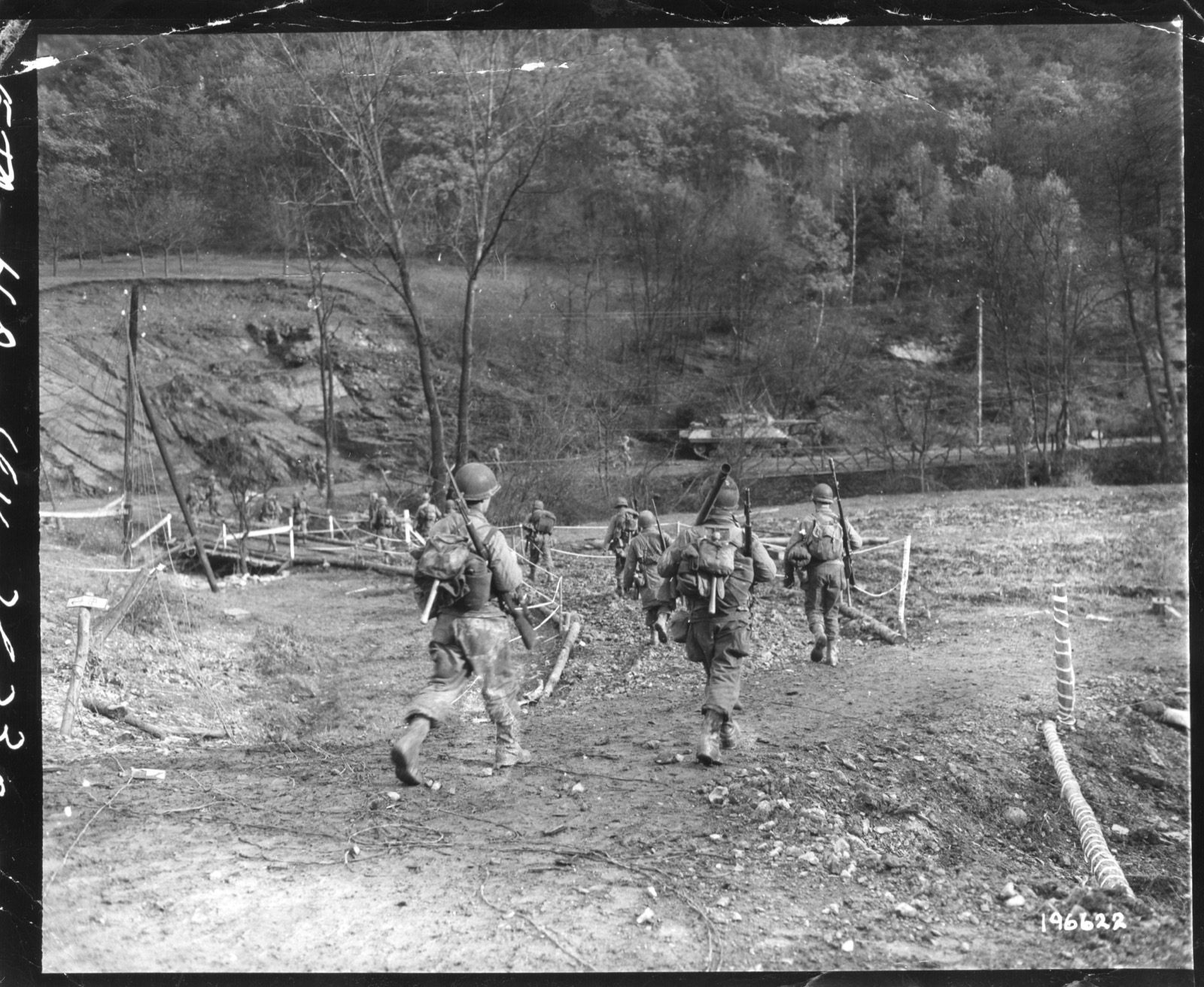
Fought from September 19 to December 16, 1944, in a 140-square-kilometer stretch of forest just east of the Belgian-German border, the Battle of Hürtgen Forest lasted 88 days, making it, according to Wikipedia's account (checked 12 October 2026), the second-longest single battle the U.S. Army has ever fought, behind only the three-month defense of Bataan in 1942. The initial American goal was not to capture the forest for its own sake. Command planners wanted to pin down German forces there so they could not reinforce the fighting further north around Aachen, with a secondary aim of pushing on to the Roer River as part of Operation Queen.
Dense fir plantations up to 30 meters tall, saturated ground, and a near-total absence of usable roads canceled out the advantages in armor and airpower that had carried American forces across France. What followed was, in the U.S. Army's retrospective judgment, one of its costliest miscalculations of the European campaign. Charles B. MacDonald, an Army combat veteran of the battle who later became one of its official historians, described it in blunt terms the Army itself has since republished: "a misconceived and basically fruitless battle that should have been avoided." Wikipedia's summary, verified 2026-10-12, puts First Army's toll at a minimum of 33,000 killed and wounded, combat and non-combat losses combined, with upper estimates reaching 55,000 against roughly 28,000 German casualties; the 4th Infantry Division alone absorbed more than 6,000 casualties in under a month of fighting there, per the Army's retrospective account of the division's service.
The Neglected Objective
While that fighting consumed division after division through September, October, and into November, the campaign's actual strategic prize sat mostly unaddressed a few miles downstream. The U.S. Army's official history of the campaign, The Siegfried Line Campaign, titles the relevant section "The Neglected Objective" and states its subject plainly: the dams on the upper reaches of the Roer, which the Germans could open to flood the valley and cut off any American force that had already crossed the river. The same history records that American commanders gave "the first firm appreciation of the genuine value of the Roer River Dams to the Germans" only on November 11, 1944, when First and Ninth Army jointly ordered no advance past the Roer "except on Army order." Even then, the official account notes, "not for almost a month thereafter was any scheme revealed for taking the dams by ground assault."
Ninth Army's wartime chroniclers, quoted in that same official history, supplied one candid explanation after the fact: "The progress made by First Army . . . did not measure up to expectations, however . . . . Since the dams were not quickly overrun, . . . the possibility that the enemy would make good tactical use of the waters impounded by the dams became a matter for the most serious consideration." In other words, the plan had assumed the dams would simply fall as a byproduct of a fast advance, and only when that advance stalled in the forest did anyone treat seizing them as a task requiring its own attack. The irony the official history draws out is sharp: had American forces controlled the dams' spillways earlier, the same German units grinding down U.S. divisions in the forest and on the Roer plain could instead have been cut off from reinforcement and supply.
A Month of Failed Air Raids
General Courtney Hodges, commanding First Army, began studying the dams for possible air bombardment as early as November 18 and pressed General Omar Bradley to back the idea four days later. The plan had a recent precedent: on October 20, 1944, P-47 fighter-bombers from Patton's Third Army had breached a comparable earthen dam at the Etang de Lindre near Metz in a single strike, removing a similar flooding threat to American lines there. SHAEF air officers initially called a strike on the much larger Roer dams impracticable, but relented after General Eisenhower personally pushed the project through over the objections of RAF Bomber Command chief Sir Arthur Harris, who thought the effort would waste aircrews on a target he considered unbreakable.
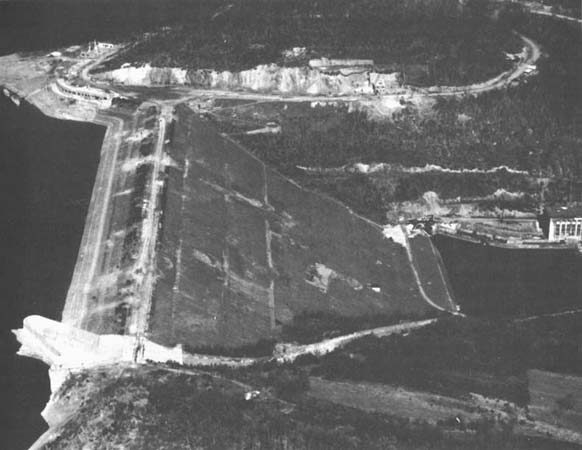
The results proved Harris's skepticism largely correct. Poor weather forced cancellations from November 30 through December 2. On December 3, 190 aircraft flew over the dams but failed to attack because of visibility; the next day, only 25 Lancasters and 3 Mosquitos of 200 aircraft dispatched actually dropped bombs, with damage the official history calls "discouragingly negligible." On December 8, 205 aircraft finally dropped 797 tons of bombs across the Urft and Schwammenauel Dams and the regulating dam between them; two hits registered on the Urft and eighteen on the Schwammenauel, and neither structure broke. Hodges still believed the dams could be broken from the air: a thousand bombers a day, he reportedly said, "should be sent over until the dam is broken." A final raid on December 11 cut the top of the Urft Dam enough to let some water spill through, "but not enough," and further attempts on December 13 and 14 were scrubbed for weather. The air campaign, in the official history's words, "had failed."

Three Days Before the Bulge
Even as the bombing campaign continued, Hodges had already ordered General Leonard Gerow's V Corps to plan a ground attack on the dams. Gerow's field order, issued December 7, set a double envelopment for December 13: the 78th Infantry Division driving northeast through the pillbox-studded Monschau Corridor, the veteran 2nd Infantry Division advancing from the south, and a combat command of the 9th Armored Division held in reserve, backed by thirteen corps artillery battalions. The terrain, the official history notes, was as forbidding as anything else American troops had faced in the campaign, including the Kall River gorge and the Kommerscheidt-Schmidt ridge, ground already infamous from the 28th Infantry Division's disastrous attack there weeks earlier.
What Gerow's planners could not have fully appreciated was that the German divisions defending that same sector, the 272nd and 277th Volksgrenadier Divisions, were simultaneously being pulled back to join the Sixth Panzer Army for an entirely different operation: the Ardennes counteroffensive, whose target date was, per the official history, "only three days away" from the American attack's own launch. On December 16, Germany's surprise offensive into the Ardennes, remembered as the Battle of the Bulge, overtook the entire Western Front, and the V Corps' three-day-old push on the Roer dams was cut short before it could finish the job it had barely begun.
Finally Taken, Two Months Late
The dams were not seized until early February 1945, when the new V Corps commander, General Clarence Huebner, revived essentially the same plan the Ardennes offensive had interrupted. On February 8, the 78th Division's 310th Infantry was to pass through the town of Schmidt and drive to Hasenfeld, at the foot of the Schwammenauel Dam, a plan that assumed Schmidt was already fully secured. It was not: German defenders held out house by house through the day, and General Hodges made no secret of his frustration that, with 40 artillery battalions and 780 guns on call, his forces could not simply "blast a road from our present front line positions straight to the dam."
Shortly before noon that day, Hodges telephoned Huebner directly to press him. Minutes later, 9th Infantry Division commander General Louis Craig happened to walk into V Corps headquarters on a routine visit; Huebner asked how quickly Craig could shift a combat team to Schmidt, and Craig answered "immediately." Huebner told him to move the entire division headquarters as well. Similar impatience at the top had already reshaped American command decisions once earlier on this front, when two of Eisenhower's own officers were relieved within weeks of the Kasserine Pass disaster after a much larger breakdown in performance. By midnight, Craig's men were in Schmidt preparing to attack before dawn. On the night of February 9, after further slow going, the 1st Battalion, 309th Infantry finally reached the dam in darkness and split into two groups, one to gain the top and cross over, the other to reach the lower level and seize the power house. An engineer team attached to the first group, after finding the spillway blown, slid down the dam's 200-foot face and entered an inspection tunnel through its bottom exit, half expecting to be blown up at any moment. The dam fell into American hands on February 10.
A Flood Engineered to Last
It was not intact. Investigation afterward showed the Germans had already done everything they intended before American troops arrived: they destroyed the Schwammenauel's power-room machinery and blew its discharge valves, and separately destroyed the discharge valves on the penstock carrying water from the Urft reservoir down to a point below the Schwammenauel, which explained why they had left the Urft Dam itself standing untouched. Together, the two demolitions were calculated, in the official history's words, to "release no major cascade of water but a steady flow calculated to create a long-lasting flood in the valley of the Roer," a deliberate engineering choice favoring maximum delay over a single destructive wave.
The choice worked. The resulting flood, together with the roughly two weeks Ninth Army needed to wait it out, pushed the jump-off date for Operation Grenade's crossing of the Roer from its original February 10 target back to February 23. The official history's summary reads less like triumph than qualified relief: "It would have been better, of course, had the Schwammenauel Dam been taken intact . . . but it was enough that the Germans had been forced to expend their weapon before any Allied troops had crossed the river downstream." A campaign's real objective sitting unaddressed for months while fighting rages around it is not unique to the Roer; a comparable planning gap, one flank left unguarded by an assumption rather than by force, let German forces bypass the Maginot Line entirely by attacking through the Ardennes in 1940, a defense that never lost a direct fight yet still failed to stop the war it was built for. And the distance between when a battle's shooting effectively ends and when its actual goal is secured runs through other American campaigns too: World War I's guns fell silent in November 1918, yet the United States remained legally at war with Germany for nearly three more years before the peace was finally ratified.