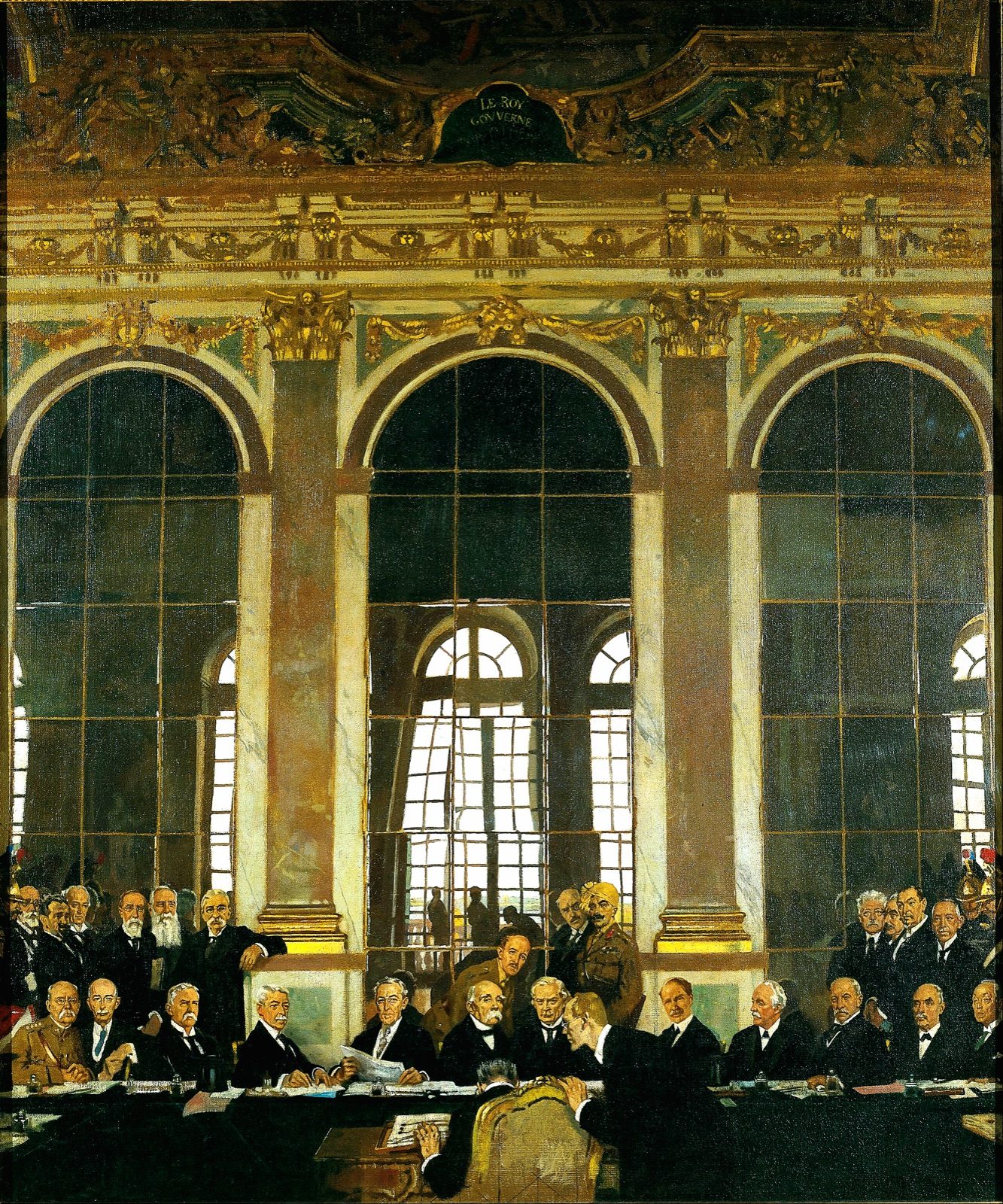
_(RA)_-_The_Signing_of_Peace_in_the_Hall_of_Mirrors,_Versailles,_28th_June_1919_-_Google_Art_Project.jpg)
An Armistice Signed at Dawn, Effective Six Hours Later
Allied supreme commander Ferdinand Foch and a German delegation led by civilian politician Matthias Erzberger signed the armistice agreement at 5:10 a.m. on November 11, 1918, inside a railway carriage that Foch used as a mobile headquarters, parked on a siding in the Forest of Compiègne, north of Paris. The document itself set the ceasefire to take effect not immediately but at 11 a.m. that same day, the 11th hour of the 11th day of the 11th month, a symbolically tidy stopping point that also gave commanders up and down a front stretching hundreds of miles time to relay the order to units that in 1918 still had no reliable way to receive it instantly.
That six-hour gap between signature and ceasefire was not a secret kept from the men doing the fighting. The National WWI Museum and Memorial's own account of the armistice notes that word the war would end that morning had circulated unofficially among Allied Expeditionary Forces for two days beforehand, and by 5 a.m. on November 11 itself, once the signing was confirmed, commanders on the Western Front knew with certainty that hostilities would stop at 11. Fighting did not stop with that knowledge. Some commanders pressed local attacks in the final hours anyway, in a few documented cases specifically to retake towns the Germans had already agreed to abandon under the armistice's own terms, ground that would have reverted to Allied hands twelve hours later without another shot fired.
The Six Hours That Killed Nearly 11,000 Men
The American Expeditionary Forces alone suffered more than 3,500 casualties on November 11, a single morning, after it was already known with certainty the war would be over by lunchtime. Across all the belligerent armies still fighting that day, the Commonwealth War Graves Commission and multiple historical accounts drawing on the same official returns put total casualties at 10,944, including 2,738 deaths, concentrated almost entirely in the six hours between the signing and the ceasefire.
Private Henry N. Gunther of the U.S. 313th Infantry Regiment was among them. According to documents held by the National Archives, including a war diary and a handwritten record of the time of death, Gunther's squad was advancing on a German roadblock near the village of Chaumont-devant-Damvillers when he stood and charged a machine-gun position at around 10:58 a.m. A German gunner, who by multiple accounts tried to wave the approaching Americans off rather than fire, shot Gunther in the left temple at 10:59 a.m. Gen. John J. Pershing's command later designated him the last American soldier killed in the war, one minute before the armistice he never lived to see took effect.
The scale of the final morning's losses drew scrutiny almost immediately. Families of the dead wrote to their representatives in Congress asking why men had died in the last hours of a war everyone knew was already over, and the House's Select Committee on Expenditures in the War Department opened a subcommittee investigation into the Armistice Day casualties. That inquiry concluded in January 1920, in a finding revisited since by Army Times and HistoryNet, that the final morning's losses amounted to needless slaughter: avoidable deaths incurred after the war's outcome, and even the exact hour it would end, had already been settled on paper.
The War That Didn't Stop Everywhere at Once
The armistice Foch and Erzberger signed bound the armies facing each other on the Western Front. It did not, and could not, instantly reach every German force still in the field. In German East Africa, Gen. Paul von Lettow-Vorbeck had spent four years leading a small, mobile force of German officers and African askari troops on a campaign that tied down a vastly larger British, Belgian, and Portuguese effort without ever suffering a decisive defeat. According to accounts from the Commonwealth War Graves Commission and the Western Front Association, Lettow-Vorbeck learned of the Compiègne armistice only days after it was signed, reportedly from a captured British officer, and did not formally surrender his force, which by then numbered roughly 1,100 remaining askari alongside a few hundred Europeans, until 11 a.m. on November 25, 1918, at Abercorn in present-day Zambia. That was two full weeks after the fighting in France had already stopped, and Lettow-Vorbeck went home undefeated in the field, the only German commander of the war never to lose a battle, having simply run out of a war to keep fighting.

An Armistice Isn't a Peace: The Treaty of Versailles
Stopping the shooting and ending the war were, legally, two separate acts, and more than seven months separated them. Allied and German representatives did not sign the formal peace treaty until June 28, 1919, in the Hall of Mirrors at the Palace of Versailles, the same room, chosen deliberately, where the German Empire had been proclaimed in 1871 after France's defeat in the Franco-Prussian War. The Treaty of Versailles imposed reparations, territorial losses, and military restrictions on Germany and created the League of Nations, and it is the document that, for the Allied powers and Germany, actually closed the war the armistice had only paused.
Versailles also was not the only peace treaty World War I required, because Germany was not the only Central Power and the Western Front was not the only front. The Ottoman Empire had signed its own armistice, at Mudros, as early as October 30, 1918, nearly two weeks before Compiègne, and Austria-Hungary followed with the Armistice of Villa Giusti on November 3. Each of the defeated Central Powers eventually required its own separate peace treaty, Austria's at Saint-Germain-en-Laye, Hungary's at Trianon, Bulgaria's at Neuilly, and the Ottoman Empire's, after a war of its own following Sèvres' collapse, finally at Lausanne in 1923, an object lesson, familiar from an entirely different set of negotiators arguing over an undefined line drawn across the Atlantic four centuries earlier, that a single signed document rarely settles a conflict's geography or its aftermath as cleanly as the date on the page suggests. There was never one single moment World War I ended for everyone involved; there were, depending on which belligerent and which front, at least half a dozen.
America's War Didn't End Until 1921
The United States fought the war under its own declaration and, in the end, made its own separate peace. President Woodrow Wilson personally attended the Versailles negotiations and signed the treaty on the Allied side, but the U.S. Senate, divided over the treaty's Article X and the League of Nations membership it would have committed America to, rejected ratification twice, once in November 1919 and again in March 1920, the same kind of lag between a war's fighting and its paperwork that, a century earlier and an ocean closer to home, had once left a war legally unresolved for five weeks after its best-known battle was already fought and won. Because the Senate never ratified Versailles, the United States technically remained at war with Germany for years after every other Allied power had made peace.
Congress resolved the gap not by revisiting Versailles but by declaring the state of war over on its own terms. The Knox-Porter Resolution, drafted by Sen. Philander Knox and Rep. Stephen Porter, passed the Senate on July 1, 1921, and President Warren G. Harding, who had taken office that March, signed it into law on July 2, 1921, formally ending the state of war Congress had declared against Germany on April 6, 1917, a declaration a decoded German cable had helped push Congress into making in the first place. A separate bilateral peace treaty between the United States and Germany, the Treaty of Berlin, followed on August 25, 1921. By the calendar, America's war lasted from April 1917 to July 1921, four years and three months, of which the last two years and eight months came after the shooting itself had already stopped.
The War Costa Rica Didn't Leave Until 1945
No country's paperwork lagged further behind than Costa Rica's. Costa Rica declared war on Germany on May 25, 1918, under President Federico Tinoco Granados, who had taken power in a 1917 coup and hoped a wartime declaration would help win the diplomatic recognition the United States had so far withheld. It did not work. Washington never recognized the Tinoco government, and when the Allied powers convened the Paris Peace Conference the following year, the United States, still refusing to treat Tinoco's government as legitimate, kept Costa Rica out of the negotiations and off the list of signatories to the Treaty of Versailles.
That left Costa Rica in the same position as the United States, a country that had declared war on Germany but never signed the document that legally ended it, except with no equivalent of the Knox-Porter Resolution to close the gap. According to Costa Rican press accounts and historical summaries of the episode, the technical state of war between Costa Rica and Germany was not resolved until 1945, in the settlement that followed World War II, twenty-seven years after Costa Rica had declared a war whose original opponent had stopped fighting in 1918 and whose government had been overthrown in 1919. Formal peace paperwork could lag behind reality by decades elsewhere too, in the opposite direction: on the night the Molotov-Ribbentrop Pact carved up Poland and the Baltic states between Germany and the Soviet Union in August 1939, Moscow publicly denied the secret partition agreement even existed for the next fifty years, until a Kremlin commission finally confirmed it in 1989.