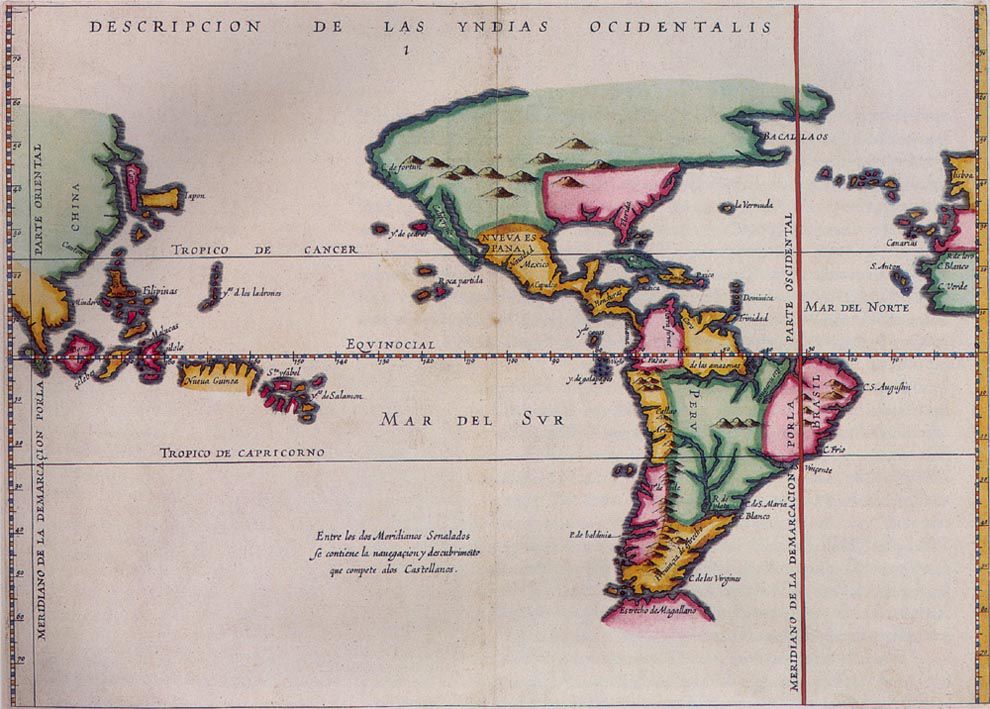

A Pope Draws a Line 100 Leagues Wide
The Treaty of Tordesillas did not start as a treaty between Spain and Portugal at all. It started as a papal ruling. When Christopher Columbus returned to Spain in March 1493 claiming he had reached islands off Asia, King Ferdinand II of Aragon and Queen Isabella I of Castile moved fast to lock in a claim before Portugal, then the dominant maritime power with its own established routes down the African coast toward India, could contest it. They turned to Pope Alexander VI, a Spanish-born pontiff generally regarded as sympathetic to the Spanish crown, who issued the bull Inter caetera on May 4, 1493. It granted Spain everything "found or to be found" west and south of a line drawn pole to pole, 100 leagues from any island in the Azores or Cape Verde group, and a follow-up bull that September, Dudum siquidem, extended the grant to cover lands "at one time or even still belonging to India" even if they fell east of the line.
Portugal's King John II rejected the 100-league line outright. A hundred leagues barely cleared the Cape Verde islands themselves, and Portuguese pilots, with a generation of accumulated experience sailing the South Atlantic toward the Cape of Good Hope, knew the prevailing winds and currents around West Africa well enough to argue the line left no safe margin for their own route to India. Rather than escalate through Rome, where Alexander VI's Spanish sympathies gave Portugal little hope of a better ruling, John II opened direct negotiations with Ferdinand and Isabella. The two crowns met at the small Castilian town of Tordesillas and, on June 7, 1494, agreed to move the line dramatically further west: 370 leagues from the Cape Verde islands, 270 leagues past where the pope had drawn it. Pope Julius II did not formally ratify the amended line until January 24, 1506, twelve years after the two crowns most affected by it had already agreed to and started acting on it. A different pair of powers carved up contested territory between themselves four and a half centuries later with even less public honesty about it: Germany and the Soviet Union secretly agreed to partition Poland and the Baltic states in August 1939, a division Moscow would deny existed for the next fifty years.
A Line Nobody Could Actually Locate
The most consequential detail in the Treaty of Tordesillas is what it left out. The text specifies the new line only as a distance in leagues west of the Cape Verde islands. It does not say which of the roughly ten Cape Verde islands the count should begin from, a nontrivial gap given the islands span a meaningful spread of longitude. It does not define the length of a "league" in any unit that would let a cartographer convert the figure into degrees of longitude, and sixteenth-century Spanish and Portuguese leagues were not even standardized against each other. And Europe in 1494 still had only rough estimates of the earth's actual circumference, so even a precisely defined league could not be converted into a fixed position with any confidence.
The treaty's own drafters knew this was unresolved and built in a fix: a joint Spanish-Portuguese expedition was supposed to sail out, locate the line physically, and mark it. That voyage never happened. In its absence, the line's position was worked out over the following decades through a series of nonbinding calculations by pilots and cosmographers on both sides, each of whom had an obvious incentive to place the boundary in the direction most favorable to their own crown. The gap was never a minor technicality. It is the reason Brazil exists as a Portuguese-speaking anomaly in an otherwise Spanish-speaking hemisphere, and the reason a second treaty was needed a generation later to settle a dispute over the exact same unresolved math on the opposite side of the planet.
The Line That Made Brazil Portuguese
Every other major Spanish-conquered territory in the Americas ended up Spanish-speaking. Brazil did not, and the Treaty of Tordesillas is the direct reason. When Portuguese commander Pedro Álvares Cabral's fleet, bound for India along Vasco da Gama's established route, made landfall on the coast of present-day Brazil on April 22, 1500, the point of contact fell east of the renegotiated line and so within Portugal's zone rather than Spain's.
Historians remain genuinely split on whether that landfall was an accident. The traditional account holds that Atlantic currents and prevailing winds pushed Cabral's fleet unexpectedly far west of its intended course toward the Cape of Good Hope. A competing account points to an ambiguous passage in Duarte Pacheco Pereira's "Esmeraldo de Situ Orbis," suggesting a Portuguese expedition may have sighted the same coastline as much as two years earlier under royal secrecy, precisely so Portugal could establish a claim without tipping off Spain before Tordesillas was finalized. Whichever version is true, the treaty's vague line, whose exact position no one could pin down with confidence in 1500, is what let Portugal treat Cabral's landing as a lawful claim rather than a trespass into Spanish territory, and Portuguese colonization from that landfall is why Brazil speaks Portuguese today while the rest of Latin America speaks Spanish.
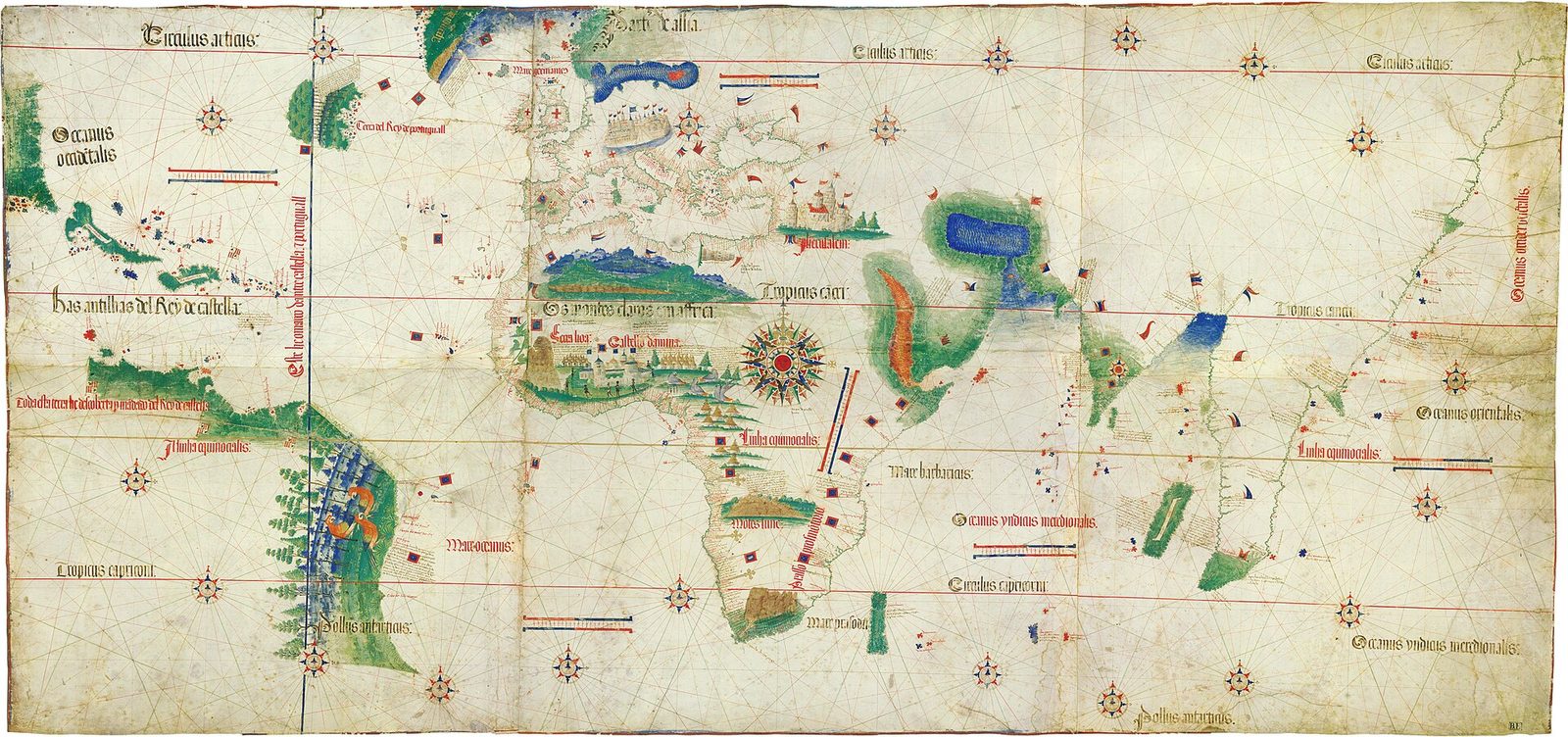
.jpg)
Finishing the Job on the Far Side of the World
Tordesillas divided the Atlantic, but a line running pole to pole also implies a second line on the opposite side of the globe, and neither crown addressed that half of the problem in 1494 because neither side yet had ships operating in the Pacific. That changed in 1520, when Ferdinand Magellan's Spanish-financed expedition rounded South America and reached the Pacific, putting Spanish and Portuguese ships on a collision course over the Moluccas, the Spice Islands of present-day Indonesia and one of the most commercially valuable territories either crown had found.
The dispute took nine more years to resolve. The Treaty of Zaragoza, signed April 22, 1529, drew the missing antimeridian roughly 297.5 leagues east of the Moluccas and assigned Portugal sovereignty over the islands, with Spain formally selling its competing claim for 350,000 gold ducats, an enormous sum reflecting how much value both crowns placed on direct spice access. Even then the settlement was not fully clean: Portugal's King John III delayed ratifying the treaty until June 30, 1530, more than a year after Spain's Charles V had already signed off on it, still negotiating the terms of a line that, like its Atlantic counterpart 35 years earlier, existed on paper well before either side could locate it with real confidence at sea.
The Treaty Two Countries Signed and Everyone Else Ignored
Tordesillas and Zaragoza only ever bound the two governments that signed them. England, France, and the Netherlands, all rising maritime powers over the following century, never accepted that a pope or a bilateral Iberian agreement could allocate the entire non-Christian world between two crowns, and they said so openly. French corsairs and English privateers, most famously Francis Drake, treated Spanish shipping and Spanish American ports as fair targets throughout the second half of the sixteenth century, and the resulting pattern of raiding beyond Europe while maintaining formal peace within it hardened into the loosely recognized doctrine known as "no peace beyond the line." That doctrine, built entirely on other powers' refusal to honor a treaty they were never party to, grew out of the same extralegal Caribbean environment that, two centuries later, let two of the era's most notorious pirates resist capture, weapons in hand, off Jamaica in 1720, a working out of the same Caribbean lawlessness that Tordesillas's exclusive claims had made inevitable the moment rival powers decided the treaty simply did not apply to them.
The empire Tordesillas and Zaragoza carved out for Spain also did not last. Three centuries after Ferdinand and Isabella secured their western hemisphere, an entire generation of revolutionaries fought to dismantle Spanish colonial rule across South America, and the borders they fought over trace back, in no small part, to a line two crowns had drawn in 1494 without being able to say exactly where it was. It is a different kind of unresolved boundary than the ten-year reign remembered mostly through six documented months, but it shares the same basic shape: a formal agreement between two rival powers over contested territory, its real-world consequences settled less by the document's precise wording than by whoever controlled the ground once the ink was dry. Two of those revolutionaries, Bolívar and José de San Martín, met privately at Guayaquil, a meeting still argued over through a letter a 2023 study calls fake.