.jpg)
A Room Built for One King, Given to Another
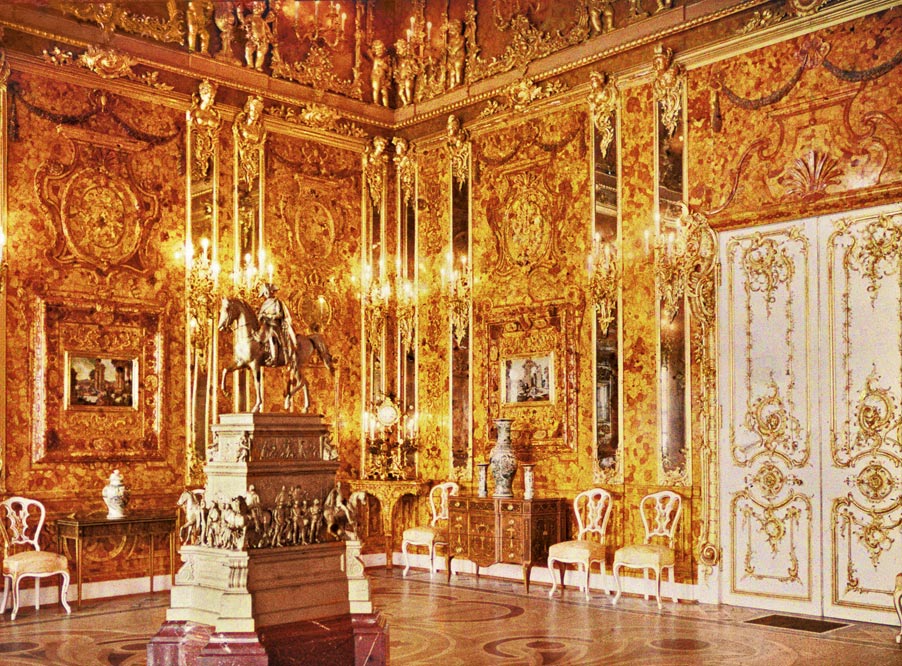
The Amber Room began as a commission for Prussia's King Frederick I, constructed between 1701 and 1714 under the design of German baroque sculptor Andreas Schlüter and built by the Danish amber craftsman Gottfried Wolfram. In 1716, Frederick's successor presented the amber panels to Tsar Peter the Great as a diplomatic gift, and Russian craftsmen eventually installed and expanded them inside the Catherine Palace at Tsarskoye Selo, outside St. Petersburg. By the 18th-century renovations that gave the room its final form, it covered roughly 180 square feet and incorporated an estimated six tons of amber and other semi-precious stone, including four Florentine mosaic panels added under Catherine II in 1763. Before the war, it was popularly described as an "Eighth Wonder of the World," a chamber where light seemed to come from the walls themselves, not just bounce off them.
Thirty-Six Hours to Take It Apart
Germany invaded the Soviet Union in June 1941, and by October a unit working under Ernst Otto zu Solms-Laubach and Georg Poensgen, part of the wartime apparatus for cataloguing and removing art and valuables from occupied territory, located the Amber Room at Tsarskoye Selo. On October 14, 1941, the team dismantled the entire room in approximately 36 hours and packed the panels into 27 crates for transport to Königsberg, then a German city on the Baltic coast and now the Russian exclave of Kaliningrad.
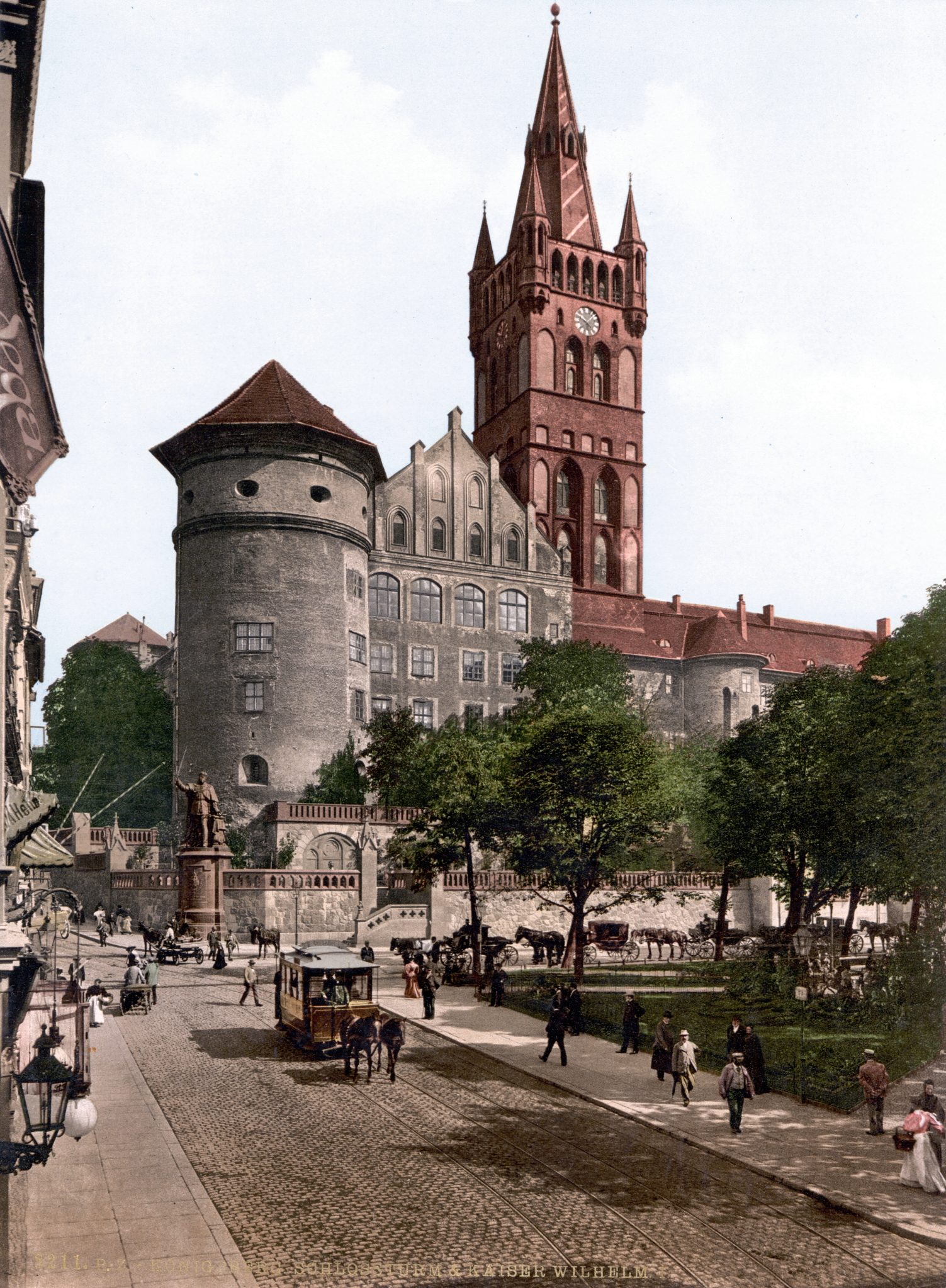
In Königsberg, Alfred Rohde, director of the city's art collections and museum, unpacked and reassembled the panels for public exhibition inside Königsberg Castle, where the room remained on display for most of the war. By August 1944, Royal Air Force bombing raids on the city forced the panels back into crates for safekeeping, and it was in that packed, unexhibited state that the room's trail effectively goes cold.

The Report Moscow Didn't Want
Soviet forces captured Königsberg in April 1945, and the castle housing the crated panels burned in a fire that Soviet investigator Alexander Brusov's later report dated to April 9–11, 1945. Sent to the ruins in May 1945 with orders to locate the missing room, Brusov filed a report in Moscow that June reaching what he treated as a settled conclusion: the Amber Room had burned in the castle fire, and the search could be closed. His physical evidence was specific. In the castle cellar, he located the burned remains of three of the four Florentine mosaic panels that had been added to the room in 1763; when he touched them, the fire-damaged mosaics reportedly disintegrated into ash in his hands.
Brusov's verdict carried an uncomfortable political implication. Accepting it meant accepting that Red Army action, whether through direct combat or the fire it triggered, had finished off an imperial treasure the Wehrmacht had looted less than four years before. Within months, Moscow reopened the case and dispatched a second investigator, Anatoly Kuchumov, the Pushkin Palace curator who had failed to evacuate the panels ahead of the German advance in 1941. Kuchumov arrived at the ruins in March 1946 under cover of a routine visit and worked the site for several weeks, this time under instructions that did not treat Brusov's fire conclusion as final.
Why a Fire Theory Doesn't Need Surviving Panels
Part of what makes the fire explanation durable, even without a surviving physical panel to confirm it, is amber's own chemistry. Fossilized tree resin softens at temperatures as low as 150 to 180 degrees Celsius (roughly 300 to 355 degrees Fahrenheit) and begins to burn, rather than simply melt, once temperatures climb past roughly 300 degrees Celsius (about 570 degrees Fahrenheit). A sustained structure fire of the kind that consumed a stone castle interior over multiple days would comfortably exceed that threshold, which is consistent with panels that burned to nothing detectable rather than surviving intact somewhere in the rubble.
Three or Four False Discoveries a Year
In the decades since, the room has been the subject of far more failed and disputed search claims than confirmed leads. Retirees in Wuppertal, Germany, led by Karl-Heinz Kleine, began digging beneath a former munitions factory believed to house a bunker in 2008 and continued for years without result. That same year, Hans-Peter Haustein, then mayor of the German town of Deutschneudorf, championed a competing theory that the panels were hidden in the region's old Nicolai Stollen copper mine, based on radar scans that detected dense underground material and 1996 documentary evidence of high-value cargo moved through the area late in the war; a rival team led by engineer Helmut Gaensel dug toward the same mine from the opposite, German side of the border while Haustein's group worked from the Czech side. In 2016, Polish researchers used ground-penetrating radar near former German army bunkers at Mamerki, close to the Russian border, and reported a possible hollow chamber, but drilling to a depth of four meters failed to reach it, and the museum director overseeing the search, Bartlomiej Plebanczyk, told the Russian news agency TASS the attempt had come up empty.
Larisa Bardovskaya, director of the Tsarskoye Selo museum that has displayed a reconstruction of the room since 2003, put the pattern in blunt terms during one of the more publicized false alarms, a German treasure hunter's 2008 discovery claim: "We hear people saying they found the Amber Room three or four times a year," she said, adding that after a check, "it all turns out to be wishful thinking." Each claim generates its own dig, its own radar survey, and its own dead end, a pattern of investigations that produce activity but not resolution, not unlike the cyanide capsule whose origin investigators were never able to trace even after the trial meant to close the case.
The 2025 Radar Anomaly in Poland
The most active current search centers on Kashubia, a historical region in northern Poland, where researcher Jan Delingowski has spent roughly a decade pursuing a theory that a German wartime depository, possibly including the Amber Room panels, was buried at a former SS training facility, the SS-Truppen Übungsplatz Westpreussen Conitz, established in 1943 near the village of Dziemiany. In 2025, a team from Poland's AGH University of Science and Technology conducted ground-penetrating radar surveys of the site and identified a subsurface anomaly consistent with a possible concealed bunker, findings that led Polish heritage authorities to approve archaeological drilling and exploratory survey work at the site on July 1, 2025.
Even the scientists behind the scan have been careful not to oversell it. "There's definitely something there, but is it the bunker we're looking for? Nobody knows," Sławomir Porzucek, a geophysics professor from AGH involved in the survey, told the Polish broadcaster Radio Zet, noting the anomaly could just as easily turn out to be a natural geological structure or buried postwar debris rather than a wartime cache. As of the most recent public reporting, drilling and survey work at the site remained preliminary, with no confirmed contents, following the same arc as every Deutschneudorf, Wuppertal, and Mamerki search before it, a record surfacing centuries after the fact and still failing to fully settle the question it was supposed to answer.
What Visitors See Today Isn't the Original
Whatever the Kashubia dig eventually turns up, it will not change what's on display at the Catherine Palace, which has shown a full reconstruction rather than the original room since 2003. The Soviet government ordered the rebuild in 1979, and Russian craftsmen spent 24 years recreating the panels using historical photographs and surviving fragments as reference. The roughly $11 million project drew in German funding, including a $3.5 million donation in 1999 from Ruhrgas, a German energy company with commercial ties to Russian gas imports, and the finished room was unveiled at a ceremony attended by Russian President Vladimir Putin and German Chancellor Gerhard Schröder on May 31, 2003. It is a careful, well-documented replica, built specifically because the original, six decades after Brusov's report, has never been recovered, not unlike the German heavy armor whose wartime reputation outran what any single verified engagement record could support.