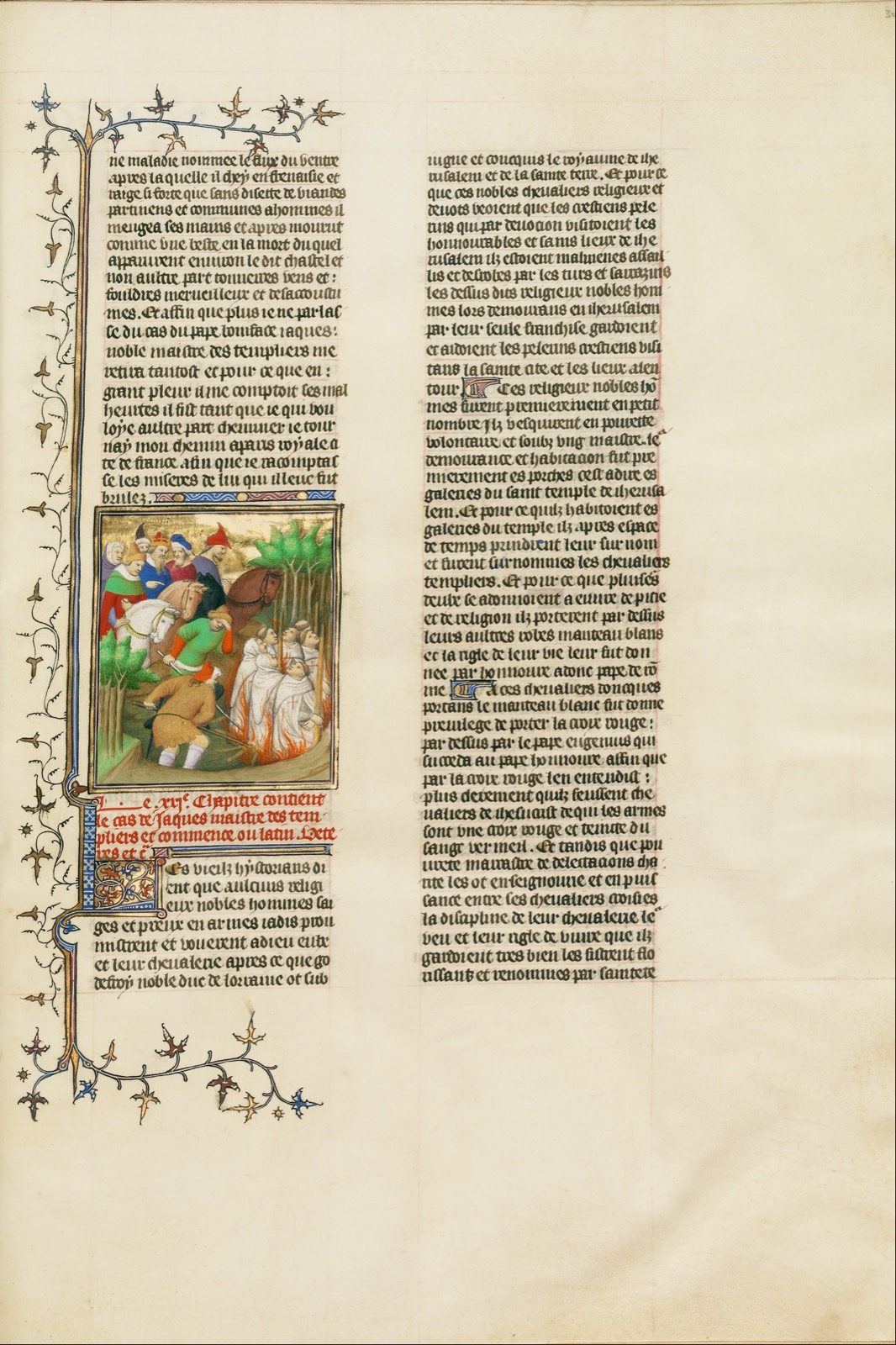
_-_The_Knights_Templar_Burned_in_the_Presence_of_Philip_the_Fair_and_His_Courtiers_-_Google_Art_Project.jpg)
Nine Knights, a Shared Horse, and a Vow the Rule Contradicts
Around 1119, a French knight named Hugues de Payens and a small band of companions founded a military order in Jerusalem, calling it the Poor Fellow-Soldiers of Christ and of the Temple of Solomon, later shortened to Knights Templar, with the stated mission of protecting Christian pilgrims traveling the dangerous roads to the Holy Land. The order remained obscure enough for its first decade that its most-repeated founding detail, that it began with exactly nine knights, actually comes from the chronicler William of Tyre describing its membership at the Council of Troyes in January 1129, ten years after the founding, not the original nine of 1119. William was writing generations after the events he described, and no contemporary 1119 document lists the order's initial membership at all. A different medieval military order left its own disputed trace, not on parchment but carved into stone: runic graffiti left by Varangian Guardsmen on a Hagia Sophia parapet is still read two different ways by the Scandinavian specialists who have studied it.
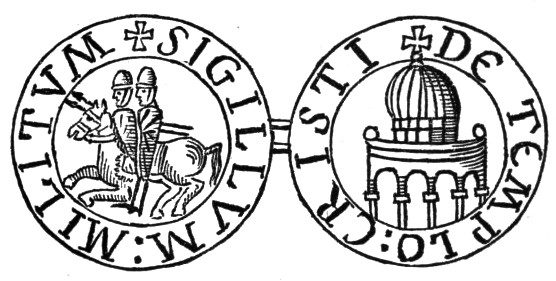
The order's best-known symbol, a wax seal showing two knights mounted on a single horse, is popularly explained as a literal reference to Templar poverty, the idea being that the order was too poor in its early years to afford one horse per man. The problem with that reading is that the Rule of the Order, drawn up under Bernard of Clairvaux's guidance and formally adopted at the same 1129 council, explicitly entitled each knight to three horses and a squire, the opposite of poverty. Historians who have studied the seal's likely 1158 origin, decades after the order's founding and well after the Rule had already been written, tend to read it instead as a symbolic statement about the knights' vowed identity as brothers-in-arms rather than a literal record of the order's finances at any point in its history.

From Guarding Pilgrims to Running Europe's First International Bank
The order that started as a handful of knights grew, by its peak in the mid-13th century, into a force of between 15,000 and 20,000 members spread across Europe and the Crusader states, though only around a tenth of that total were knights proper; the rest were sergeants, chaplains, and the laborers and administrators who ran the order's estates and finances. That administrative apparatus produced the Templars' least military legacy: starting around 1150, a pilgrim or noble could deposit funds at a Templar stronghold in Europe, most famously the order's complexes in Paris and London, and withdraw an equivalent amount at a Templar house near Jerusalem using a written letter of credit instead of carrying gold across bandit- and pirate-infested routes. Clients eventually included crusading monarchs such as Henry II of England and Philip II of France, and the network of receipts, deposits, and cross-location withdrawals is widely cited by financial historians, including in an NPR Planet Money episode built specifically around the claim, as a working precursor to the modern bank draft and letter of credit. The crusades themselves were not always coherent affairs: the Second Crusade attacked an ally at Damascus, and a feud ended the siege.
That financial reach cut two ways. It made the order genuinely useful to the European monarchs who used it as a safe-deposit system and occasional lender, but it also made the order, and specifically its Paris headquarters, holder of debts owed by kings, King Philip IV of France prominent among them, a dynamic that becomes hard to ignore once the story reaches October 1307.
Friday the 13th: An Arrest Warrant That Says "God Is Not Pleased"
At dawn on Friday, October 13, 1307, royal officers in Paris arrested Jacques de Molay, the order's Grand Master, along with roughly sixty of his knights, part of a coordinated sweep that took hundreds more Templars into custody across France that same morning, all acting on sealed orders King Philip IV's administration had prepared and distributed weeks in advance. The arrest warrant itself survives, and its opening line reads, in the original French, "Dieu n'est pas content, nous avons des ennemis de la foi dans le Royaume," "God is not pleased. We have enemies of the faith in the kingdom," the framing under which the charges of heresy, idolatry, and other offenses were formally brought.
Once in royal custody, most of the arrested Templars were subjected to torture, and the overwhelming majority confessed to the charges put to them, including heresy, spitting on the cross, and other offenses now generally treated by historians as fabricated or wildly exaggerated. Philip pressed Pope Clement V to extend the crackdown across all of Christian Europe, and on November 22, 1307, Clement issued the bull Pastoralis praeeminentiae, instructing every Christian monarch to arrest the Templars in their own territories and seize their assets, spreading a process that had started as a French royal action into a continent-wide one carried out under papal authority.
The Parchment Barbara Frale Found by Accident
For nearly seven centuries, the story available to historians ended there: arrests, coerced confessions, a 1312 dissolution, and a 1314 execution, with no surviving record of what happened when Pope Clement V's investigators actually questioned the order's leadership, apart from Philip's version of events. That changed in September 2001, when Barbara Frale, then a researcher working through uncatalogued material in the Vatican Secret Archives, came across a 58-by-70-centimeter parchment that had been misfiled in the wrong archival collection since 1628 and had gone unread by scholars for the roughly 373 years since. "I thought I was dreaming," Frale later told a reporter, adding that it took her six months to fully accept that what she had found was real.
The document, now known as the Chinon Parchment, is dated August 17-20, 1308, and records the secret proceedings held at the Château de Chinon in France's Loire Valley, where three cardinals acting as Clement's personal representatives interrogated de Molay and the order's other senior leaders directly, separately from the French royal inquisition Philip controlled. According to the parchment's own text, after hearing the leaders recant confessions extracted under torture, the papal commission granted them absolution and formally readmitted them to the sacraments of the Church, a papal intervention with real practical consequences, not unlike the line a different pope helped broker nearly two centuries later to divide an unexplored world between two rival crowns. That absolution took place a full four years before Clement dissolved the Templars anyway.
Absolved, Not Exonerated, and Disbanded All the Same
The Chinon Parchment is often summarized in popular retellings as proof the Templars were "innocent," but the document itself does not go that far. What the parchment records is that Clement's investigators absolved the Templar leadership specifically of the heresy charge, the most serious accusation against them, while still noting lesser irregularities in the order's internal practices; historians of the document draw a careful distinction between absolution, a religious act clearing someone of sin, and exoneration, a formal finding of innocence on the underlying charge. Clement's own subsequent actions reflect that distinction: rather than publicizing the Chinon findings, he kept them out of the official trial record and, in 1312, under continued pressure from Philip and without ever formally convicting the order of heresy, dissolved the Knights Templar at the Council of Vienne regardless.
Jacques de Molay spent nearly six more years in custody after his private absolution at Chinon before being burned at the stake in Paris on March 18, 1314, still formally unconvicted of the charge that had triggered his arrest. A popular legend, first recorded generations after the fact and by no eyewitness, holds that de Molay cursed both Clement and Philip from the flames, summoning them to face divine judgment within the year; Clement did die the following month and Philip died that same year in a hunting accident, a chronological coincidence that has kept the legend alive precisely because no contemporary document records de Molay actually saying it, the same gap between a documented record and a dramatic line invented well after the fact that runs through another falsely-attributed deathbed scene from this era of executions and trials.
799 Numbered Copies: How a Secret Became a Vatican Publication
The Chinon Parchment's contents did not reach the public until Frale's research was formally announced in 2007, when the Vatican Secret Archives published a limited facsimile edition titled Processus Contra Templarios, reproducing the parchment alongside the wider trial record in a two-volume set with text in Latin, Italian, and English, bound in vellum and goatskin and printed in exactly 799 numbered copies. Even after nearly seven hundred years, in other words, the Vatican's release of the document that reopened the case was itself a deliberately scarce object, sold through a small commission rather than published as an open scholarly edition, a reminder that access to the record of a medieval military order founded to guard pilgrims on the same roads once traveled by a crusading king who spent barely six months of his ten-year reign in the country he actually ruled has never been entirely straightforward, even once the document survives.