Six Thousand Warriors for an Emperor's Sister
In 988, Byzantine emperor Basil II was in trouble. A rebel general, Bardas Phokas, controlled most of Asia Minor and had already been acclaimed emperor by his own troops, and Basil's existing forces had failed to stop him. Basil turned to Vladimir I of Kiev, invoking a military-assistance treaty his father had struck after the 971 siege of Dorostolon, and asked for troops. Vladimir sent 6,000 Rus warriors, and in exchange received Basil's sister Anna in marriage, along with Vladimir's own baptism into Christianity, a condition Byzantine sources treat as the price of marrying into the imperial family. The following year, in 989, those same Rus troops landed at Chrysopolis under Basil's personal command and helped break Phokas's rebellion, and the emperor kept the arrangement going afterward: a standing bodyguard drawn from men with no family, faction, or property inside the empire to defend.
That was the point. Byzantine court politics ran on factional loyalty, and a native Byzantine guard unit was a native Byzantine guard unit first, loyal to whichever general or eunuch chamberlain had promoted it, before it was loyal to whoever currently sat on the throne. Norse and Rus recruits had no local relatives to protect, no local faction to favor, and no realistic path to the throne themselves, which made them, in the eyes of a dynasty that had just watched a general try to seize power by force, close to the safest bodyguard available. Byzantium had already spent three centuries defending its coastline with Greek fire, a naval weapon aimed at enemies outside the empire; an all-foreign palace guard was the answer to a threat no incendiary weapon could touch, the empire's generals.
From Kievan Rus to Anglo-Saxon England
The guard's ethnic makeup did not stay fixed at Norse and Rus. After William of Normandy's victory at the Battle of Hastings in 1066, a wave of Anglo-Saxon nobles and soldiers left England rather than live under Norman rule, and Byzantine sources from the late 11th and early 12th centuries begin referring to English Varangians specifically, distinct from the earlier Scandinavian recruits. The scale of that migration is not just a literary impression: lead seals belonging to Byzantium's chief financial ministry have turned up along the banks of the Thames, physical evidence that the empire was actively paying to recruit in England rather than simply absorbing refugees who happened to arrive. By the reign of Alexios I Komnenos, later in the 11th century, the influx of English recruits was large enough that Byzantine and Western sources alike describe English as a working language inside the unit, alongside Norse. For the battles in England before that migration, the comparison of Viking defeats covers Stamford Bridge alongside earlier conflicts.
That kept the guard's original logic intact even as its recruiting pool shifted. An Anglo-Saxon exile, like a Norse mercenary before him, had no stake in Byzantine court factions and nowhere else to go, which made him just as reliable a bodyguard by the standard that mattered. The unit's identity outlasted its original recruiting base by a wide margin: individual soldiers in Constantinople were still identifying themselves as Varangians as late as the early 1400s, and chroniclers describe guardsmen among the defenders when Orban's cannon finally broke walls the city had held for over a thousand years in 1453, even though the unit's original Norse and Anglo-Saxon core had long since been absorbed into the city's Greek-speaking population.
A Guardsman Who Attacked a Woman in Thrace, and Paid for It
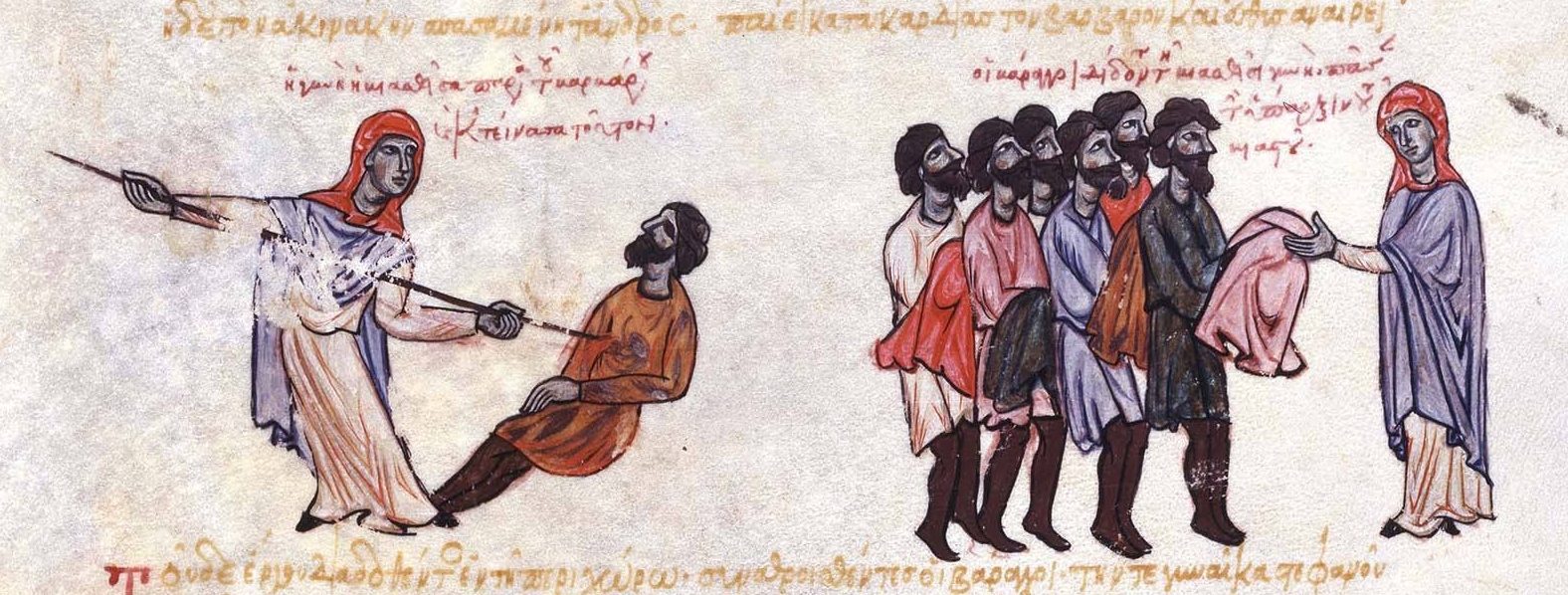
One incident, recorded in John Skylitzes's chronicle and illustrated in the 12th-century Madrid Skylitzes manuscript, shows how the guard's leadership enforced discipline outside the palace. In 1034, during the reign of Michael IV of Paphlagonia, a Varangian stationed for the winter in the Thracian Theme came across a local woman alone and, in the chronicle's phrasing, translated from the Greek, "was trying to steal her purity." When he tried force rather than persuasion, she pulled his own sword and killed him. When the news reached the other Varangians garrisoned nearby, they did not retaliate against her. According to Skylitzes's account, they awarded her a wreath, surrendered to her all of the dead man's possessions, and then left his body unburied, the customary penalty under Byzantine law for a man who died committing a crime. The manuscript's red-ink caption for the accompanying miniature, again in translation, reads simply: "The Varangians giving the raped woman all of the rapist's belongings."
The episode is preserved because a scribe thought it worth illustrating, not because it was typical of how mercenary garrisons usually policed themselves in the medieval world; foreign troops were, and are, more often remembered for the violence they got away with than the violence their own comrades punished. Whatever the unit's motives (a genuine code of conduct, an emperor's standing orders, or simple public relations toward the population they were stationed among) the story survives specifically because a Byzantine historian recorded a case where a Varangian's own comrades sided against him.
The Two Names Carved in Hagia Sophia's Marble
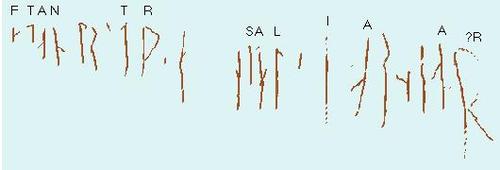
Almost everything known about the Varangian Guard comes from outside sources, Byzantine chroniclers, Norse sagas, and the occasional archaeological find like the Thames seals. What makes Hagia Sophia's runic inscriptions unusual is that, if the attribution holds, they are the guardsmen's handiwork: graffiti carved by the men themselves into the marble parapet of the church's upper gallery, sometime between the 9th and 11th centuries.
The first inscription was found in 1964, on a parapet on the top floor of the southern gallery, and published six years later by Elisabeth Svärdström in the Swedish journal Fornvännen. Centuries of wear have reduced it to a single legible fragment, "-ftan", which Svärdström identified as the tail end of the Norse name Halfdan; the rest of the line is gone, though Svärdström noted it likely followed a common runic formula along the lines of "[name] carved these runes." A second inscription, in a niche in the northern part of the same gallery, has a stranger history. Folke Högberg found it in 1975 and reported it to Stockholm's Department of Runes in 1984, but it went unpublished. Archaeologist Mats G. Larsson rediscovered the same carving independently in 1988 and published his own reading the following year: "ari:k", which he interpreted as a shortened "Ári m(ade these runes)." The reading was considered uncertain enough that the inscription wasn't even registered in the runic periodical Nytt om runer that year.
The dispute did not end there. Högberg's original 1975 reading differed from Larsson's, and in 1997 it found a defender: Svein Indrelid, a professor of archaeology at the University of Bergen, argued the carving instead reads as the personal name Árni, plain graffiti rather than a formal inscription. When Larsson learned of Högberg and Indrelid's interpretation, he stood by his own. No consensus reading exists as of the last published survey of the site, by runologist James E. Knirk in 1999. Indrelid had also copied five more possible runic marks on the same parapet in 1997 and handed them over to the Norwegian Runic Archive, unconfirmed and unpublished, which means the marble in Hagia Sophia's gallery may still hold more Varangian names than anyone has been able to read.