
A Vanguard Command Nobody Wanted, Then Reclaimed
British Gen. Henry Clinton evacuated Philadelphia on June 18, 1778, marching his army overland toward New York after the French entry into the war tipped the strategic balance against a British foothold deep in Pennsylvania. Washington's Continentals shadowed the column, and a leading battlefield-preservation nonprofit's tally puts the forces that would eventually converge near Monmouth Court House at roughly 14,500 Americans against a British total of about 21,000, including Hessian and Loyalist units, though only a portion of each army was directly engaged once the fighting started.
Washington offered command of an advance strike force to the Marquis de Lafayette after Charles Lee, the army's senior major general, initially argued against attacking Clinton's column at all and declined the assignment. Lee then reasserted his seniority and reclaimed the command days before the battle. On the morning of June 28, with brutal midsummer heat already building, Lee's advance force of roughly 5,000 men engaged the British rearguard near Monmouth Court House around 10 a.m., and within a few hours began falling back without any order from Washington to do so. Another Continental general's retreat two years later drew scrutiny for its distance rather than its cause: after the disastrous Battle of Camden in 1780, Horatio Gates fled the field so fast he outran his own army, covering roughly 180 miles in three and a half days, a flight Alexander Hamilton mocked in a letter at the time.
The Confrontation, and What Washington Probably Didn't Say
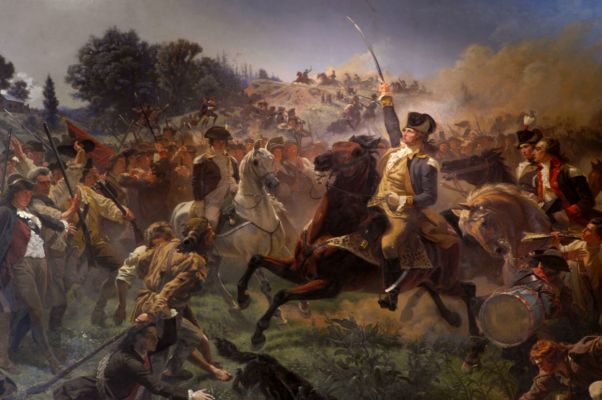
Washington rode forward to find his own advance force retreating in disorder before it had fought any general action, met Lee on the road, and confronted him angrily before riding ahead to reorganize the retreating troops into a defensive line himself. That line held for the rest of the day, buying time for the main army to form up behind it, and the fighting continued until nightfall in what multiple accounts of the battle, including Warfare History Network's, describe as the longest single-day battle of the entire Revolutionary War.
The popular version of that roadside confrontation, Washington calling Lee a "damned poltroon" and cursing "till the leaves shook on the tree," comes from postwar recollections attributed to Gen. Charles Scott and the Marquis de Lafayette. A 2022 scholarly study examined those accounts against court-martial testimony taken from officers who were actually present, given within weeks of the battle, and found that neither Scott nor Lafayette was positioned to have heard the exchange firsthand; the contemporary testimony describes an angry rebuke but records no profanity, and historians have never reached consensus on Washington's actual words.
An Army That Couldn't Agree on Its Own Dead
Both armies fought the day's second half in wool uniforms, British infantrymen carrying packs of roughly 80 pounds, under a sun contemporaries described as merciless even before the fighting began. Wikipedia's account of the battle notes (checked 12 October 2026) that during the British approach march alone, a third of the German auxiliary troops in Clinton's column were overcome by heat and left by the roadside, and roughly 256 of them later deserted rather than continue. Martin's memoir recorded men on both sides collapsing well before any exchange of fire reached them.
The two surviving British casualty returns for the battle itself agree closely on everything except the heat toll. Clinton's official report to London and a separate regimental return preserved in Kemble's journal both give the same 65 killed, 170 wounded, and 64 missing, but Clinton adds 59 fatigue deaths as a distinct fourth category, bringing his reported total to 358, while the Kemble-derived return instead folds a lower figure, 56, into the existing wounded and missing tallies as a footnote, leaving its own total at 299. Whichever count is used, heat killed nearly as many of Clinton's men that day, 56 to 59, as combat did, 65, a toll the general's own paperwork couldn't fully reconcile with itself. Washington's casualty report, by contrast, breaks its 69 dead and 161 wounded down by rank and unit with no heat category at all. Armed confrontations among Americans didn't end with the Revolution, either: roughly 60 armed WWII veterans besieged a Tennessee jail in 1946 over a contested county election, and, remarkably, no one died in two days of actual fighting despite a wire report the next day claiming otherwise.
The Court-Martial That Struck One Word
Lee faced three charges: disobeying orders by not attacking the British column as instructed, misbehaving before the enemy through an unnecessary and disorderly retreat, and disrespecting the commander-in-chief in two letters he sent Washington after the battle demanding satisfaction for his treatment. The trial ran from July 4 to August 12, 1778, in New Brunswick, New Jersey, under Lord Stirling's presidency, and drew testimony from 39 witnesses. The court found Lee guilty on all three counts, but it struck the word "shameful" from the second charge's description of his retreat, softening the language even as it upheld the underlying finding.
The sentence, suspension from the army for twelve months, reached Congress that December, where delegates confirmed it by a 13-to-7 vote on December 5, 1778. Lee spent his suspension writing letters attacking Washington and the congressmen who had supported the verdict, and Congress formally dismissed him from the army altogether on January 10, 1780. He died of a fever in Philadelphia in 1782, never reinstated. Patriot officers could turn just as harshly on prisoners of their own side's making: six days after Kings Mountain, a different court-martial condemned three dozen Loyalist captives to hang, a sentence carried out on nine of them before it was halted.
The Water-Carrier Who Outlived the Record
Monmouth's best-known figure has the thinnest documentation of all. Martin's 1830 memoir, published 52 years after the battle, describes an unnamed woman who carried water to artillerymen and, after her husband collapsed at his gun, took over swabbing and loading the cannon herself, a story Martin recounts almost as camp folklore rather than eyewitness certainty, complete with a cannonball supposedly passing between her legs without harming her. The name "Molly Pitcher" attached to that story wasn't printed until 1837, nearly six decades after the battle it supposedly describes.
Mary Ludwig Hays McCauley is the woman most often identified as the source of the legend, but the paperwork from that era stays silent on the details that made her famous. The Pennsylvania legislature granted her a pension in 1822, eight years before Martin's memoir was even published, and the wording of that act credits her only with unspecified "services during the revolutionary war," not water-carrying or artillery work. Her 1832 obituary in The American Volunteer likewise praised her as "an efficient aid ... to the sick and wounded" without mentioning either detail. The Revolutionary War's opening battle produced its own retroactively invented line, Paul Revere never actually shouted "the British are coming," a phrase traced to an 1860 poem written 85 years after the fact; Monmouth's most famous figure got her name into print sooner than that, but the 59-year gap is still most of a lifetime removed from the events it describes.