
A Fee System That Made Arrests Profitable
Paul Cantrell won the McMinn County sheriff's race in 1936 as part of the Crump political machine's reach into East Tennessee, was re-elected in 1938 and 1940, then moved up to the state senate in 1942 and 1944 while his former deputy, Pat Mansfield, took over as sheriff. The office ran on a fee system: the sheriff and his deputies were paid for every person they arrested, booked, and released, which turned traffic stops into a revenue line. Buses passing through the county were routinely pulled over and their passengers ticketed for drunkenness whether or not they had been drinking. Between 1936 and 1946 those fees added up to almost $300,000, worth roughly $3.7 million in 2024 dollars, and the U.S. Department of Justice investigated election-fraud complaints from the county in 1940, 1942, and 1944 without ever resolving any of them.
With most of the county's young men off fighting the war, the sheriff's office increasingly staffed itself with ex-convicts as deputies. By 1946, McMinn County had roughly 3,000 returning veterans, close to a tenth of its entire population, and deputies made a habit of shaking down newly discharged GIs for their mustering-out pay on trumped-up drunkenness charges. A group of veterans, organized as the GI Non-Partisan League, put up their own slate for the August 1946 election, deliberately balanced with three Republicans and two Democrats to match the county's political makeup. Running against Cantrell for sheriff was Knox Henry, a decorated 33-year-old veteran of the North Africa campaign.
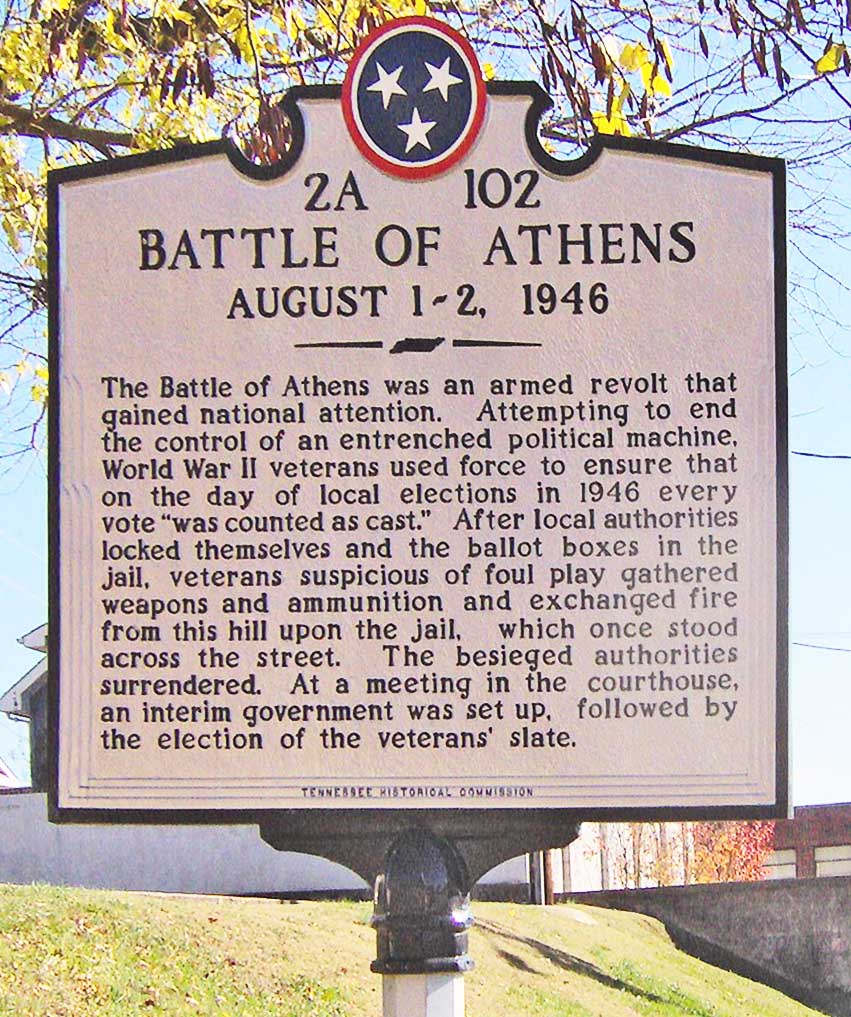
The Vote Tom Gillespie Never Got to Cast
Sheriff Mansfield brought in more than 200 armed deputies for election day, most from neighboring counties and some from out of state, paid $50 apiece, against the roughly 15 patrolmen who normally worked the county's precincts. Around 3 p.m. at the Athens Water Works polling place, a patrolman named C.M. "Windy" Wise stopped Tom Gillespie, an elderly Black farmer, from casting his ballot. When Gillespie and a GI poll watcher objected, Wise struck Gillespie with brass knuckles, and as Gillespie dropped his ballot and ran, Wise drew his pistol and shot him in the back. Gillespie survived. Wise turned out to be the only person from the entire two-day fight ever criminally charged: he was sentenced to three years in the Tennessee State Penitentiary, served about one before being paroled, and never returned to Athens.
The same afternoon at the twelfth precinct, a Mansfield-aligned election official named Minus Wilburn struck GI poll watcher Bob Hairrell with a blackjack and kicked him in the face during a dispute over an underage voter, sending Hairrell to the hospital. By evening, deputies had carried three contested ballot boxes into the county jail, where Cantrell, Mansfield, and roughly 50 more deputies gathered. That night, GI organizer Bill White sent a handful of men to break into the National Guard Armory; they came out with 70 rifles and two Thompson submachine guns, which White distributed, a rifle and a bandoleer of ammunition each, to about 60 men.
Dynamite, an Ambulance, and a Report the Times Got Wrong
The GIs split into two positions, one on the second floor of a bank across from the jail and another at the post office, and by around 9 p.m. gunfire had broken out after the deputies refused to hand over the ballot boxes. Homemade Molotov cocktails couldn't be thrown far enough to reach the jail, so the GIs turned to dynamite, taping sticks together and hurling them at parked cruisers outside; the first blast flipped a car onto its roof. To do more damage, White crawled close enough to place a charge directly against the jail's porch. At some point an ambulance pulled up outside, and the GIs held their fire assuming it had come for the wounded; instead, two men jumped in and it sped off carrying Cantrell and Mansfield to safety. The remaining deputies surrendered around 3:30 a.m.
The next day, The New York Times reported that the night had been "bloody" and that a sheriff had been killed, sourcing the account to Athens Post-Athenian publisher Lowell Arterburn. No one died in the fighting itself. Roughly 20 to 30 people were wounded, and unconfirmed rumors that three men trapped in the jail had been killed were denied by GI leaders. Fort Sumter is the more famous instance of a battle that killed no one during the fighting itself, with the Civil War's first two deaths not coming until two days later, during the Union garrison's own farewell salute to its flag. Athens ran the opposite direction: a wire service told readers someone had died in a fight that, in fact, killed no one at all.
2,175 to 1,270, and a Machine That Grew Back
When the recovered ballots were finally counted, Henry beat Cantrell 2,175 votes to 1,270, and the rest of the GI slate won by similar margins. The new administration replaced the fee system, capped official salaries at $5,000, raided gambling operations tied to the old machine, and pushed out the deputies who had run it. White himself was made a sheriff's deputy specifically to police the GIs who had just put him in power; by his own account he broke up sixteen fights in one weekend keeping veterans from shooting up the homes of former Cantrell supporters. In September, Athens's mayor and all four aldermen resigned after a shotgun blast through an alderman's front window, a resignation the McMinn County VFW and American Legion posts had already been demanding.
The reform did not hold. By January 4, 1947, four of the GI Non-Partisan League's five original leaders signed an open letter admitting: "We abolished one machine only to replace it with another and more powerful one in the making." The League's momentum faded within a year, and county politics returned to its old patterns. Press coverage of the episode faded fast too, after an Associated Press executive told a veterans' conference the wire service would try to stop pairing the word "veteran" with crime coverage. Audie Murphy's Medal of Honor citation carries a comparable mismatch on a single number: it credits him with roughly 50 casualties at Holtzwihr, yet the 240 figure that actually covers his entire war keeps getting cited as if it described that one hour.