.jpg)
The Field Went to William
Ask who won the Battle of Hastings and the answer is William, Duke of Normandy. Fighting began around nine on the morning of Saturday 14 October 1066 and ran until dusk. By the end King Harold Godwinson was dead, and so were his brothers Gyrth and Leofwine. No reliable casualty figures survive. One modern guess is about 2,000 Normans and 4,000 Englishmen, and Orderic Vitalis's ratio of roughly one casualty in four may be close even though his raw figures are inflated (Wikipedia, "Battle of Hastings").
William expected the surviving English leaders to submit. They proclaimed Edgar Ætheling king, with Earls Edwin and Morcar and the archbishops Stigand and Ealdred behind him. William had to march round the Kent coast, beat a force at Southwark, fail to storm London Bridge, and swing west to Wallingford, where Stigand finally submitted. The English leaders gave in at Berkhamsted, and William was crowned in Westminster Abbey on 25 December 1066.
The crown did not end the fighting either. Exeter, where Harold's mother Gytha had taken refuge, stood a siege of eighteen days in early 1068 before it surrendered on generous terms, a short affair next to the 172 days Kenilworth Castle held out in 1266. The last organised rebels, in the fens around Ely, were only overcome in 1071 after the Normans built a pontoon to reach the island (Wikipedia, "Siege of Exeter (1068)" and "Norman Conquest"). Taking the whole country cost William about five years.
Was Harold's Army Too Tired to Win?
The standard explanation for the result is exhaustion. Harold dismissed his southern militia on 8 September, hurried north, crushed Harald Hardrada's Norwegians at Stamford Bridge on 25 September, and then had to cover more than 250 miles to reach Hastings by 14 October. The conquest historian Allen Brown blamed "reckless and impulsive haste" for a defeat that followed a mad dash south.
In March 2026 Tom Licence of the University of East Anglia published an argument that this march never happened as described. He went back to the Latin and Old English texts and found Harold hurrying south and moving his army south, but no actual march. The Anglo-Saxon Chronicle's remark that the fleet came home, he says, means it returned to London, as an entry for 1052 uses the same wording. That points to a fleet Harold never disbanded, and since a fleet was on the River Wharfe when he advanced on the Vikings, Licence reads the campaign as one fought partly by ship, with far less walking. He adds that a translation of a Norman account written around 1071 turned a Latin phrase meaning "returning speedily" into "forced marches" (Licence, The Conversation).
This is one historian's reading and no published rebuttal has turned up yet. Standard accounts still describe a march of about a week at roughly 27 miles a day, with Harold's northern reinforcements under Edwin and Morcar left behind. But if Licence is right, the tired-army explanation loses its main support, and the cause of defeat has to be found on the ridge itself.
The Retreat That May Have Been Planned
On the ridge, the opening hours went badly for William. His archers shot uphill with little effect, the spearmen could not open the English shield wall, and the cavalry made no headway either. A retreat began, blamed on the Bretons on William's left, and a rumour spread that the duke was dead. Some of the English chased the fleeing Normans downhill. William then rode along his line showing his face to prove he lived, turned on the pursuers, and overwhelmed the party that rallied on a hillock.
William of Poitiers says the Normans later used feigned flight twice on purpose. Some historians argue the story was invented afterward to excuse a real panic, but most accept the tactic, in part because the earlier genuine flight was not glossed over in the sources. The likely effect was modest. The feints did not break the line, but they probably thinned out the housecarls, who were replaced by fyrd levies while the wall held (Wikipedia, "Battle of Hastings").
The sources record no single manoeuvre that broke the English. What came next is not in dispute. Harold fell late in the day, his troops lost their leader, and the collapse followed. The one uncomfortable question is how the king died.
How Harold Died Depends on the Source
The schoolroom answer is an arrow in the eye, and it is missing from the earliest accounts. The Carmen de Hastingae Proelio, a Latin poem that some scholars date to early 1067, has William and three companions killing Harold. One drives a lance through his shield and chest, one cuts off his head below the helm, one pierces his belly, and one severs his thigh. William of Jumièges puts his death in the first assault. William of Poitiers, the duke's chaplain, gives a detailed account of the battle yet never says how Harold died, only that the body could be recognised by certain signs, since the face was no help (Medievalists.net, 2022).
The arrow enters the written record in the 1080s with Amatus of Montecassino. William of Malmesbury later has an arrow going into the brain while a knight wounds the king's thigh. The Battle Abbey chronicle says no one could tell who struck the blow. Wikipedia treats the Carmen's claim that William himself killed Harold as unlikely, since a feat like that would have been recorded elsewhere. Modern biographers split. Ian Walker thinks an arrow probably did strike Harold in the eye, and Peter Rex concludes nobody can say (Wikipedia, "Battle of Hastings").
Tallied by date, the Carmen (about 1067) has knights, Jumièges (late 1060s) has the first assault, Poitiers (1070s) is silent, and Amatus (1080s) is the earliest known source to give the arrow. Paul Bernardi argues in Historia magazine that the Carmen is the likeliest account, because William could not afford to leave Harold alive in the gathering dark and would have needed him visibly dead. It is a reasoned case that stops short of proof, and it depends on trusting a poem written to please the winner, which is the weak point.
The Tapestry's Arrow Postdates the Middle Ages
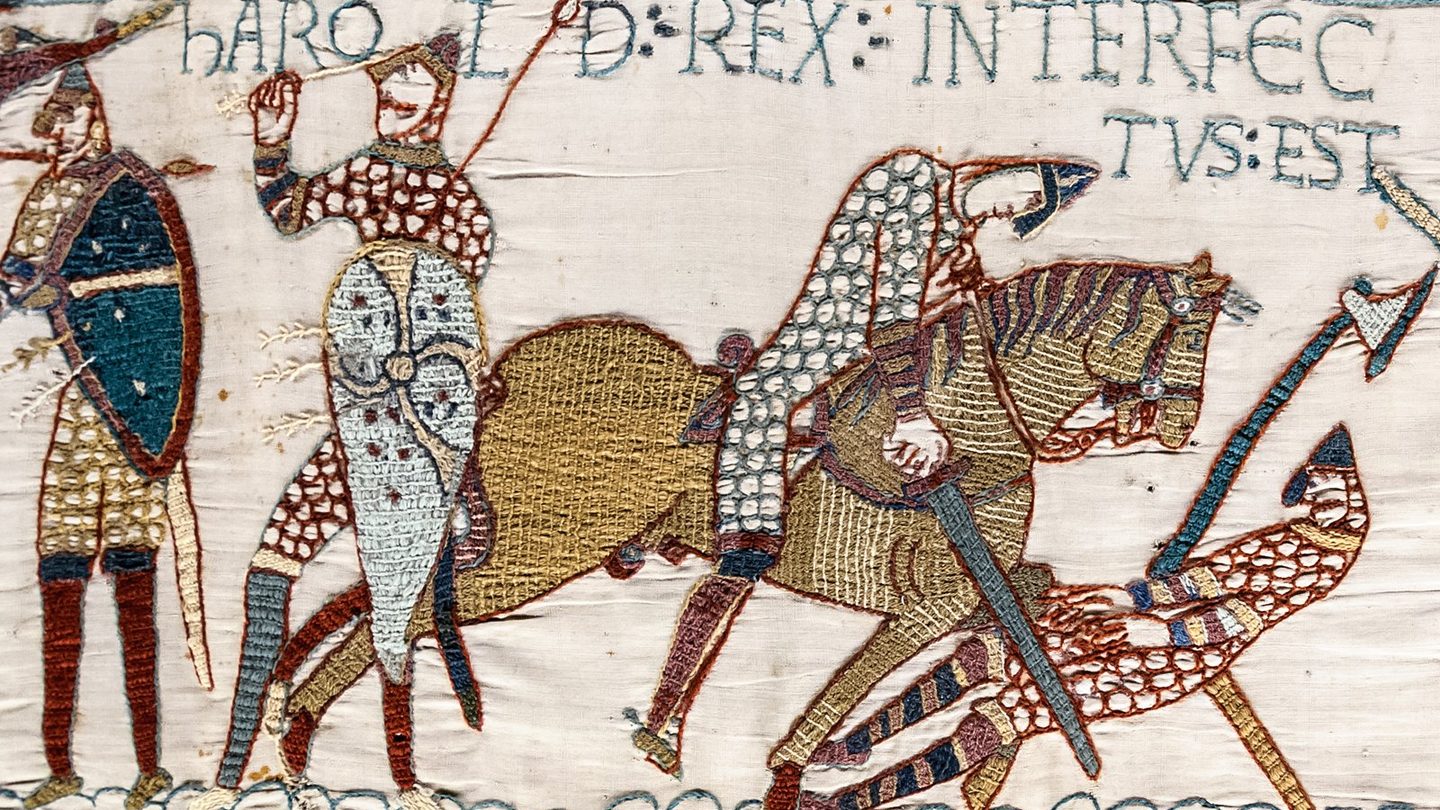
Most people who picture the arrow are picturing scene 57 of the Bayeux Tapestry, where the label reads that King Harold has been killed. The trouble is that the figure holding an arrow at his face is largely modern. N. P. Brooks and H. E. Walker wrote that the scene was restored in 1842 in machine-spun wools, that only the head and shoulders of the arrow figure are original, and that the arrow itself and most of the body are restoration (quoted in Medievalists.net).
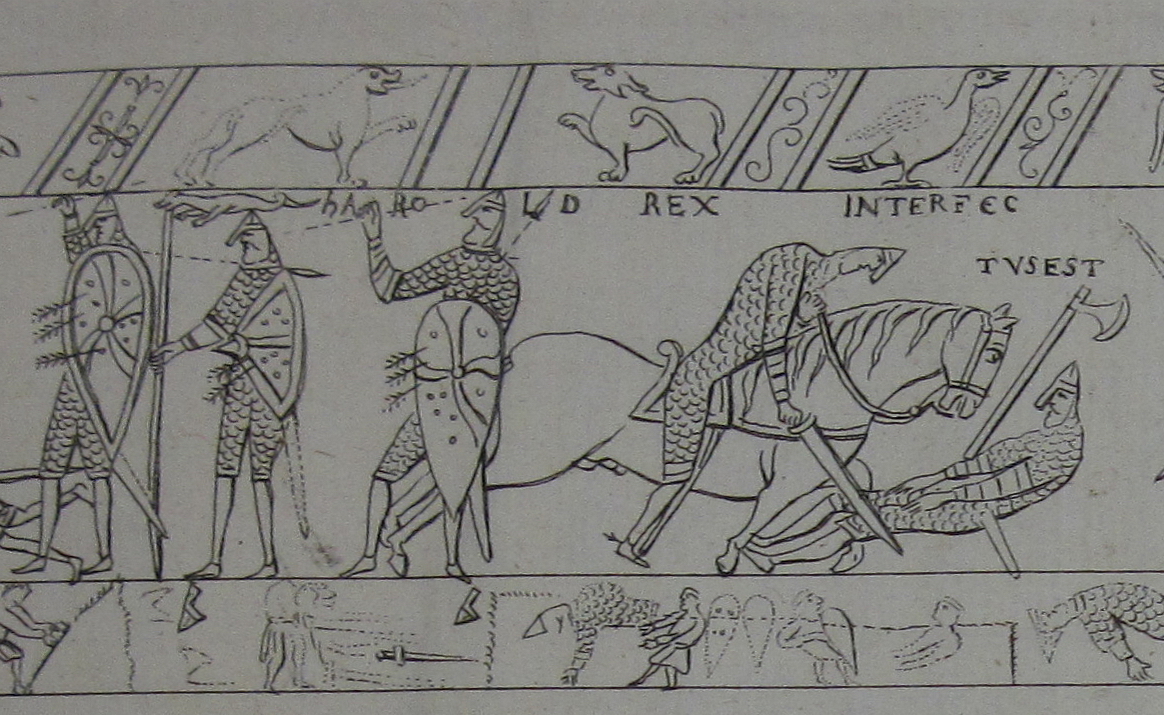
The evidence for that comes from before the restoration. A drawing made for Bernard de Montfaucon around 1729, engraved in 1730, shows the same figure with a raised hand and no arrow in his eye. Medievalists.net reads what he holds as a spear or, at best, a shaft without fletching. The arrow first appears in Charles Stothard's engraving, published between 1819 and 1823. Nobody can now tell whether the arrow was Stothard's own invention or a faithful copy of repairs made between Montfaucon's day and his. Historia's account agrees that modern analysis shows the figure originally held a spear above his head.
The tapestry therefore cannot serve as a witness, though Harold may still have taken an arrow somewhere in the fight. The label may also refer to the fallen man being cut down beside him, and M. K. Lawson has argued that the missing letters once read that Harold was thrown to the ground.

What Happened to Harold's Body
By William of Poitiers's account the duke returned to a field "covered with corpses for a vast distance", with two of Harold's brothers lying beside the king. Harold himself had been stripped of every mark of rank. Nobody agrees where he was buried. Waltham Abbey later claimed him, and the Vita Haroldi, written around 1205, has him surviving the battle and calls the arrow story a malicious attack on the truth (Medievalists.net, 2022).
William founded Battle Abbey on the site, and its high altar was said to mark where Harold died. Other survivors chose exile, and Byzantine sources begin to mention English soldiers in the Varangian Guard within a generation or so.