
A Secret March, Betrayed by Lanterns
General Thomas Gage, the British military governor of Massachusetts, sent roughly 700 to 800 regulars out of Boston on the night of April 18, 1775, under orders to march “with the utmost expedition and secrecy to Concord” and “seize and destroy” colonial military stores gathered there. A persistent local legend holds that the real target was the arrest of patriot leaders John Hancock and Samuel Adams, who were staying near Lexington that night, but Gage's actual written orders, which survive, say nothing about arresting anyone. The idea that the two men were marked for capture appears to have been a fear the Sons of Liberty in Boston held at the time, not a fact reflected in British command orders. New England had seen a colonial legal proceeding ignite a war before: the one-witness trial of John Sassamon's accused killers started King Philip's War.
The secrecy did not last. Paul Revere and William Dawes set out by different routes to warn the countryside, joined partway by Dr. Samuel Prescott. According to Revere's own 1775 deposition, what he and the other riders actually called out was that “the Regulars are coming out”, not the later, more famous phrase “the British are coming.” The distinction mattered at the time: colonists in April 1775 still considered themselves British subjects, so “Regulars” was the clearer way to identify the army marching against them. Revere's ride also ended earlier than popular memory suggests. Around 1:30 a.m., he, Dawes, and Prescott rode into a British patrol on the outskirts of Lincoln. Dawes and Prescott escaped, Prescott by jumping his horse over a stone wall, but Revere was captured, questioned for roughly an hour, and released without his horse. He played no further part in the day's events; it was Prescott who carried the warning on to Concord. Some defensive positions held out far longer than a single night's ride: Kenilworth Castle's water defenses withstood a siege for 172 days in 1266, the longest in medieval English history, and no attacking force ever broke through them by force.
Lexington Green: An Unclaimed Shot
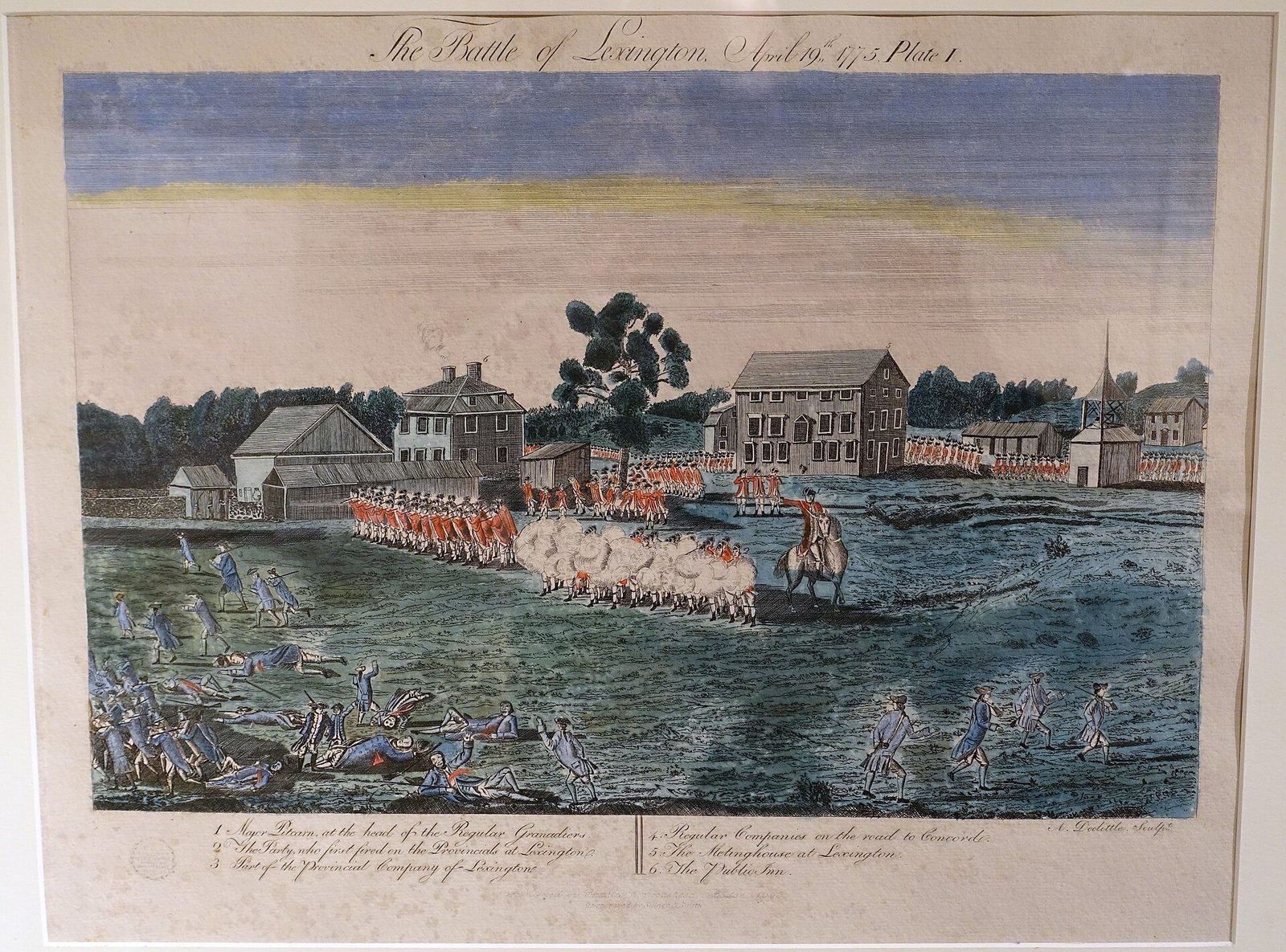
Around 5:00 a.m., the British advance column under Major John Pitcairn reached Lexington and found about 70 to 77 militiamen under Captain John Parker drawn up on the town green. Parker, badly outnumbered, ordered his men to disperse. In the confusion of men breaking ranks amid mounted British officers shouting at them, a shot rang out from an undetermined source. Both sides blamed the other then and have ever since: British accounts describe a shot from behind a wall or from the militia ranks, while colonial accounts describe a shot fired by a British officer or by a nervous regular. No credible historical account, including the National Park Service's own review of the depositions taken within days of the fight, identifies a definite source for the shot. Accountability after a battlefield failure sometimes lands with more certainty than the failure's own cause: unlike Lexington's still-unresolved first shot, the command failures behind a WWII defeat in North Africa were clear enough that Eisenhower fired two officers within the same month after the Battle of Kasserine Pass.
Whatever its origin, the single shot triggered a ragged British volley and then a bayonet charge into the dispersing militia. Eight colonists were killed and about ten wounded; the British suffered no fatalities and only one reported injury. The action at Lexington was over in minutes, and the British column re-formed and continued its march to Concord, six miles away, unaware that the morning's real fighting was still ahead of them.

The North Bridge and the “Shot Heard Round the World”
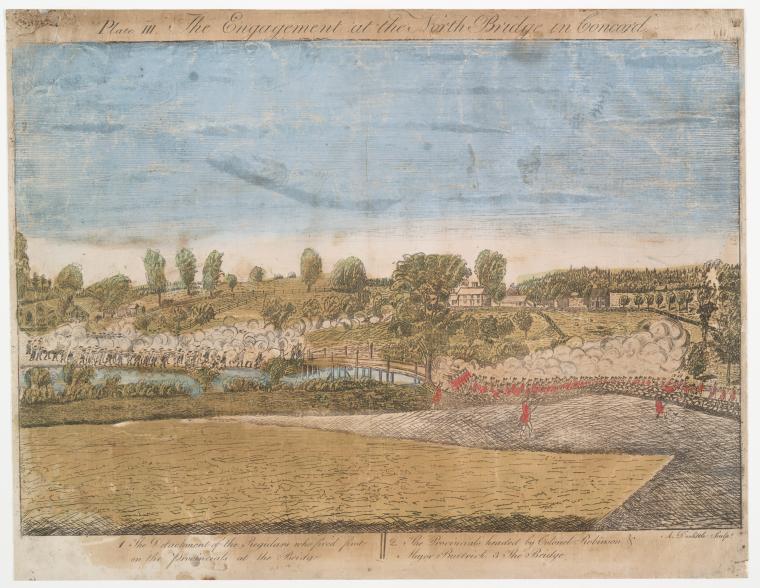
By the time the British reached Concord around 8:00 a.m., word of the Lexington shooting had spread and armed militia companies from Concord and surrounding towns, roughly 400 men by mid-morning, had gathered on a ridge overlooking the North Bridge, across the Concord River from a detachment of about 100 regulars. When the militia saw smoke rising from the town center (British soldiers were burning gun carriages, not buildings, but it looked from a distance like the town itself was on fire), Major John Buttrick led the militia companies down toward the bridge to intervene.
As the militia advanced in close column, British soldiers on the far side fired first, killing Acton company captain Isaac Davis and private Abner Hosmer instantly. Buttrick's response, recorded by multiple witnesses in something close to the same words, was immediate: “Fire, for God's sake, fire!” The militia volley that followed killed three regulars and wounded nine others, and the outnumbered British detachment broke and retreated toward the town center. That exchange at the North Bridge, not the earlier, unresolved shot at Lexington, is the volley Ralph Waldo Emerson would later immortalize as the “shot heard round the world,” because it was the first time colonial militia fired on British troops in an organized, deliberate volley rather than a chaotic skirmish.
The Battle Road: A Sixteen-Mile Gauntlet
Having failed to find most of the military stores (colonial militia had moved or hidden the bulk of it in the preceding days), Lieutenant Colonel Francis Smith's column began its return march to Boston around noon. What followed was not a single battle but a running, sixteen-mile ambush along what is now called Battle Road. Thousands of militiamen from dozens of Massachusetts towns had converged on the route, and they fired on the British column from behind stone walls, trees, and houses the entire way back. The British were saved from complete disaster only by a relief brigade of roughly 1,000 men under Brigadier General Hugh Percy, which met the retreating column at Lexington in the early afternoon with artillery that briefly scattered the militia.
By the time the last British soldiers reached the safety of Charlestown that evening, the day's fighting had cost the British 273 casualties, 73 killed, 174 wounded, and 26 missing, against 95 colonial casualties: 49 killed, 41 wounded, and 5 missing, figures drawn from the National Park Service's tally at Minute Man National Historical Park, which administers the battlefield. Casualty counts for April 19 vary between authorities: the American Battlefield Trust puts the British total at 300 and the colonial total at 93, differing mainly over how many British soldiers went missing. Within days, roughly 20,000 New England militiamen had converged on Boston, beginning the siege that would keep the British army bottled up in the city for the next eleven months. Delayed recognition of a campaign's real objective recurs in American military history too: the U.S. Army didn't formally recognize the Roer River dams as the actual strategic prize of the Battle of Hürtgen Forest until barely a month before it finally moved on them, in its own official history calling them "the neglected objective."
Two Famous Lines That Came Later
Two of the most quoted lines associated with April 19, 1775, were not recorded on the day itself. The first is Captain Parker's supposed order to his militia: “Stand your ground. Don't fire unless fired upon, but if they mean to have a war, let it begin here.” The phrase is carved into the militia monument on Lexington Green today, but its documented source is Parker's grandson, the Boston abolitionist minister Theodore Parker, who first recounted it publicly decades after the battle and later gave a version of it to historian George Bancroft, changing at least one word (“want” to “mean”) between tellings. Paul Revere's own 1775 deposition, a contemporary source, unlike Theodore Parker's later recollection, records Captain Parker's actual order rather differently: to “let the troops pass by, and don't molest them, without they begin first.”
The second is “The British are coming,” attributed to Paul Revere, which does not appear in any contemporary account of his ride and is generally traced to Henry Wadsworth Longfellow's 1860 poem “Paul Revere's Ride,” written 85 years after the event for a different purpose: rallying Northern sentiment on the eve of the Civil War. Likewise, the phrase “shot heard round the world” itself is not something anyone said in 1775, it comes from the opening stanza of Emerson's “Concord Hymn,” written for the 1837 dedication of the Concord battle monument, 62 years after the fighting it describes. Restraint on one battlefield didn't always carry over to the next: four days before Brandywine, Patrick Ferguson declined to shoot a fleeing Continental officer he later learned might have been Washington himself, then led a raid thirteen months later that killed more than forty sleeping soldiers without the same hesitation.