
A Refugee Architect and a City Under Siege
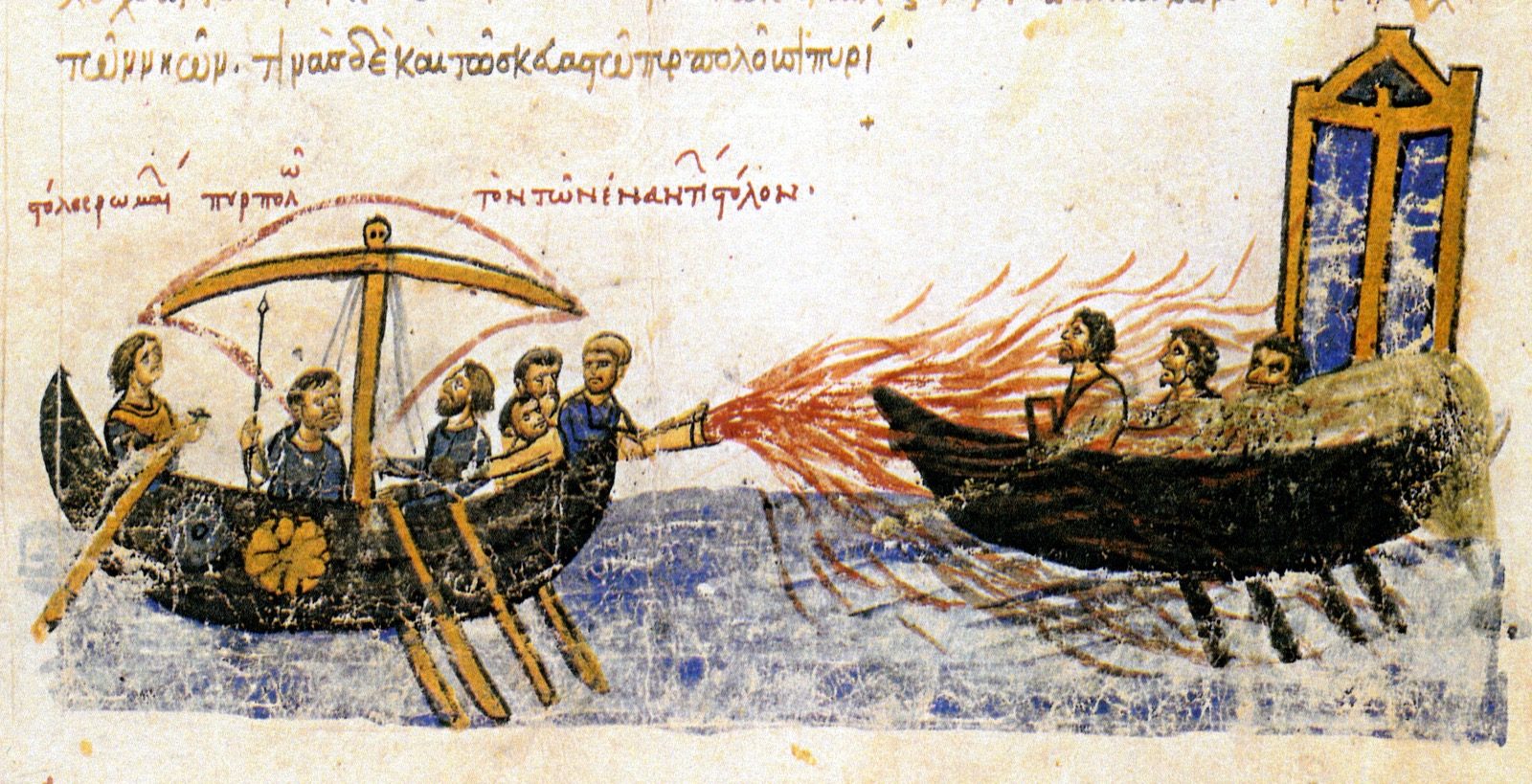
The man credited with the invention was Kallinikos, an architect and engineer from Heliopolis in Syria who fled to Constantinople after the region fell under Arab control. The 8th-century Byzantine chronicler Theophanes the Confessor, writing the earliest surviving account of the episode, put it plainly: "At that time Kallinikos, an artificer from Heliopolis, fled to the Romans. He had devised a sea fire which ignited the Arab ships and burned them with all hands." Sources differ on exactly when the weapon was formally introduced, some place it in 672 CE under Emperor Constantine IV, but the traditional account, drawn mainly from Theophanes' chronicle, holds that it was proven in combat during the empire's most desperate hour: a prolonged Arab siege of Constantinople dated 674 to 678 CE, the first of two major sieges the city would survive within half a century. Byzantine ships equipped with the new weapon broke the Arab naval blockade, and the empire that had just lost most of its territory in the Levant and North Africa to the same enemy suddenly had a weapon no one else possessed. That four-year dating is not settled history; historian Marek Jankowiak's 2013 study in *Travaux et Mémoires* argues Theophanes conflated the real Arab campaign, a shorter one led by Yazid ibn Mu'awiyah with its main assault in spring 668, with unrelated later fighting, and redates the decisive engagement to 667-669 CE.
The timing mattered as much as the technology. Constantinople in the 670s was an empire that had shrunk drastically in a single generation, and a weapon capable of destroying an entire blockading fleet from a defensive position was less a battlefield curiosity than a strategic lifeline. The empire would lean on it again during the second great Arab siege of 717-718 CE, when Byzantine fire ships helped break another attempt to take the city, cementing Greek fire's reputation as the reason Constantinople kept surviving encirclements that, on paper, it had no right to survive.
Bronze Siphons, Pressurized Nozzles, and Fire That Burned on Water
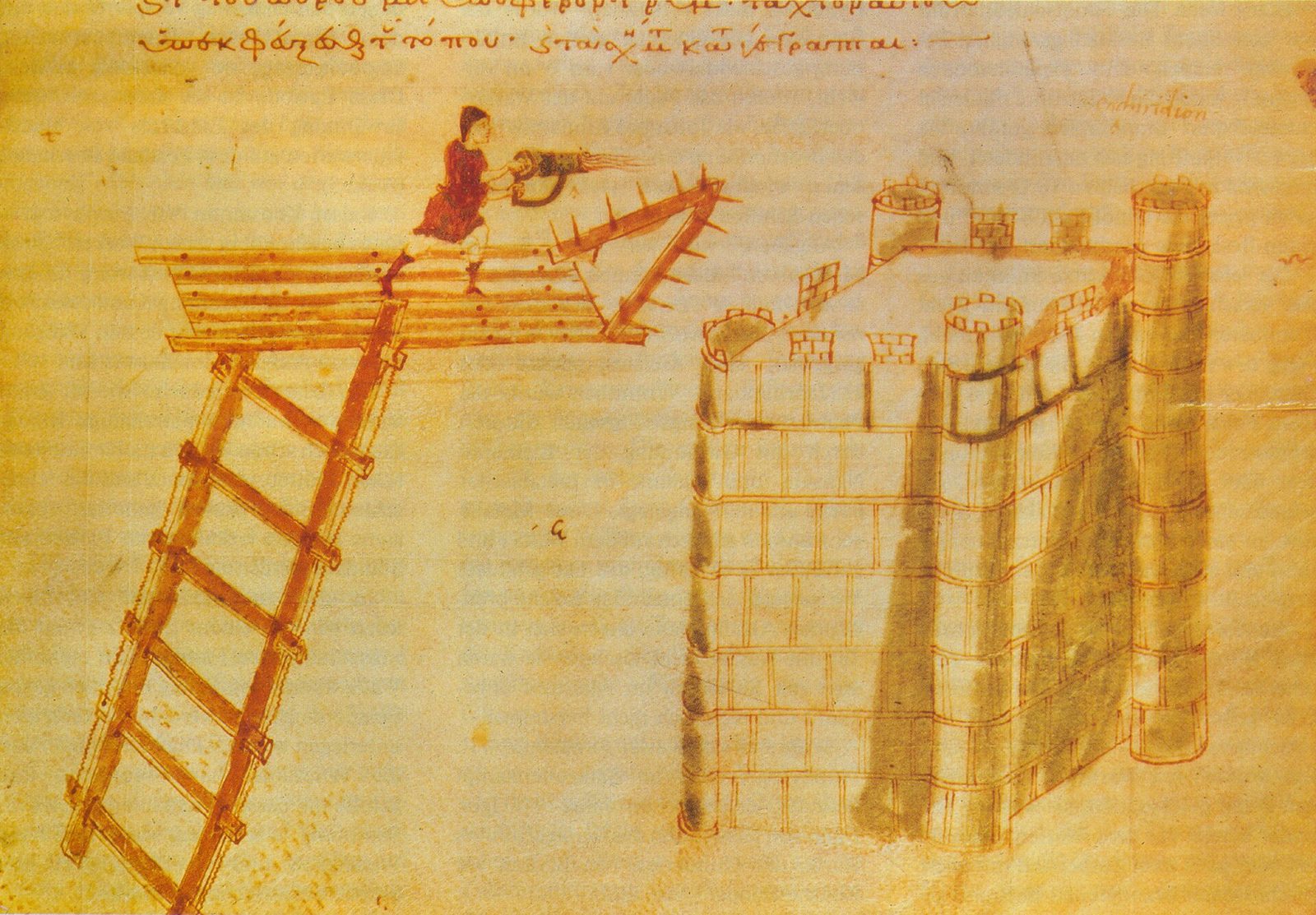
Greek fire's tactical value came from its delivery system as much as its chemistry. The primary method was a bronze tube, or siphon, mounted in the bow of a dromon, the Byzantine navy's standard fast galley, connected below deck to a heated pressure vessel operated by a dedicated crew. Sailors pumped the mixture, heated to increase its flow and ignitability, up through the tube to a swiveling nozzle that let a crewman aim a jet of burning liquid directly at an enemy ship's hull, rigging, or crew. Smaller hand-siphons let infantry deploy it on land or during boarding actions, while clay grenades filled with the same or a similar substance could be thrown by hand or launched by catapult, and unmanned fire ships loaded with the mixture were sent downwind into anchored enemy fleets.
What made the weapon uniquely terrifying, according to the World History Encyclopedia's account, was that it clung to whatever it touched and burned especially well on the surface of water, so that jumping overboard offered little protection and standard firefighting methods failed outright; period accounts describe crews reaching for vinegar or sand, not water, in the rare cases they managed to fight it at all. That combination, a weapon that could be aimed like an early flamethrower and that turned the sea itself into a hazard, not an escape route, is what let a numerically overmatched Byzantine fleet repeatedly break sieges that should have ended the empire.

What the Weapon Actually Did in Battle
The clearest surviving eyewitness description comes from the 941 CE battle in which a Byzantine fleet under Emperor Romanos I intercepted a Rus flotilla under Prince Igor of Kiev advancing on Constantinople. The 10th-century Italian chronicler Liutprand of Cremona, writing decades later from secondhand Byzantine accounts, recorded that "the Greeks began to fling their fire all around; and the Rusii seeing the flames threw themselves in haste from their ships, preferring to be drowned in the water to being burned alive in the fire." It is one of the few contemporary-era descriptions that captures the psychological effect of the weapon as vividly as its physical one: sailors chose drowning over facing it.
Greek fire's combat record extends well beyond that single engagement. Byzantine forces used it to help suppress the major naval rebellion of Thomas the Slav in 821-822 CE, and Byzantine chroniclers credit it with contributing to victories into the later 10th century, including operations under Emperor John I Tzimisces and Basil II. The consistent pattern across these engagements, spanning roughly two and a half centuries from the 670s to the 940s and beyond, is that Greek fire tended to matter most in defensive or naval-interception scenarios, where a smaller Byzantine force could use the weapon's range and psychological shock to offset an enemy's numerical advantage, rather than as a tool of territorial conquest.
Why Capturing It Wasn't Enough
The most telling episode in Greek fire's history may be one of its rare failures for the enemy who obtained it. In 812 CE, Bulgar forces under Khan Krum captured a quantity of the weapon along with Byzantine siphons, first at the fall of Develtos and then again months later at Mesembria, where the Byzantine garrison left 36 bronze siphons behind. Duke University historian Alex Roland, in his 1992 *Technology and Culture* paper "Secrecy, Technology, and War: Greek Fire and the Defense of Byzantium, 678-1204," treats this as the clearest test case for how the weapon's secrecy actually worked: the Bulgars had the physical material and equipment in hand, and were still unable to put it to effective use. Centuries later, a French novelist invented an entirely different explanation for why armored cavalry failed on a battlefield: Victor Hugo's hidden ravine swallowing Napoleon's cuirassiers at Waterloo turns out to be a literary dramatization built on an already-exaggerated local legend, not the actual battlefield record.
Roland's argument, later discussed and summarized in a widely upvoted r/AskHistorians thread, is that Greek fire functioned less like a single secret recipe and more like a medieval trade secret comparable to the closely guarded methods behind Wootz steel or Cremona violin varnish. Knowledge of it passed down within a small circle of practitioners. It included not just an ingredient list but tacit, hands-on skill in operating a dangerous, complex system. Producing and deploying it required pressure vessels able to withstand both heat and pressure, pumps that would not fail under the same stress, and sealing materials that would not degrade in contact with boiling oil and resin, all while a crew worked with a substance that could just as easily engulf their own wooden ship as the enemy's. That operational know-how, not merely the ingredient list, is what Roland argues the Bulgars lacked in 812. It is also what kept the weapon a genuine Byzantine monopoly for centuries even after isolated batches fell into hostile hands. The gap between having the material and knowing what to do with it is a different kind of wartime secrecy than the sort broken by the intercepted and decoded Zimmermann Telegram, where the enemy's failure was cryptographic rather than industrial.
A Formula That Died With the Empire
Exactly what went into Greek fire remains genuinely unresolved. The most thorough scholarly treatment, chemist and historian J.R. Partington's *A History of Greek Fire and Gunpowder* (Johns Hopkins University Press), examined the available chemical possibilities in detail and rejected the idea that it was an early gunpowder weapon, concluding instead that petroleum or naphtha, likely combined with pine resin and possibly sulfur, formed the probable base, with quicklime as a plausible but unconfirmed ignition agent. Modern academic treatments have not moved much beyond that level of informed uncertainty; the Royal Museums Greenwich account describes the same core uncertainty over both the exact mixture and precisely how it was ignited. Physical evidence for ancient weapons only sometimes survives by chance rather than by design: a cube-shaped elephant bone recovered beside Carthaginian catapult stones in Córdoba, Spain, gave archaeologists the first direct evidence anywhere in Europe of the war elephants Carthage fielded against Rome, confirmed by radiocarbon dating published in 2026.
Byzantine use of the weapon fades from the historical record sometime after the Fourth Crusade's sack of Constantinople in 1204 CE, when Latin crusaders occupied and looted the city, disrupting the specialized state workshops and personnel that had kept the secret contained for roughly five centuries. The machine-gun stalemate that trench warfare imposed on the Western Front ended through new combined-arms tactics and technology that restored mobility to the battlefield; Greek fire ended a different way. No enemy ever matched or countered it directly. Instead, the narrow, family- and guild-like chain of specialists who knew how to build and operate the delivery system was broken, and with the Byzantine state that had protected that chain in terminal decline afterward, no one ever reconstructed it. That is a loss of operational knowledge closer in kind to how the Navajo Code Talkers' unwritten, unbroken code depended on knowledge that lived in people rather than on paper.