
A Toast to the Führer's Health
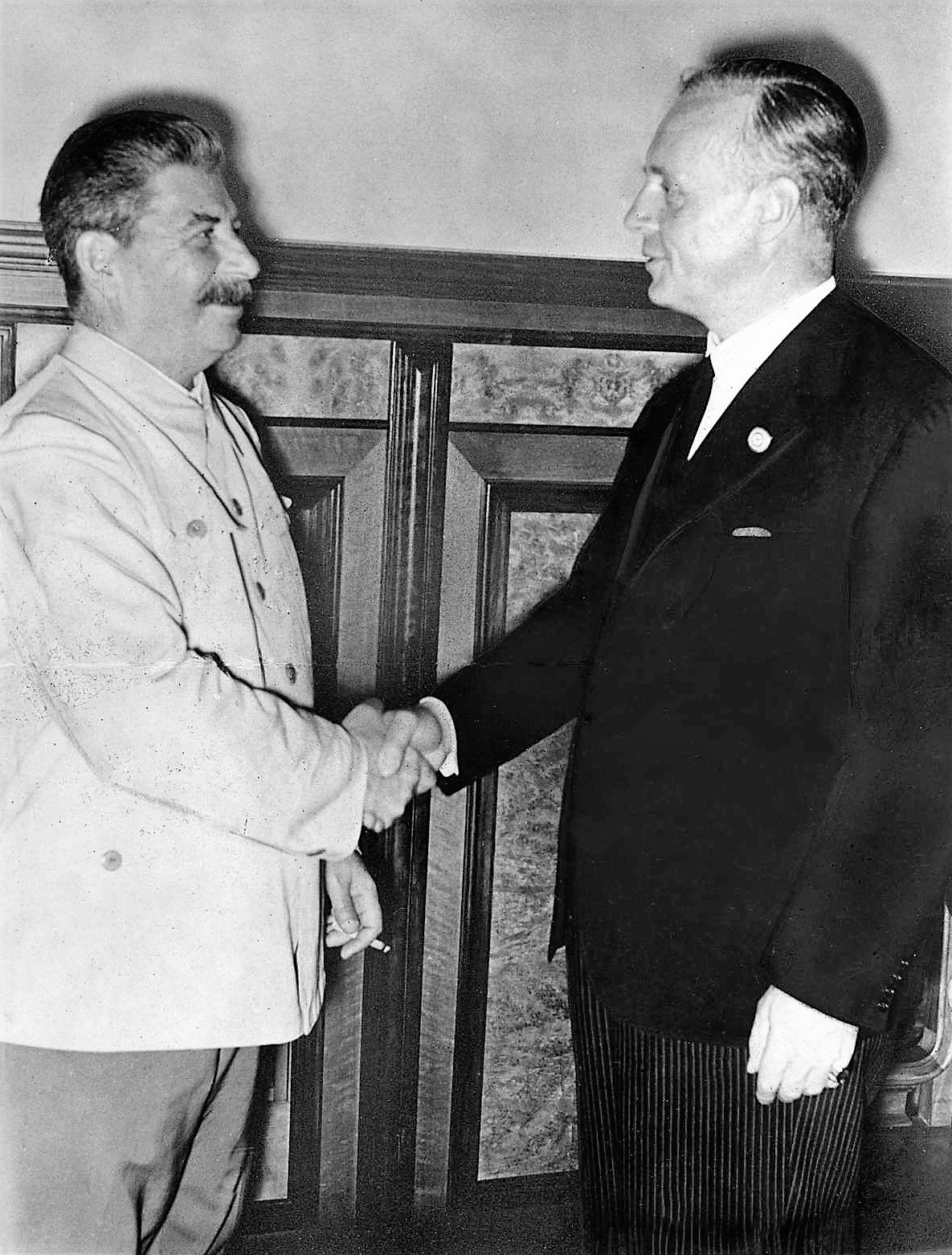
Joachim von Ribbentrop, Nazi Germany's foreign minister, flew into Moscow on August 23, 1939, to close a deal that had seemed unthinkable a year earlier: a non-aggression pact between the two regimes each had spent the 1930s defining itself against. Hitler had built his movement on annihilating Bolshevism; Stalin's had spent a decade preparing Soviet citizens for an eventual war against fascism. The signing itself dragged past midnight, so while the treaty carries the date August 23, 1939, Molotov and Ribbentrop actually put their names to it in the early hours of the 24th.
What followed the signing was a supper at the Kremlin, and German diplomatic accounts of that evening, the most detailed coming from embassy counselor Gustav Hilger in his 1953 memoir The Incompatible Allies, describe an atmosphere closer to a state visit between allies than a deal between mortal enemies. Stalin reportedly raised a glass of Crimean sparkling wine and said, in the rendering that has circulated in English-language accounts since, that he knew how much the German nation loved its Führer and wished to drink to his health. Whatever the precise wording, the gesture itself is not in serious dispute: the two governments that had spent the decade calling each other's ideology an existential threat to civilization spent that particular night drinking to each other's leader.
The Protocol Both Armies Used Within Weeks
Attached to the published treaty was a secret protocol that never mentioned non-aggression at all. It drew a line through Poland along the Narev, Vistula, and San rivers, marking out which half would fall into each power's sphere, and it placed Finland, Estonia, and Latvia in the Soviet sphere outright. Article II went further than dividing territory; it left open whether Poland should keep existing as a country at all, stating that "the question of whether the interests of both parties make desirable the maintenance of an independent Polish State and how such a state should be bounded can only be definitely determined in the course of further political developments." Lithuania was initially assigned to Germany's sphere, then reassigned to the Soviet Union five weeks later under a supplementary agreement, in exchange for shifting more of central Poland into the German zone.
Germany invaded Poland from the west on September 1, 1939, eight days after the pact was signed. The spearhead of that invasion in the north was the newly formed XIX Army Corps under Heinz Guderian, pushing out of Pomerania toward the Polish Corridor, more than a decade before historians would start arguing over how much of his later reputation as the architect of Blitzkrieg he owed to a British writer's editing pen. Britain and France, bound by treaty to Poland, declared war on Germany two days later and then spent the next eight months behind the fortress line built to avoid refighting the First World War, waiting for an attack that wouldn't come until the following May. The Soviet Union invaded from the east on September 17, following the line the secret protocol had already drawn, and by the start of October the two armies had met in the middle and divided the country between them, exactly as Article I of the protocol had specified five weeks earlier.
A Secret Denied Until One of Its Authors Was Dead
Proof of the secret protocol reached the West well before the Cold War even hardened into shape. American prosecutors working the Nuremberg trials recovered a copy from captured German Foreign Ministry files, and the U.S. State Department published the document in full in its 1948 collection Nazi-Soviet Relations, 1939-1941. The Soviet government's response was flat denial, a position it held to for the next four decades regardless of what the West had already put into print. Vyacheslav Molotov, the protocol's Soviet signatory, never broke from that line. He died on November 8, 1986, at age 96, still insisting the document was a fabrication.
It took Mikhail Gorbachev's government to end the denial. In 1989 Gorbachev appointed Politburo member Alexander Yakovlev to head a commission investigating whether the protocol was genuine, and in December 1989 the commission reported back that it was. On December 24, 1989, the Congress of People's Deputies of the Soviet Union formally acknowledged the protocol's existence and declared it invalid from the moment it was signed, 43 years after American prosecutors had first recovered the document and three years after the man who signed it had gone to his grave denying it.
Eleven Days of Silence
The pact held for 22 months. On June 22, 1941, Germany launched Operation Barbarossa, a surprise invasion along a front stretching from the Baltic to the Black Sea, breaking the non-aggression treaty Hitler and Stalin's governments had signed and then jointly acted on in Poland less than two years earlier. Vyacheslav Molotov, still foreign minister, was the one who addressed the Soviet public that day, going on state radio hours after the invasion began to tell citizens the country was at war.
Stalin's own address didn't come until July 3, eleven days later, and when it arrived, its language marked a real departure from how he normally spoke to the country. "Comrades, citizens, brothers and sisters, men of our army and navy! My words are addressed to you, dear friends," the speech opened, a warmer, more personal register than the Soviet leader had used in public before. What filled the eleven days in between is documented in a single, specific episode rather than the extended disappearance later popular accounts describe: on June 29-30, a Politburo delegation that included Molotov, Beria, and Anastas Mikoyan traveled to Stalin's dacha outside Moscow and found him withdrawn. According to Mikoyan's own later account, Stalin asked the group why they had come, apparently believing they might be there to arrest him; the meeting ended instead with the group proposing, and Stalin agreeing to chair, a new State Defense Committee, formed the next day, June 30, with total authority over the war effort. The historical record backs that one documented meeting; an unrecorded week-long breakdown is a claim it never made. Stalin's most celebrated wartime marshal, Georgy Zhukov, later faced a Bonapartism charge that failed in 1946 and succeeded in 1957.
The Number Historians Actually Use
"Hitler vs Stalin" gets searched as a comparison, and the most rigorous attempt to answer it with an actual count comes from historian Timothy Snyder's 2010 book Bloodlands: Europe Between Hitler and Stalin. Snyder didn't try to tally each regime's total death toll everywhere it ruled; he narrowed his count to a specific region, the overlapping territory from central Poland through Ukraine, Belarus, and the Baltic states where both dictatorships directly operated between 1933 and 1945, and counted only deliberate, noncombatant deaths within it. The count breaks down like this: Germany deliberately killed about 11 million noncombatants in that territory, a number that rises above 12 million once foreseeable deaths from deportation, starvation, and camp sentences are folded in. For the Soviet Union under Stalin, Snyder's analogous figures are about 6 million deliberate deaths, rising to roughly 9 million with the same broader accounting.
That specific, regionally bounded count is the number historians actually cite when the comparison comes up, a real tally standing in for what's usually just a slogan about who was worse. It leaves out plenty on both sides: Soviet Gulag and famine deaths outside the bloodlands region Snyder defined, and German killing in Western Europe and among Soviet POWs and combatants elsewhere, none of which factors into that particular tally. What it does capture is the one span of time and geography where the two regimes' campaigns of mass killing directly overlapped, the same ground the toast in Moscow and the secret protocol had already carved into spheres of influence.