A Childhood Illness, Not a Battle Scar
Masamune was born in 1567, the eldest son of Date Terumune, a daimyō in Japan's Tōhoku region. As a small child he contracted smallpox, and the disease cost him the sight in his right eye. That much is not disputed by any biography, popular or academic. What happened to the eye after that, whether it stayed sightless in its socket or was physically removed, is where the record gets thin and the storytelling takes over.
The most repeated version says that a senior Date retainer warned young Masamune that an enemy could seize him by a dead eye in close combat, so he plucked it out himself. A second version, more often told in popular retellings, has his trusted attendant Katakura Kojūrō cutting the eye out with a small blade and fitting him with an improvised eyepatch made from a sword's hand-guard, restoring the boy's confidence and setting him on the path to conquering the north. Japanese historian Watanabe Daimon, in a 2024 piece reviewing the sourcing behind Masamune's popular image, flags this specific gouging episode as doubtful: no document from the Sengoku period itself describes it, by either version, and no contemporary source describes an eyepatch of any kind.
The Name Arrived 194 Years Late
Search any Sengoku-era chronicle, diary, or letter for the phrase dokuganryū attached to Masamune's name, and you won't find it. According to Watanabe's research, no wartime document uses the label at all. It surfaces for the first time in 1830, when the Confucian scholar and poet Rai San'yō wrote a poem about Masamune in his collection Eishi Zekku ("Quatrains on History") and, for the first time on record, called him dokuganryū, the one-eyed dragon.
San'yō wasn't inventing the phrase from nothing. Dokuganryū had already existed for nearly a millennium as the nickname of Li Keyong, a celebrated one-eyed general of the late Tang dynasty in China; San'yō was drawing a literary comparison between the two warlords, not reporting what Masamune's contemporaries called him. Masamune died in 1636. San'yō's poem is dated 1830. The gap between the man and his most famous nickname is 194 years, longer than the United States has existed as a country from the poem's own vantage point.
A Portrait That Kept Both Eyes, on His Own Orders
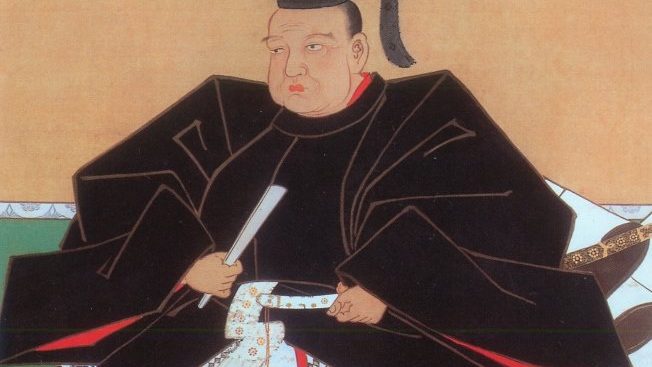
The formal portrait of Masamune held today by the Sendai City Museum, painted by the shogunate's court painter Kanō Yasunobu around 1676, forty years after Masamune's death, shows a heavyset man in black court robes with both eyes fully open and alert. Nothing about the face suggests blindness on either side. That wasn't an artistic choice made for flattery; it was a written instruction. Masamune considered a portrait showing his missing eye to be a mark of disrespect toward the body his parents had given him, and he left orders that any painting made of him show both eyes intact.
His household kept to that instruction after his death. Every subsequent portrait and wooden memorial statue of Masamune known to survive depicts both eyes, typically with the right one rendered just slightly smaller than the left, a small concession to the historical fact without breaking the letter of his order. The man modern audiences remember chiefly for the eye he lost spent his own legacy planning making sure his official image never showed it missing at all.
The Eyepatch Is a Twentieth-Century Costume Choice
If there's no record of an eyepatch during Masamune's lifetime, where did the image come from? The first time Masamune appeared on screen wearing one was a 1942 film titled Dokuganryū Masamune. Even that didn't settle the matter: for decades after, screen and stage depictions largely dropped the eyepatch again, usually showing Masamune with one eye simply closed instead. The look now considered inseparable from him, an eyepatch styled after a sword's tsuba hand-guard, became fixed in the popular imagination through one specific performance: Ken Watanabe playing Masamune in NHK's 1987 Taiga drama, also called Dokuganryū Masamune. That series remains the highest-rated year in the history of NHK's annual historical drama slot, with an average audience share above 39 percent and a series finale watched by an estimated 47.8 percent of the country, a single hit broadcast doing more to fix Masamune's face in the popular imagination than anything he did himself while alive.
The image proved durable enough to travel. Concept artist Ralph McQuarrie, describing the early design process for Darth Vader in Steve Sansweet's book Star Wars: From Concept to Screen to Collectible, recounts George Lucas asking for a villain who might wear "some kind of big helmet like a Japanese warrior." McQuarrie and sculptor Brian Muir built Vader's silhouette around a samurai kabuto helmet and mempo facial armor, the same general armor tradition Masamune is remembered for. One detail didn't survive the translation: Masamune's signature crescent moon, mounted on the front of his helmet, never made it onto Vader's final design, which kept the broad samurai shape but left out the one ornament most associated with Masamune specifically.
A Brother Killed, and a Death-Shroud Story With No Source
The eye wasn't the only source of family violence around Masamune. His mother, Yoshihime, known to some chroniclers as the "Demon Princess of Ōu," favored Masamune's younger brother Kojirō as heir to the Date clan and clashed with her elder son for years. According to the account preserved in later Date family records, during the tense spring of 1590, with Masamune's household divided over whether to answer Toyotomi Hideyoshi's summons to the Siege of Odawara, Yoshihime served her elder son a poisoned meal; Masamune survived by taking an antidote, and in the confrontation that followed he killed Kojirō himself. Kojirō's death that April isn't in dispute. What's harder to verify is the poisoning itself: no surviving 1590 document independently corroborates the attempt, and the dramatic detail comes down to us only through family accounts compiled generations after the fact.
A second, equally dramatic legend attaches to what happened once Masamune finally reached Hideyoshi. He had delayed his march to Odawara long enough to infuriate his overlord, who was already investigating him for attacking the Ashina clan in violation of a truce Hideyoshi had imposed on Japan's daimyō. When Masamune arrived, Hideyoshi made him wait, then had him grilled over both offenses before sparing his life while still stripping him of several districts. Popular legend has Masamune facing Hideyoshi dressed in a white funeral shroud, resolved to die, with a small dagger hidden in his robe in case he had to fight his way out. Watanabe Daimon traced this story to its likely origin: Masamune himself told it, decades later, to a lord named Maeda Toshitsune, whose retainer Sekiya Masaharu wrote it down in his own memorandum. That memorandum does describe the hidden dagger. It does not, by Watanabe's reading, mention a funeral shroud at all, a detail that appears to have been added somewhere between Masamune's own telling and the version now repeated as established fact. Hideyoshi's mercy toward a defiant, delayed vassal wasn't a given either way; years later he had no such qualms about ordering 39 members of his own adopted heir's household executed once an infant son made that heir inconvenient.
What He Actually Built
Set the legends aside and Masamune's real record is substantial enough on its own. After Sekigahara in 1600, Tokugawa Ieyasu granted him the Sendai domain, and Masamune personally oversaw construction of Aoba Castle on a defensible hill above what was then a small fishing village, moving his own household there in 1604 along with roughly 52,000 retainers and their families. The city he built around that castle remains one of Tōhoku's major centers today. Popular reputations built on late, secondhand retellings aren't unique to Masamune: Miyamoto Musashi's famous claim of sixty undefeated duels survives only in a preface he wrote near the end of his life, decades before any outside biography appeared.
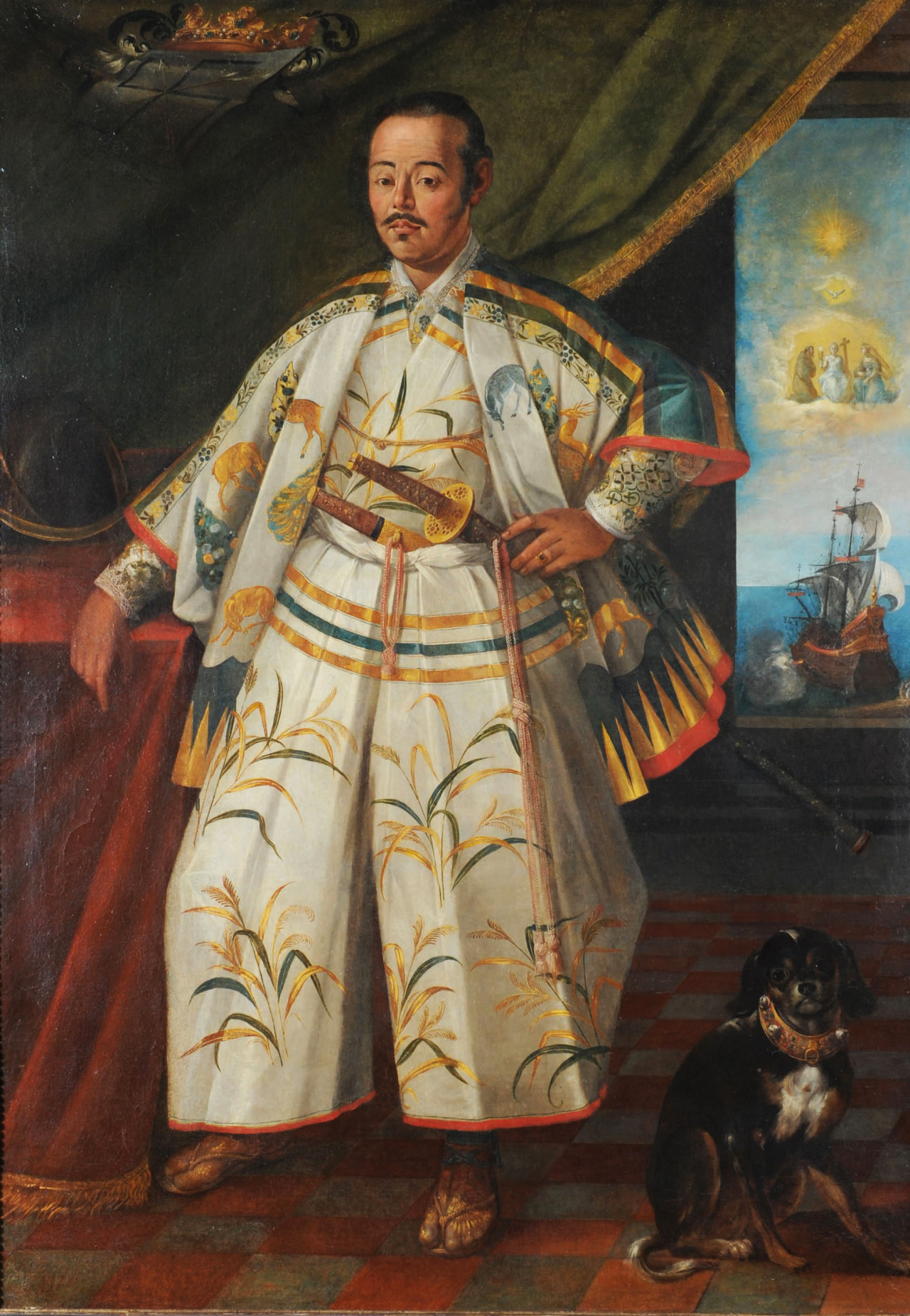
Masamune's most unusual project was diplomatic rather than military. In 1613 he funded construction of the galleon San Juan Bautista using European shipbuilding techniques and sent his retainer Hasekura Tsunenaga, accompanied by the missionary Luis Sotelo and roughly 180 travelers, on a mission to Spain and the Vatican seeking trade relations and missionaries for his domain. The embassy reached Rome in the autumn of 1615; Pope Paul V received Hasekura in a formal audience at the Quirinal Palace on November 3 of that year. The mission didn't secure the trade agreement Masamune wanted, and by the time Hasekura returned to Japan in 1620, the shogunate had turned firmly against Christianity, making his own achievement politically useless almost as soon as he completed it. A handful of the embassy's Japanese members chose to stay behind in Coria del Río, near Seville, rather than go home to a country turning hostile to their new faith. Roughly 600 of their descendants live in Spain today, still carrying the surname Japón.