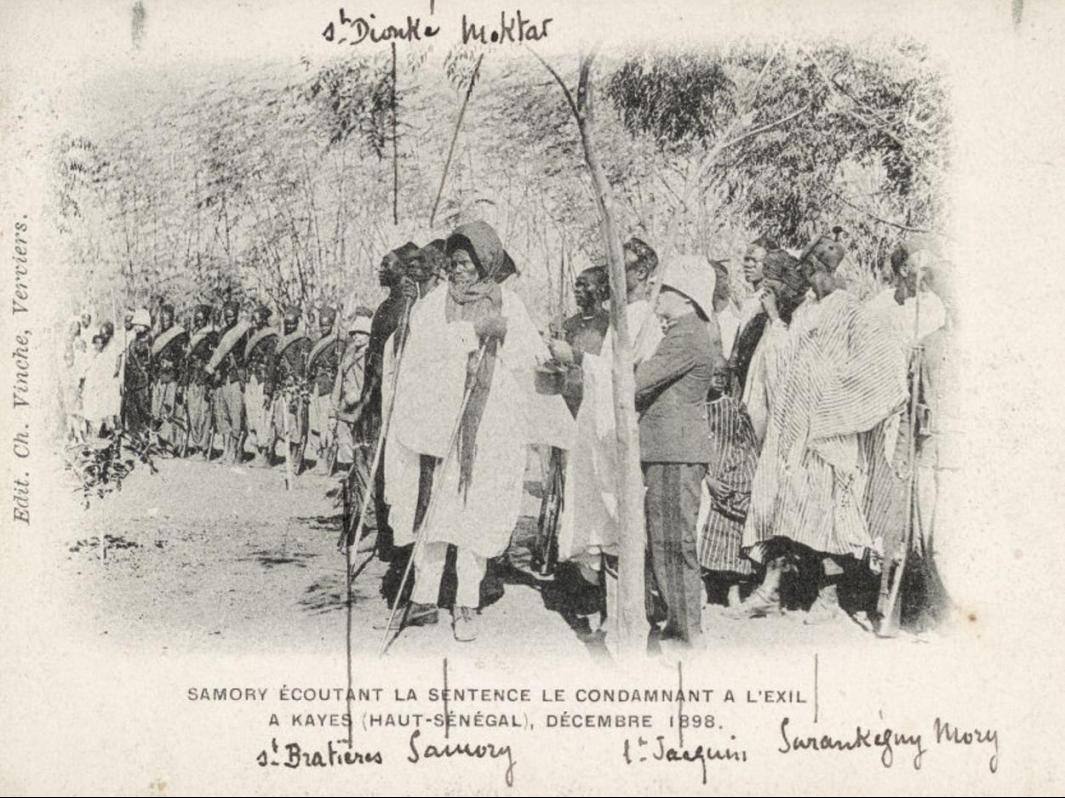
_Samory_%C3%A9coutant_la_sentence_le_condamnant_%C3%A0_l%27exil.jpg)
A Battle That Made His Name, and Showed the Gap
Samori Ture had been importing breech-loading rifles through the British colony of Sierra Leone since the 1870s, and by 1878 he had built enough of a following in the Manding region of what is now Guinea and Mali to proclaim himself Faama, military leader, of an empire that would become known as Wassoulou. France's colonial push east from Senegal reached his borders in 1882, when a French commander declared the town of Kiniéran, where a rival chief had taken refuge, a French protectorate. Ture sacked it on February 21. A relief column arrived too late to save the town but caught up with his army five days later at Samaya.
That battle nearly ended the war before it began. Wikipedia's account of the clash (checked 12 October 2026) describes the sofa infantry's traditional frontal charges turning into a slaughter against the latest French weaponry. Ture adapted immediately, switching to guerrilla tactics and hit-and-run cavalry raids that harassed the French column back to the Niger River. The retreat cost France a battle it should have won outright on firepower alone, and it gave Ture something more durable than a single victory: a reputation, across a region watching France's advance with alarm, as the one African leader who could stand up to it. That reputation pulled in volunteers and boosted recruitment for years afterward. It also left an unresolved problem sitting underneath every campaign that followed. Samaya had been decided by whose rifles fired faster and further, and the gap it exposed never fully closed.
Three Hundred Smiths, a Dozen Rifles a Week
Ture's answer to that gap was to build his own supply. Research on Samorian army organization published in the Journal of African History, echoed in later popular accounts drawing on the same body of research, puts an estimated 300 to 400 blacksmiths working full-time in Wassoulou territory, using locally sourced metal to manufacture roughly ten to twelve breech-loading rifles a week, plus 200 to 300 rounds of ammunition a day. Some of the guns were built entirely from scratch; others started as damaged imports the smiths learned to repair and then to copy outright. Among African states of the period, only the Merina kingdom in Madagascar and Emperor Tewodros II's Ethiopia are known to have approached that level of domestic firearms self-sufficiency.
It still was not enough. When Ture laid siege to the fortified Kenedougou capital of Sikasso in 1887, an operation that would drag on for 15 months, Wikipedia's account of the war (checked 12 October 2026) notes that his elite troops were equipped with the Gras rifle, which local blacksmiths had learned to repair and even build from scratch, but not in the quantities necessary to supply his entire army of 30,000 to 35,000 infantry and 3,000 cavalry. He also had no artillery to bring against Sikasso's defenses, among the most developed in West Africa at the time. The siege collapsed by the end of the 1888 rainy season, undone by disease, a rumor that Ture himself had died, and a supply line running on porters through hostile territory. Historians treat it as the high point of his power and the start of its decline.
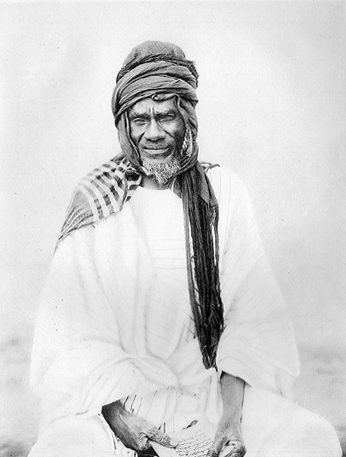

One Army, Three Rifles, Three Jobs
By March 1891, France was done negotiating. Colonel Louis Archinard led a surprise column out of Nyamina toward Ture's stronghold at Kankan, expecting to finish the war in weeks. Knowing his fortifications could not survive French artillery, Ture abandoned static defense altogether and shifted to a war of maneuver and scorched earth, a decision he formalized that August at a war council in Missamaghana. Wikipedia's account of that council (checked 12 October 2026) describes the specific system that resulted: troops issued captured or negotiated modern repeating rifles were assigned to fight the French directly, soldiers carrying the older bolt-action chassepot pushed the empire's frontier east to build a strategic reserve of territory and supply, and men still armed with flintlocks handled home-guard and internal security duty.
The logic tracked the production numbers directly. With roughly a dozen rifles a week coming out of the workshops and imported repeaters growing scarcer (Britain had stopped selling breechloaders to West African buyers under the Brussels Conference Act of 1890, and France's advance was closing off Ture's other routes), the newest, most effective weapons could not be issued evenly. Concentrating them on the troops actually engaging French columns, while assigning older stock to garrison duty and territorial expansion, stretched a limited arsenal across three different jobs at once. Reorganizing a fighting force around a strategic constraint rather than inherited status has other precedents on this site: Genghis Khan broke the Mongols' clan-based war bands into decimal units and promoted merit over bloodline, elevating a blacksmith's son to top command, a different fix for the same underlying problem of building a force that could out-organize richer, better-equipped rivals. Wikipedia's summary (checked 12 October 2026) describes the payoff of Ture's version bluntly: the system let him "fall back into territory already conquered and organized, leaving no food for the French, for the next seven years."
The Workshops Went East Too
Archinard's forces took Kankan on April 11, 1891, and then Ture's capital at Bissandougou, but found both cities stripped of anything worth capturing; the population, army, and administration had already withdrawn. That pattern repeated for years. By 1893, French forces had captured Faranah and cut Wassoulou off from its established arms route through Liberia and Sierra Leone, forcing Ture onto a longer supply line through the Gold Coast instead. The Manding heartland of his empire was effectively gone, but he still commanded roughly 12,000 infantry and 2,000 cavalry, and a moving retinue of some 120,000 people, as he pushed the entire state east toward the Bandama and Comoé Rivers.
That migration was not just an army in retreat. Accounts of the period describe Ture relocating his government, his herds, and his gunsmithing workshops along with his people, burning each district behind him as he left it so French forces inherited nothing but ash. He reestablished a base at Dabakala in early 1895 and briefly held the trading city of Kong, though it broke into revolt over stalled commerce and Ture destroyed it in May 1897. He also tried to build an anti-European alliance with the Ashanti Empire; it collapsed when the British defeated the Ashanti first. Colonial-era resistance in West Africa did not always end in retreat: at Rorke's Drift in 1879, a vastly outnumbered British garrison held a supply station against a Zulu assault, an action later remembered for the unusually large number of medals it produced.
Captured Without a Fight
The end came from intelligence, not firepower. France captured Sikasso, seat of the rival Kenedougou kingdom, on May 1, 1898, freeing colonial forces to concentrate entirely on Ture. He tried to migrate again, this time toward Liberia, but unfamiliar mountainous terrain, hostile local populations, and continued French attacks turned the march into a disaster; thousands of his people died of starvation along the way. Acting on information from sofa deserters, French captain Henri Gouraud surprised what remained of Ture's forces at Guelemou on September 29, 1898, and took the Almamy prisoner without a fight.
Sixteen years after Samaya first exposed the firepower gap, and after building a domestic gun industry, a tiered arming system, and a retreat spanning hundreds of kilometers to compensate for it, Ture's capture had nothing to do with rifles at all. He was moved to Kayes, sentenced to exile on December 22, 1898, and taken to Saint-Louis, Senegal in early January 1899, where he attempted suicide the night before his scheduled deportation and survived. He was shipped to Gabon on February 5 and held at a prison camp on Missanga Island in the Ogooué River, a posting so lethal to its inmates that it was known as the "dry guillotine." Ture died there of pneumonia on June 2, 1900. A version of the same technology gap that undid his Sikasso siege, the mismatch between an army's ambitions and the ammunition its bullets actually needed, also separated two designs of an entirely different rifle: the French Minié ball needed a small iron cup its own designer considered essential, a part the U.S. arsenal at Harpers Ferry left out and still made work.