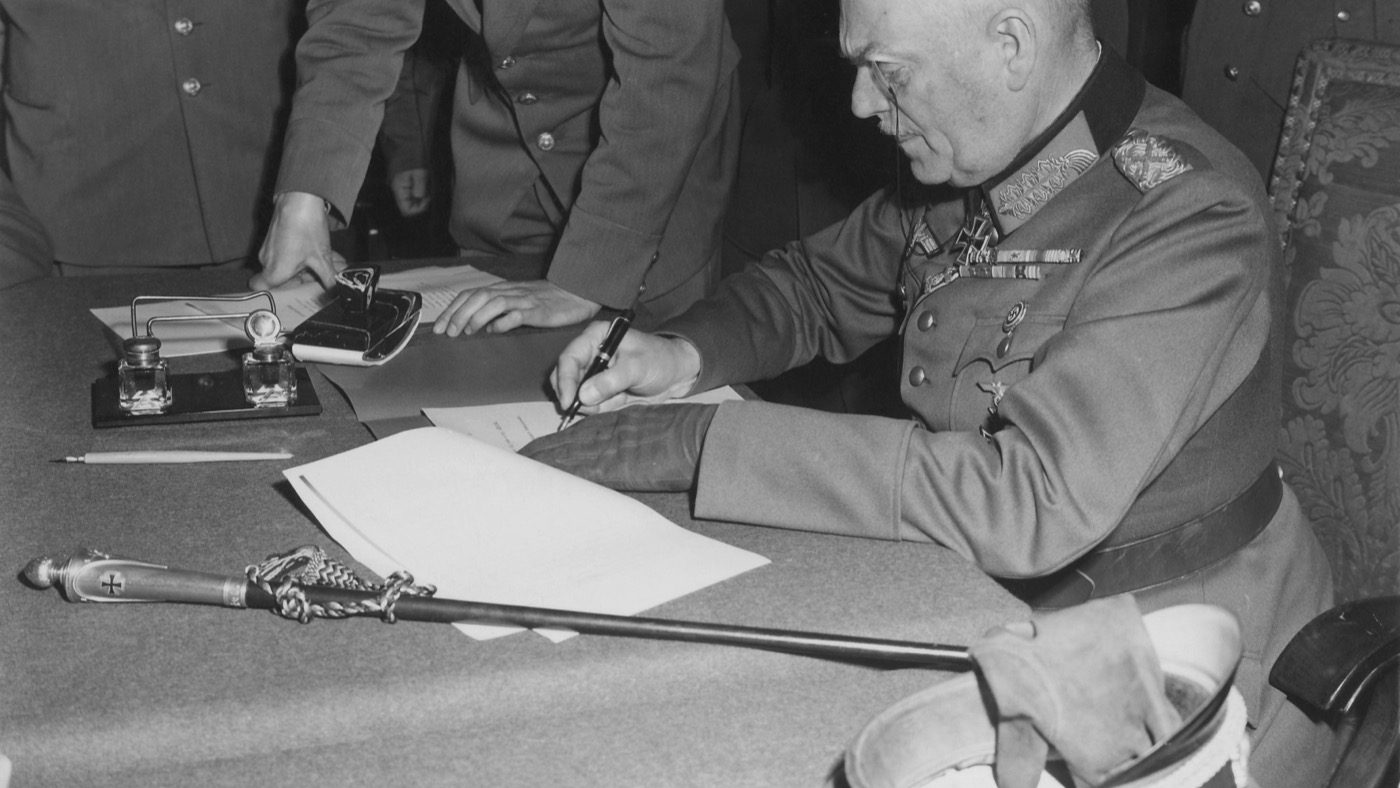
A Lackey With a Signature
Keitel became Chief of the High Command of the Armed Forces (Oberkommando der Wehrmacht, OKW) on February 4, 1938, the same day Hitler personally took command of the entire Wehrmacht and reduced the post to a staff role with no independent authority over the army, navy, or air force, each of which answered to Hitler directly. Fellow officers had a name for what that arrangement made of him: "Lakaitel," a pun on Lakai, the German word for lackey. The nickname stuck because Keitel earned it. Where a stronger figure might have pushed back, as Heinz Guderian did often enough to be sacked from his own Eastern Front command in December 1941, Keitel signed. Over the next three years his signature or initials went onto the invasion timetables for Austria, Czechoslovakia, Poland, Norway, the Low Countries, and the Soviet Union, on directives he later told the tribunal he had personally opposed on military and legal grounds and signed anyway.
That record of compliance became his entire legal defense once the war ended. On the witness stand, Keitel put it as a description of duty rather than an excuse: "When an order was given, I acted according to my duty as I saw it, without permitting myself to be confused by the possible, but not always foreseeable, consequences." The International Military Tribunal did not buy it. Its judgment against him held that superior orders, even for a soldier, could not mitigate crimes "committed consciously, ruthlessly and without military excuse or justification," and it pointed to specific documents showing Keitel had not merely relayed Hitler's orders but had, at moments, made them harsher on his own initiative.
The Order, and the Objection
On September 8, 1941, less than three months after Germany broke its own non-aggression pact with the Soviet Union and invaded, OKW issued a new set of regulations governing how German forces were to handle Soviet prisoners of war. The rules extended a principle already set by the Commissar Order three months earlier, that captured Red Army personnel identified as politically dangerous were not ordinary prisoners: the Sicherheitsdienst (SD) and Sicherheitspolizei (SIPO), the Reich's security police and intelligence apparatus, would screen camps and decide who among the prisoners should be killed, using criteria the Wehrmacht itself had no part in setting.
Wilhelm Canaris, the admiral who ran the Abwehr, Germany's military intelligence service, addressed a formal memorandum of protest to Keitel on September 15, 1941. He argued the regulations violated general principles of international law governing the treatment of prisoners, warned they would produce arbitrary killings, and objected specifically that the fate of prisoners the Wehrmacht itself had captured would be decided by an SD screening process operating under standards the army was never shown. It was a legal argument, made through the correct channel, by the one man in the German high command professionally positioned to make it.
Approved and Backed, in His Own Hand
Canaris's memorandum came back to him with an answer written in the margin, dated September 23, 1941 and initialed by Keitel: "The objections arise from the military concept of chivalrous warfare. This is the destruction of an ideology. Therefore I approve and back the measures." There was no order from Hitler to relay in that sentence, no directive Keitel could later claim he had merely carried. It was his own reasoning, in his own hand, rejecting an international-law objection as sentimental military tradition standing in the way of an ideological war.
It was not an isolated moment. When Josef Terboven, the Reich Commissioner running occupied Norway, wrote to propose holding the relatives of suspected saboteurs responsible and asked whether firing squads could be authorized for that purpose, Keitel again answered in the margin of the memo rather than referring the question upward: "Yes, that is the best." At his own trial, Keitel told the court he had privately agreed with Canaris's legal objection and had argued the point with Hitler before losing the argument. The documents the prosecution produced show no trace of that private disagreement, only a chief of staff who, given a formal warning that a policy broke international law, wrote back that he approved of it.
The Line He Said Wasn't His
On a separate track from the Canaris exchange, Keitel signed an order on September 16, 1941 setting the ratio for reprisal killings in the East: fifty to a hundred Communists executed for every German soldier attacked. The Nuremberg judgment records that the order carried its own justification attached, that human life "was less than nothing" in the territories concerned. On October 1, roughly two weeks later, Keitel ordered field commanders to keep hostages on hand at all times for exactly this purpose.
Keitel disputed the most quoted version of that reasoning at trial. In his final statement to the tribunal on August 31, 1946, he singled out a line the French chief prosecutor had attributed to him in closing argument, that "human life was worth less than nothing in the occupied territories," and rejected it flatly: "These terrible words are not my words. I did not think them up, and did not make them the contents of any order either. The fact that my name is connected with the transmission of this Fuehrer order weighs heavily enough upon me." The judgment handed down a month later still tied the September 16 order, and the sentiment behind it, to Keitel's signature. Whether Hitler or Keitel first put the words on paper, the order that carried them out went out from Keitel's headquarters over Keitel's name.
A Soldier's Death, Denied
Keitel's own defense counsel had put a question to him some months before his final statement to the tribunal: how would he act if placed in the same position again? His answer, quoted in his final statement: "Then I would rather choose death than to let myself be drawn into the net of such pernicious methods." The tribunal took him at something close to his word. Convicted on October 1, 1946 on all four counts of the indictment, conspiracy to commit crimes against peace, crimes against peace itself, war crimes, and crimes against humanity, he was sentenced to death.
Keitel petitioned the Allied Control Council for one concession: execution by firing squad, the death of a soldier and not a criminal's. The council refused, ruling that his crimes were criminal, not military, in character; there would be no reprieve of the kind that later spared Albert Kesselring, whose own 1947 death sentence was commuted to life imprisonment before a lobbying campaign got him released outright. Early on October 16, 1946, Keitel was hanged at Nuremberg Prison. His last words, by the account of the American officers present, invoked the more than two million German soldiers he said had already died for the country: "I follow now my sons, all for Germany." The rope and trapdoor used that night were later found to have been badly calculated; accounts of how long Keitel struggled before he died range from about 24 to 28 minutes, depending on which witness's timing is used.