
A Plan Copied From Tannenberg
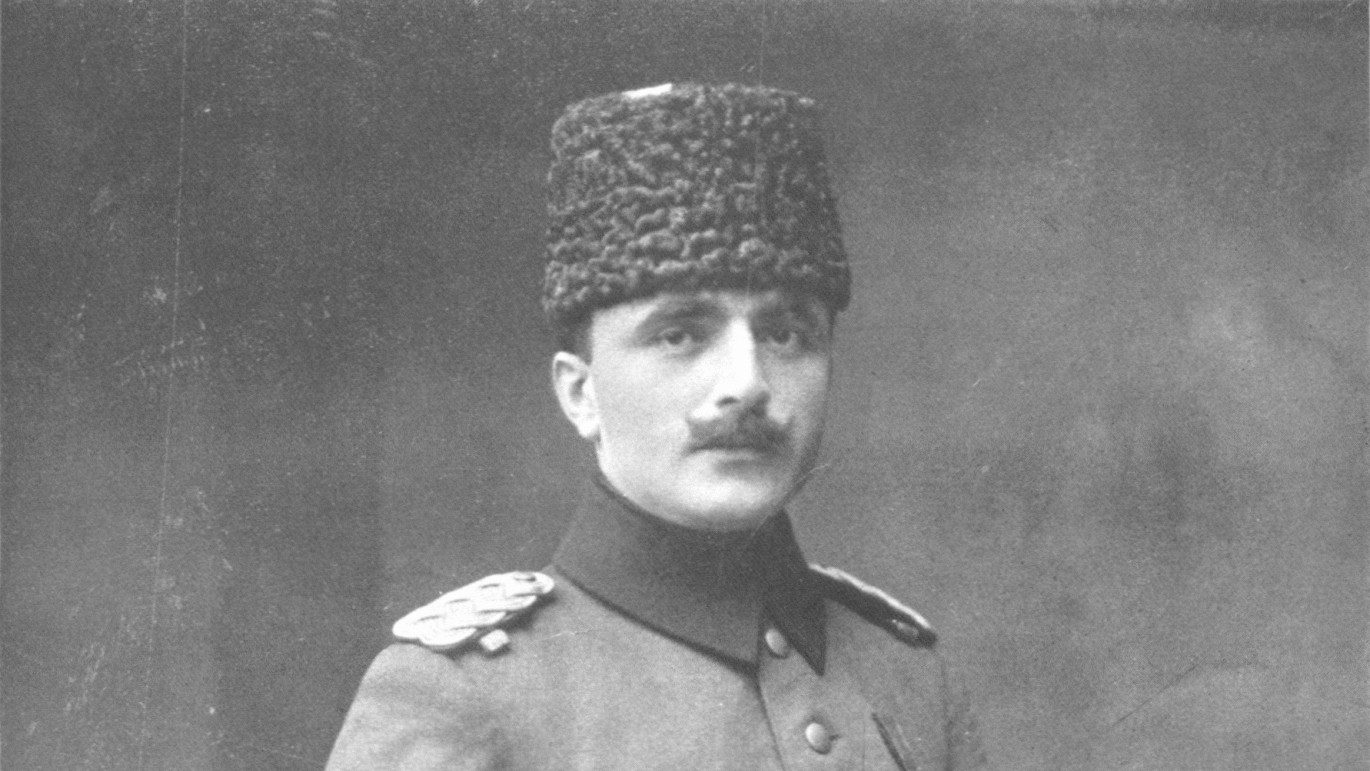
Enver Bey helped lead the 1908 Young Turk Revolution that forced Sultan Abdulhamid II to restore the Ottoman constitution, then rose fast enough inside the Committee of Union and Progress that the January 1913 coup left him as one of three men effectively running the empire, alongside Talaat Pasha on the civilian side and Cemal Pasha at the navy. Enver took the War Ministry and kept it that October when the empire joined Germany and Austria-Hungary against Russia, Britain, and France, ruling a state that had already lost most of its European territory in the Balkan Wars and controlled only a fraction of the land Mehmed II once governed from a rebuilt Constantinople.
Enver had studied Germany's victory at Tannenberg that August, where two field armies encircled and destroyed a larger Russian force on the open plains of East Prussia, and concluded the Russian army defending the Caucasus was vulnerable to the same maneuver. His plan sent the IX and X Corps, roughly 68,000 men between them, on a wide flanking march through the mountains toward the rail junction at Sarikamis while the XI Corps held the main Russian force in place, aiming to cut the Russians off from Kars and destroy them in the open. A successful envelopment, he judged, would open a road toward Tbilisi, threaten Russian access to Caspian oil, and possibly draw the Caucasus's Muslim population into revolt against the Tsar.
The General Who Warned Him in Writing, Then Resigned
Hasan Izzet Pasha, the Third Army's actual field commander, backed the plan while Enver worked out its details, then soured on it once he weighed the terrain and the calendar against the timetable. On December 18, with the offensive already scheduled, he telegraphed Enver that the flanking corps would need eight or nine days to cross the mountain passes, that the exposed XI Corps risked being crushed alone in the meantime, and that he judged the whole operation's outcome doubtful given how poorly the army had actually been prepared for it. Enver did not answer that message in writing. Hasan Izzet telegraphed again the same day, asking to be relieved of a command he no longer had, in his own phrase, the strength or the confidence to carry out.
Enver traveled to the front to talk him back into the plan, failed, and took direct personal command of the Third Army himself rather than delay or scale it back; his earlier parting words to Hasan Izzet, that he would either return to Istanbul or "watch your actions as a spectator," described neither outcome, since he stayed and led the offensive in person. Written warnings didn't always change what came next in this war: a former French war minister who had proposed replacing uniforms he judged dangerously visible lost that fight to a rival lawmaker's declaration that the color was France itself, and infantry marched into 1914 wearing the same trousers regardless. Hasan Izzet's telegrams met a comparable wall, except he chose to step aside from a plan he considered doomed rather than execute it.
Winter Killed the Army Before the Russians Did
The offensive opened on December 22 into terrain the German-inspired plan hadn't accounted for. Tannenberg had been fought in high summer on the flat plains of East Prussia; the Sarikamis campaign sent the IX and X Corps through mountain passes 1,500 to 2,000 meters above sea level in the depths of a Caucasian winter, and the two corps set out without winter coats, carrying only dry bread and olives as rations. An estimated 25,000 Ottoman soldiers froze to death in the Allahuekber Mountains before serious fighting even began, a figure that shows up independently in Turkish officers' postwar memoirs alongside roughly 30,000 more killed or wounded in combat, 20,000 who later died of disease in hospital, and 7,000 taken prisoner.
How many men the Third Army actually had left by the time the offensive collapsed on January 17 is disputed even in the Ottoman army's own contemporary reporting. Commander Hasan Izzet's eventual successor, Hafiz Hakki Pasha, put total Ottoman deaths at 30,000; the German officer attached to the Ottoman staff, Lieutenant Colonel Felix Guse, gave two different figures in different accounts, one of 11,000 dead with 3,500 captured and another of 30,000 dead with 27,000 captured. What isn't disputed is how thin the army had worn by the retreat: on January 8, the XI Corps could field only about 10,000 rifles even after 5,000 fresh reinforcements arrived, and Russian pursuers found a Third Army whose overall strength, by multiple Ottoman accounts, had fallen to somewhere under 20,000 combat-ready men. Enver himself left the front for Istanbul on January 9, handing command to Hafiz Hakki Pasha eight days before the retreat was complete; Hafiz Hakki died of typhus the following month.
Praised the Armenians, Then Ordered Them Disarmed
An Armenian soldier carried Enver on his back through Russian lines during the fighting retreat from Sarikamis in late December, saving him from capture. On January 22, 1915, arriving back in Constantinople from the front, he gave a public speech congratulating Armenians for doing their duty on the Caucasus front and elsewhere, and the following month, in a letter to Bishop Karekin Khachadourian, the Armenian prelate of Konya, he again praised Armenian troops for their bravery and loyalty.
Five weeks on, on February 25, the Ottoman General Staff issued Enver's Directive No. 8682, titled "Increased Security Precautions," ordering ethnic Armenian soldiers and officers removed from combat units, command posts, and headquarters staffs, citing fear that they would collaborate with the advancing Russians. Armenian conscripts pulled from the ranks under that order were reassigned to unarmed labor battalions, and the Armenian National Institute's account of the genocide's run-up treats the sequence, public praise in January, a private letter of praise in February, then a directive stripping the same soldiers of their weapons before that month was out, as one of the earliest documented steps in a campaign that escalated into the mass deportations and killings beginning that April. The defeat Enver had personally engineered supplied the pretext; the machinery for what followed, in the form of a secret CUP paramilitary unit already operating inside the War Ministry, existed independently of it.
Sent by the Bolsheviks, Killed by Them a Year Later
Enver fled Constantinople for Germany on November 2, 1918, days after the Ottoman armistice, together with Talaat Pasha and Cemal Pasha. An Ottoman court-martial tried the three men in absentia the following year and, on July 5, 1919, sentenced Enver to death for plunging the empire into a war without legitimate cause, for the forced deportation of Armenians, and for leaving the country without permission. The Ottoman Empire's own war didn't end cleanly at that armistice either: the peace settlement that was supposed to close it collapsed and had to be renegotiated from scratch at Lausanne, with nearly five years elapsing since the fighting stopped, while Enver himself was already dead by the time that treaty was finally signed.
In Berlin, Enver met Bolshevik official Karl Radek, and by 1920 he had traveled to Moscow and offered his services to the new Soviet government, which planned to use his standing among Muslims to help pacify unrest in Russian Central Asia. Sent to Bukhara in 1921 to negotiate on the Bolsheviks' behalf, Enver instead defected to the Basmachi movement fighting Soviet rule, styled himself commander of the resistance, and pursued his own ambitions for a pan-Turkic state stretching into Central Asia. The revolt collapsed under a Red Army counteroffensive through the summer of 1922, and on August 4, 1922, a Red Army cavalry unit ambushed Enver's group near the village of Chagan; Enver was killed in the fighting, nine months after the same government had sent him east to work for it.