
Refused in Paris, Hired in Vienna
Eugene was born in Paris in 1663 into a cadet branch of the House of Savoy. His family first steered him toward the Church, partly because of his poor physique and bearing. In February 1683, at 19, he asked Louis XIV for a company in the French army and was turned down. Accounts disagree on why. Some say the king thought him unfit for soldiering, others point to the disgrace of his mother, Olympia Mancini, and Wikipedia's account, checked 12 October 2026, adds that the king disliked his looks. The tidy version that he was “too short and too ugly” turns up in a Budapest walking-tour audio guide with no source attached.
One of his brothers, Louis Julius, had joined the Imperial army and was killed fighting the Ottomans in 1683. Eugene left for Austria and fought at the relief of Vienna that September. A nineteenth-century encyclopedia entry says Louis XIV later offered him a marshal's baton, the governorship of Champagne that his father had held, and a pension, and that Eugene refused. The entry gives no firm date and no second source turned up, so treat the story as unconfirmed. By 1693 Eugene was an Imperial field marshal.
Zenta, 1697: Ignoring the Emperor's Caution
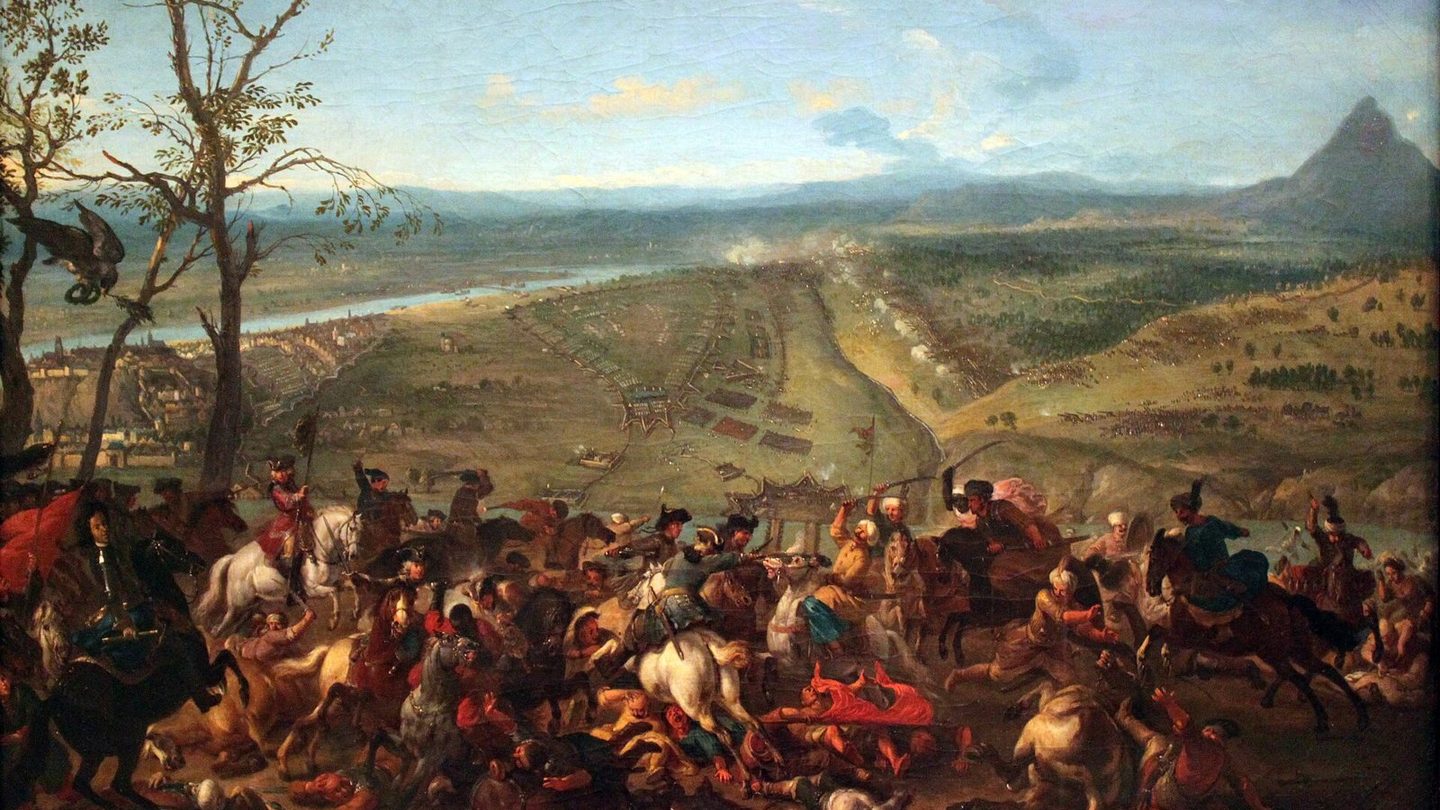
Emperor Leopold I told his young commander in Hungary to avoid battle unless victory was practically certain. His opponent was the Ottoman Empire, one of the three states that historians label gunpowder empires. When Eugene learned that Sultan Mustafa II was marching on Transylvania, he dropped the defensive plan and caught the Ottoman army while it crossed the Tisza at Zenta on 11 September 1697. The Imperial attack hit a force split by the river, and the victory pushed Vienna toward the Treaty of Karlowitz, signed on 26 January 1699. Eugene then raided into Bosnia, and the raid ended with the sack of Sarajevo.
The ratio of losses was lopsided, but nobody agrees on the numbers, a problem that also dogs the Winged Hussars at Kircholm. Wikipedia's infobox, checked 12 October 2026, gives the Holy League 429 dead and 1,598 wounded. For the Ottomans, the same infobox gives up to 30,000 killed, wounded or drowned according to some modern historians, against 7,000 to 8,000 in some Ottoman chronicles (checked 12 October 2026). Even the Imperial army's size is disputed, at about 31,000 in one account and 50,000 in another. The victory itself is not in doubt, but the totals around it are soft.
Blenheim and Turin: Partner, Then Commander
In 1704 Eugene joined Marlborough in southern Germany, and at Blenheim on 13 August he commanded the Allied right, about 16,000 men, against the French and Bavarian wing at Lützingen. His attacks were thrown back three times, which kept that wing busy while Marlborough broke the centre. Wikipedia notes (checked 12 October 2026) that continental opinion treats Blenheim as much Eugene's win as Marlborough's, and quotes Winston Churchill's tribute to his “fire and spirit”.
Sole command in Italy went worse at first. In 1705 Vendôme blocked his move toward Turin, and with no boats, little bridging material and an army wasting from desertion and sickness, Eugene could do nothing. In 1706 he arrived in April just as Vendôme beat Reventlow at Calcinato, and had to organize a retreat. Then Louis XIV pulled Vendôme north after Ramillies. Eugene slipped past the French field army, joined the cavalry of Victor Amadeus II, and on 7 September attacked south of Turin and broke the siege lines. Sources put his relief force at 30,000 to 36,000 against 40,000 to 60,000 French and Spanish. The French left northern Italy, and Eugene became governor of Milan.
Malplaquet, 1709: The Cost Column
In mid-June 1709 Eugene wrote to the Emperor that the next battle would be the biggest and bloodiest yet. He was right. At Malplaquet on 11 September the Dutch infantry on one flank charged and was cut to pieces, while Eugene's own attack on the other flank suffered almost as badly. Villars weakened his centre to feed the flanks, and Marlborough broke through. The Allies took the field and then Mons, which fell on 21 October.
The price was steep. Most estimates put Allied casualties at about 22,000 against about 11,000 French, and the accounts collected by Lynn, Holmes, Chandler and Somerset run from 21,000 to 25,000 killed or wounded on the Allied side. One of the bloodiest battles of the century bought no decisive breakthrough, and 1710 brought only another round of sieges.
Denain, 1712: No British Army, No Bridge
By 1712 Britain's government was negotiating with France, and on 21 May the Duke of Ormonde received “restraining orders” forbidding him to take part in any military action, and the British contingent soon left the campaign. Eugene carried on with Imperial and Dutch troops alone. On 24 July (some sources say 25 July) Villars crossed the Scheldt with about 24,000 men and hit the Allied post at Denain, held by around 10,000 men under the Earl of Albemarle.
Eugene's reinforcements could not cross the river in time. Albemarle was captured with more than 4,000 men, and Wikipedia gives Allied losses at 6,500 to 8,000 against 500 to 2,100 French (checked 12 October 2026). Wikipedia adds (checked 12 October 2026) that the French then retook Douai, Le Quesnoy and Bouchain, undoing in one summer the forward position the Allies had built up over years. Some contemporaries blamed an Italian lady in Eugene's entourage, a story Voltaire repeated. On this evidence the lost British contingent and an uncrossable river explain Denain better than any story about his entourage.
Belgrade, 1717: Attacking Through the Fog
His last great campaign was against the Ottomans again. At Peterwardein on 5 August 1716, Eugene resisted calls for caution, pressed the attack and won. Temeswar fell that October, ending 164 years of Ottoman rule there.
Belgrade was the main prize. Its garrison numbered 30,000, and Eugene besieged it from mid-June 1717. In early August a relief army, put at 140,000 to 200,000 men under Grand Vizier Hacı Halil Pasha, appeared on the plateau east of the city. Eugene's men had dysentery and were under constant bombardment, and Europe expected his destruction. He judged that only a decisive victory could save his army. On 16 August about 40,000 Imperial troops marched through fog, caught the relief force unaware and routed it. Belgrade surrendered days later, on 21 August by Wikipedia's siege dates (checked 12 October 2026), and the Treaty of Passarowitz followed on 21 July 1718.
The Last War, 1733 to 1735
When France declared war on Austria in October 1733, Eugene was president of the Imperial War Council and commander-in-chief, in his seventies, and short of money and good troops. Wikipedia describes (checked 12 October 2026) his mental and physical powers as in rapid decline. On the Rhine in 1734 he was outnumbered and on the defensive. He moved to relieve Philippsburg in June, but the fortress surrendered in July and the relief army, put at 70,000 men in one account, never reached it. In 1735 he ran another cautious defensive campaign.
The deeper charge is administrative. After the Turkish war, Wikipedia says (checked 12 October 2026) Eugene never built a trained field army, and held that fighting men could be made when war came. Austria met the French in 1733 outclassed. Frederick of Prussia, who watched him on the Rhine as a young prince, was shocked at his condition. In 1758 the older Frederick credited Eugene with teaching him to keep grand objectives in view. Eugene died in Vienna in April 1736. His heart was buried at Superga near Turin and his body at St Stephen's Cathedral.
So Was He a Good General?
Judged by what he did with limited means, yes. Zenta, Turin and Belgrade were each fought against odds and each ended a campaign or a war. At each, Eugene chose to attack when a cautious officer would have waited. All three were won by a commander who could choose the moment against an enemy that could not.
The weaker entries have a different cause. In 1705, 1712 and 1734 he lacked money, allies or healthy troops, and Malplaquet shows what his willingness to attack cost when the other side was Villars on a prepared line. He was a great field commander when the objective was clear and the enemy off balance. As an administrator he left an army that was thin when the next war arrived. One caution on all of the above: every casualty and strength figure here comes from secondary histories and encyclopedias, none from a muster roll, and the sources disagree often enough that the ratios are more reliable than the totals.