
A Campaign Built Around Restraint
Operation Rolling Thunder began on March 2, 1965, when U.S. and South Vietnamese aircraft struck a supply depot and naval base at Quang Khe, seven months after Congress voted almost unanimously to give Johnson broad war powers over a second North Vietnamese attack the Navy itself later admitted probably never happened, and it continued for 43 months until President Lyndon Johnson halted it on November 1, 1968. Its stated objectives, laid out in the campaign's planning documents, were to reduce the flow of men and materiel from North to South Vietnam, raise the morale of a South Vietnamese government under military pressure, and demonstrate to Hanoi's leadership that continued support for the war in the South would carry a cost at home. It was explicitly not designed to invade North Vietnam, topple its government, or compel a change in regime; nuclear weapons were never authorized, and only tactical rather than strategic aircraft and ordnance were used, a deliberate signal that the campaign was meant to stay limited (Air University Review, "Rolling Thunder and the Law of War," W. Hays Parks, 1982).
The campaign's geography expanded gradually and on a political timetable, not a military one. Strikes were initially confined to the southern portion of North Vietnam; over the following year, target areas moved steadily north until, by mid-1966, American aircraft were hitting military and industrial sites across the country, including the outskirts of Hanoi and Haiphong themselves. That gradualism was the whole point: Rolling Thunder was designed as "graduated pressure," escalating slowly enough that Hanoi could recalculate its position at each step without the campaign itself widening the war beyond the two Vietnams.
Lunch at the White House Decided the Target List
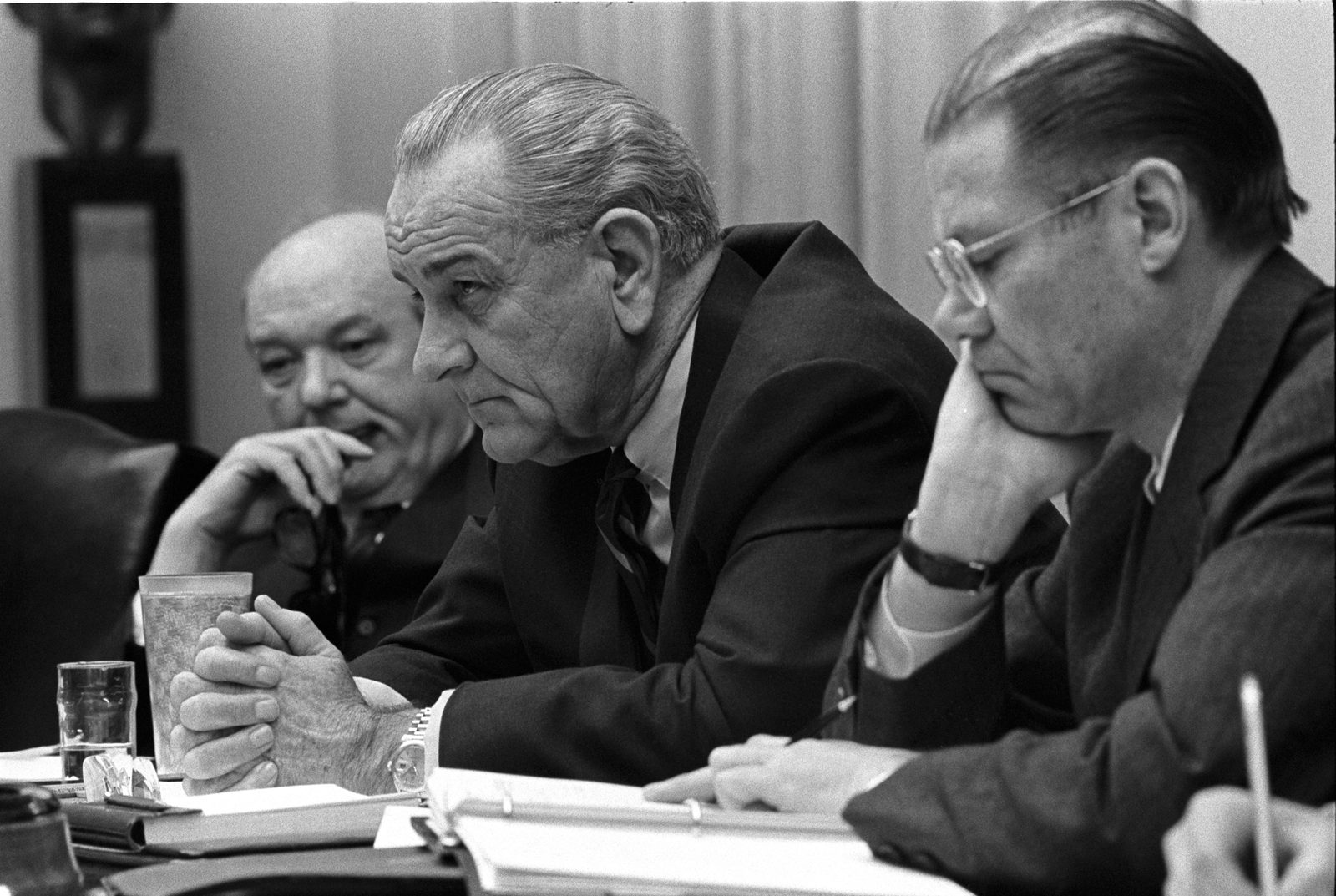
For most of Rolling Thunder's run, the final say on which targets could be struck belonged to a small group of civilians who met weekly, not to the military commanders directing the air war from the Pacific. Admiral U.S. Grant Sharp, the Commander in Chief, Pacific, who oversaw the air campaign from Honolulu, wrote afterward that "the final decision on what targets were to be authorized, the number of sorties allowed, and in many instances even the tactics to be used by our pilots was made at a Tuesday luncheon in the White House, attended by the President, the Secretary of State, the Secretary of Defense, Presidential Assistant Walt Rostow, and the Presidential Press Secretary." Sharp added the detail that mattered most to officers who felt shut out of the process: "no professional military man, not even the Chairman of the JCS, was present at these luncheons until late in 1967" (Air & Space Forces Magazine, "Rolling Thunder", quoting Sharp). Even after Joint Chiefs Chairman Earle Wheeler began attending, he made it to only about three of the lunches per quarter (Air University Review, 1982).
The mechanics of the lunch, as reconstructed from Pentagon records, followed a fixed procedure with little room for improvisation. Each week, the Air Force proposed targets that were reviewed by the Pacific Command, then the Joint Chiefs, before reaching the Pentagon's civilian staff. There, each proposed target was reduced to a single sheet of paper and graded on four criteria maintained by the Office of the Assistant Secretary of Defense for International Security Affairs: the military value of hitting it, the risk to U.S. aircraft and pilots, estimated civilian casualties, and the danger to third-country nationals who might be present. Every lunch attendee scored each target against those four categories individually; the scores were averaged, and Johnson reviewed the averaged list and personally chose which targets would be struck that week, along with specific parameters governing the strike: the number of aircraft authorized, the date and time, ingress and egress routes, which weapons could be used, and whether pilots had authority to restrike a target that survived the first pass (Air University Review, 1982).
How thinly some of these decisions were documented shows up in the State Department's own official history. Ahead of the September 13, 1966, lunch, national security adviser Walt Rostow forwarded Johnson a suggested agenda noting that the Joint Chiefs had recommended additional bombing targets, that the State Department was resisting them over concerns about "escalatory signals" during concurrent Rusk-Gromyko arms talks, and that Defense Secretary Robert McNamara wanted the target list frozen near its current level. The department's historians later wrote that "no record has been found of the discussion at the lunch meeting on September 13" itself; what survives is only a State Department official's after-the-fact recollection that Rusk and McNamara agreed privately not to proceed with the proposed target package (Office of the Historian, U.S. Department of State, Foreign Relations of the United States, 1964-1968, Volume IV, Document 226). McNamara sat at that table for both decisions: the same defense secretary running Rolling Thunder's Tuesday Lunch also personally reworked the nuclear deterrence doctrine that became known as mutually assured destruction, another case where a single official's private calculations, not a formal interagency process, ended up shaping U.S. strategy.
Rings Drawn Around Hanoi and Haiphong
The caution that shaped the target list also shaped the map. Restricted zones of 30 miles around Hanoi and 10 miles around Haiphong meant no target inside either ring could be struck without specific White House approval, and even an approved strike came with limited authority to go back for a second pass. Nested inside those restricted zones were smaller prohibited zones, 10 miles around Hanoi and 4 miles around Haiphong, where authorization was harder still to get and restrike was never permitted at all. A separate buffer zone ran along the Chinese border, 30 miles wide from the Laos frontier east to the 106th meridian, narrowing to 25 miles from there to the Gulf of Tonkin, so that pilots operating near the frontier had to keep their bombs well clear of Chinese territory (Air University Review, 1982).
That same 106-degree line also marked the western edge of what military planners called Route Package VI, the sector containing the highest concentration of valuable interdiction targets in the entire country, precisely because it wrapped around Hanoi and Haiphong. Strike forces operating inside it needed clearance even for targets of opportunity they spotted mid-mission, rather than the standing authority pilots had elsewhere in North Vietnam. The restrictions extended to air defenses themselves: surface-to-air missile sites built inside the Hanoi and Haiphong prohibited zones could not be attacked even though they were actively firing on U.S. aircraft, and with an effective range of roughly 17 nautical miles, a single SAM battery positioned inside one of those rings could threaten pilots operating well outside it while sitting functionally untouchable itself (Air University Review, 1982).
The MiG Base Washington Wouldn't Touch
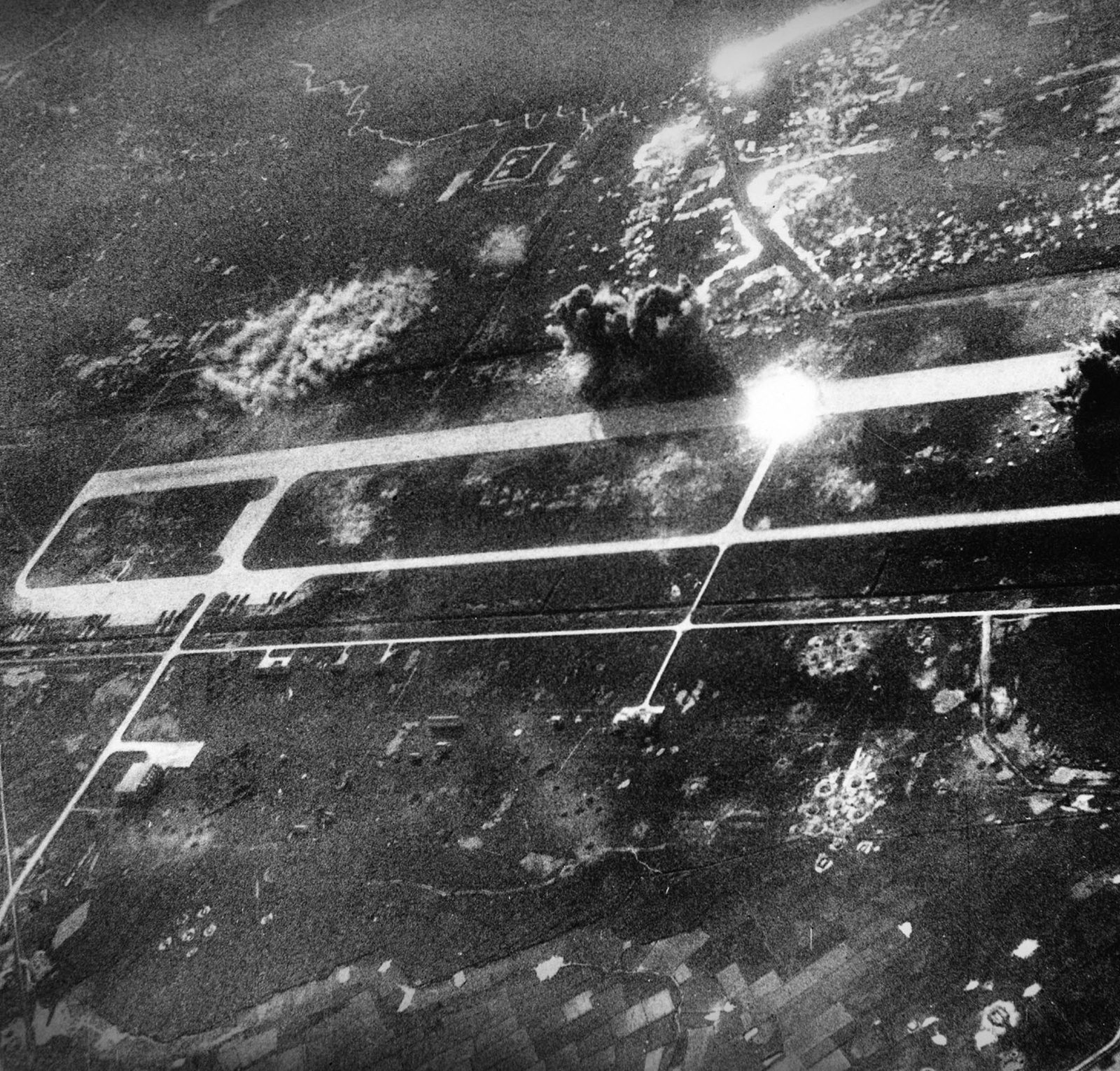
The clearest single example of how long Washington's caution could hold up an obvious target sits at Phuc Yen airfield, North Vietnam's principal jet interceptor base northwest of Hanoi. On July 24, 1965, a Soviet-made SA-2 surface-to-air missile shot down a U.S. aircraft, the first American loss to a SAM in the war. The same day, a 10-mile prohibited strike zone went up around Phuc Yen. Over the next two years, the Joint Chiefs of Staff repeatedly asked to have the airfield authorized for attack; the request came up often enough, and was denied often enough, that Phuc Yen was simply dropped from some of the weekly Tuesday Lunch target lists during later phases of the campaign rather than resubmitted every time (Air University Review, 1982).
Combined U.S. Air Force and Navy aircraft finally hit the airfield on October 24, 1967, and again the following day (Air University Review, 1982; Rolling Thunder Remembered, "24 October 1967 — Phuc Yen MiG Airbase, JCS 6, Finally"). The gap between the two dates, from the SAM loss that triggered the no-strike zone on July 24, 1965, to the strike finally flown on October 24, 1967, comes to exactly 27 months, with both the imposition and the lifting of the restriction landing on the 24th of their respective months.

Restriction by Policy, Not Always by Law
W. Hays Parks, a Marine Corps judge advocate who specialized in the law of armed conflict, made the case in his 1982 Air University Review analysis that this entire apparatus of buffer zones, prohibited rings, and personal presidential sign-off was frequently mistaken, by the pilots flying under it and by later writers, for something the law of war required. Some restrictions genuinely were legal obligations: attacks on purely civilian populations and non-military objects were prohibited under the law of armed conflict regardless of policy preference. But Parks argued that most of Rolling Thunder's specific limits, the mileage rings around Hanoi and Haiphong, the requirement that individual targets clear a White House lunch table, the reluctance to hit an active fighter base for over two years, went well beyond what the law of war obligated the United States to do. They were policy choices, driven by the Johnson administration's fear of provoking direct Chinese or Soviet intervention and by concern over international opinion, dressed up in later memory as legal constraints rather than the deliberate escalation-control decisions they actually were.
That distinction shaped how the war was remembered as much as how it was fought. Pilots who flew Rolling Thunder missions spent years afterward describing a war fought "with one hand tied behind our back," a framing Ronald Reagan later invoked on the presidential campaign trail when he promised never to send U.S. forces into combat under similar restrictions. Parks's point was narrower and more specific: the restrictions were real, but conflating a two-year hold on bombing a single airfield with an international legal requirement obscured just how much of Rolling Thunder's caution came from a Tuesday lunch table in Washington, not from Geneva. Vietnam-era memory has proven durable in the other direction too: decades of archive searches have found almost no contemporaneous evidence for the popular story that antiwar protesters spat on returning veterans at U.S. airports, a claim that hardened into accepted fact well after the war ended, the same way "fought with one hand tied behind our back" hardened into a legal claim it was never quite accurate to make.