
Rules of Engagement Are Not the Same Thing as the Laws of War
Rules of engagement are, in Britannica's definition, the military directives that describe the circumstances under which a nation's forces will enter into and continue combat with an opposing force, spelling out when, where, how, and against whom force may be used. That sounds like it should be a fixed body of law, similar to the Geneva Conventions or the rules that govern how prisoners of war must be treated. It is not. The Hague and Geneva Conventions set the outer legal boundary of what any nation's forces may lawfully do in war under international humanitarian law; ROE are the narrower, mission-specific operational instructions a commander issues within that legal boundary, and they routinely sit well inside that boundary, nowhere near its edge.
That distinction matters because it means ROE are not permanent. A single nation can, and regularly does, issue tighter or looser ROE for the same legal war depending on the mission, the theater, and often the specific week, without ever changing the underlying law it is operating under. The clearest illustration of how far that swing can go, and how much is riding on it, played out in the U.S. military twice within a single decade, in exactly opposite directions.
A German-Born Lawyer Wrote the First American Version in 1863
The document usually credited as the starting point for written battlefield conduct rules is General Orders No. 100, known as the Lieber Code, which President Lincoln endorsed on April 24, 1863. It was drafted by Francis Lieber, a German-born legal scholar who had been imprisoned in Prussia for his political views before emigrating to the United States, working alongside a committee of four Union generals. The code covered martial law, military jurisdiction, and the treatment of prisoners of war, deserters, and spies, and the Library of Congress's law blog credits it as the first modern attempt to codify the laws of armed conflict in the way the term is understood today.
The Lieber Code went on to shape the Hague Conventions of 1899 and 1907 and, after the Second World War, the four Geneva Conventions of 1949, according to the International Committee of the Red Cross's casebook on the law of The Hague. What none of those documents did, though, was tell an individual soldier standing at a gate exactly when to load a rifle. That instruction, the operational rule rather than the underlying legal principle, was left to individual commands to write, mission by mission, a gap that a 20th-century Marine command in Lebanon would fill in a way that turned out to be lethally restrictive.
Beirut, October 23, 1983: A Rulebook Written for the Wrong Mission
The Marines deployed to Beirut in 1982 as part of the Multinational Force were operating under what the mission itself called a "presence" posture, sent to reassure, not to fight, discouraged from fortifying too visibly or behaving like an occupying army. Under the peacetime rules of engagement that followed from that posture, sentries carried M16 rifles without a loaded magazine, according to the sentry's account preserved by HistoryNet and Marine Corps Times. At 6:22 a.m. on October 23, 1983, a 19-ton truck carrying roughly 12,000 pounds of explosives drove into the compound. Lance Corporal Eddie DiFranco, on watch at the gate, recognized what was happening: "Soon as I saw [the truck] over here, I knew what was going to happen," he later recalled. He was still slapping a magazine into his rifle and chambering a round when the truck passed him and reached the barracks.
The building collapsed, killing 241 U.S. service members, 220 Marines, 18 sailors, and three soldiers, the deadliest single day for the Marine Corps since Iwo Jima in 1945, per the U.S. State Department's accounting. The Pentagon's subsequent Long Commission inquiry did not lay the disaster solely on the unloaded rifles; it found more broadly that security measures in the compound were "neither commensurate with the increasing level of threat...nor sufficient to preclude catastrophic losses" of the kind the Marines suffered that morning. But the restrictive ROE, calibrated for a peacekeeping mission that Beirut had already stopped being, sat squarely inside that broader failure, and it left one of the war's clearest lessons: rules written for the mission a command wishes it still had can be exactly the wrong rules for the mission it is actually in, the same mismatch that turned a supposedly impregnable defensive line into a byword for planning for the last war instead of the next one a conflict earlier.
The Overcorrection: From Stark to Vincennes in Fourteen Months
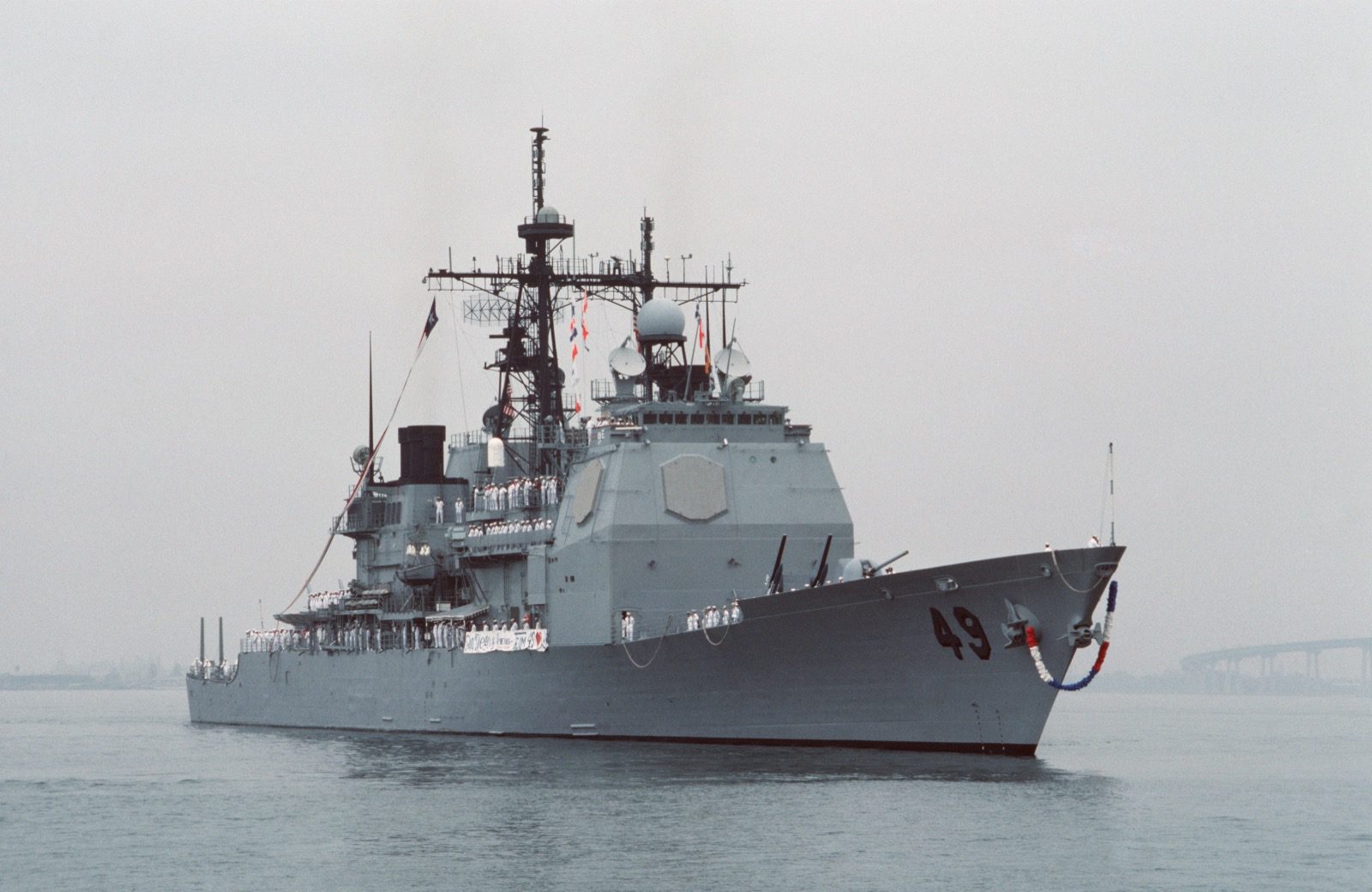
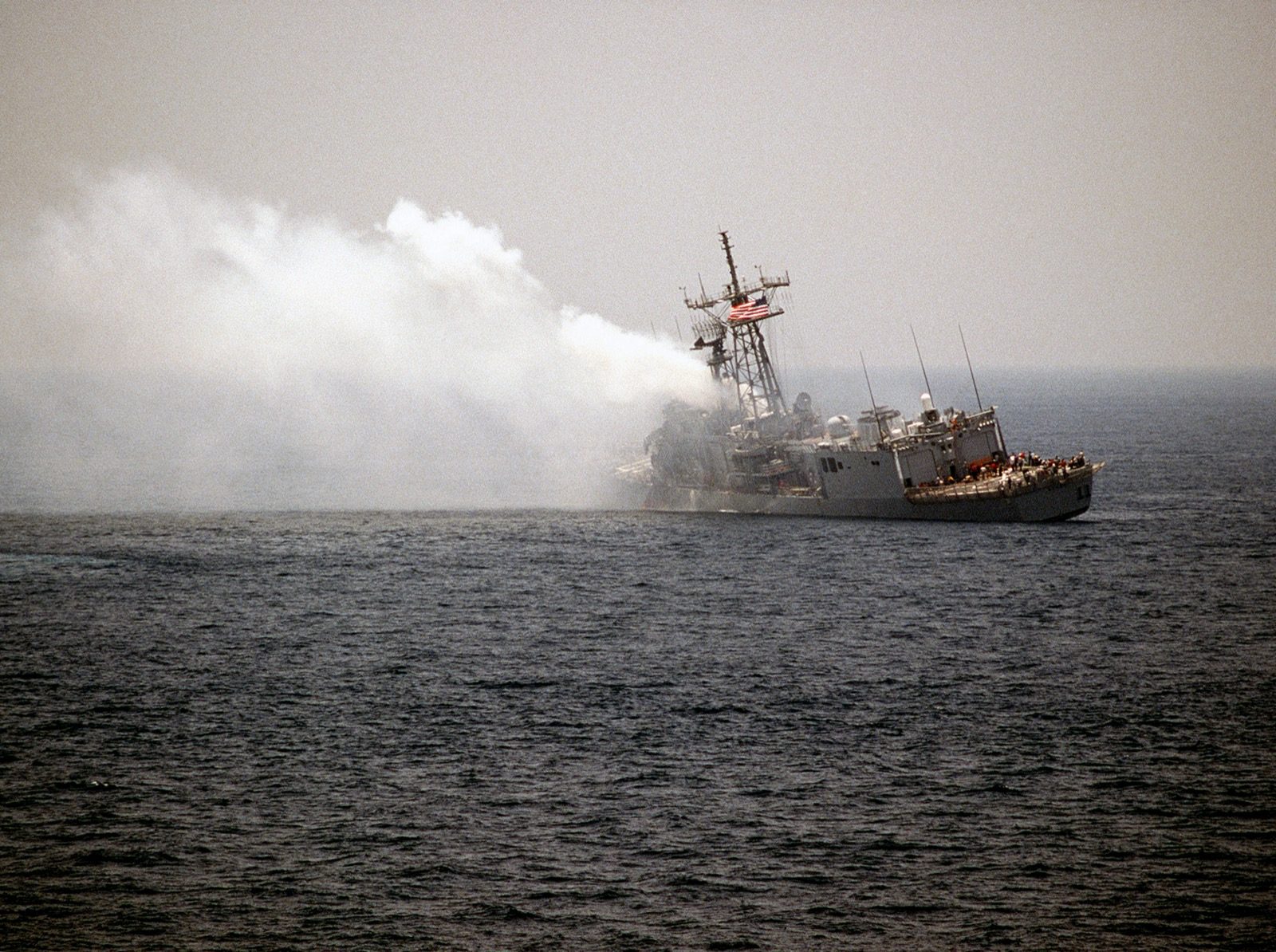
The U.S. Navy learned a version of the same lesson in the Persian Gulf less than four years later, from the opposite direction. On May 17, 1987, an Iraqi Mirage F1 fired two Exocet missiles into the frigate USS Stark, killing 37 sailors. Stark's own ROE, built around a "neutral presence" mission protecting merchant shipping in a war the U.S. was not formally party to, meant the ship held fire on an aircraft that had not yet confirmed hostile intent, according to the U.S. Naval Institute's account of the attack. Iraq apologized and called it a mistake, but the U.S. response was to conclude the rules themselves had been too relaxed: the Navy revised Gulf ROE afterward to let ships engage aircraft showing hostile intent, not just a confirmed attack, and to fire sooner on unidentified contacts.
Fourteen months later, on July 3, 1988, the guided-missile cruiser USS Vincennes, commanded by Captain William C. Rogers III, was engaged with Iranian gunboats in the Strait of Hormuz when its Aegis radar system reported an aircraft, actually Iran Air Flight 655, a commercial Airbus A300, on what the crew read as a descending, attacking trajectory, when the plane was in fact climbing from 1,200 to 12,000 feet on a scheduled route to Dubai. Rogers ordered a missile fired. All 290 people aboard were killed. The Pentagon's own formal investigation into the shootdown, completed August 19, 1988, concluded the engagement had complied with the prevailing rules of engagement, the same loosened standard adopted after Stark specifically to prevent a second Stark. The ROE had done exactly the job it was redesigned to do; it just did that job to a civilian airliner instead of a threat, a wrong read under pressure that recalls an earlier war's ambiguous radar and sonar readings, misread in the moment and used to justify an escalation that outlived the accuracy of the intelligence behind it.
_listing_after_missile_hit_in_the_Persian_Gulf_on_18_May_1987.jpeg)
1986 Tried to Fix This. It Took Until 1994 to Actually Work.
The gap that let Beirut happen was real, but the Marines who served there were not working from a system nobody had ever tried to fix. In 1979, Chief of Naval Operations Admiral Thomas Hayward had already ordered the Navy to standardize its own peacetime ROE, and by 1981 the Joint Chiefs had adopted a Worldwide Peacetime Rules of Engagement for Seaborne Forces, though that still covered naval operations only, not the kind of Marine ground deployment Beirut was. Admiral William Crowe, who as commander of the Pacific Fleet had separately ordered the same standard applied across every service under his command, pushed the idea further once he became Chairman of the Joint Chiefs: on June 26, 1986, the Joint Chiefs adopted a renamed JCS Peacetime Rules of Engagement, intended to cover sea, air, and land forces alike. Getting land forces to actually adopt it, according to the operational law handbook maintained by Duke University's Lawfire program, met with only limited success.
That first attempt at unification was less than a year old when the Stark was hit, and barely two years old when the Vincennes shot down Iran Air 655, and its own scope, peacetime operations specifically, left real ambiguity about which rules applied once a cruiser was already exchanging fire with Iranian gunboats. Both incidents, Beirut and the Vincennes, are cited directly by the Lawfire handbook as the reason the Joint Chiefs launched the review that produced the Standing Rules of Engagement (SROE), CJCSI 3121.01, issued October 1, 1994. That version did what the 1986 document had only partly managed: it extended standing rules across the full range of military operations rather than peacetime alone, and made compliance with the international law of war an explicit, stated requirement, no longer just an unspoken assumption. It has since been updated twice, in 2000 and again in 2005, and that 2005 version still forms the backbone of how the U.S. military writes ROE today.
Lieber's 1863 code never answered the operational question a sentry or a ship captain actually faces, and it turns out that having a standing document did not automatically close that gap either: Beirut happened before any joint document existed to answer it, and the Vincennes happened after one did, just one still scoped to peacetime and still unevenly adopted outside the Navy. It took a mission-by-mission failure in 1983, then a scoped-but-insufficient standing document's failure in 1988, and only then a second, fuller rewrite in 1994, explicitly prompted by both incidents, before the framework in place today took shape, a process closer in spirit to the reactive doctrinal reversals nuclear planners kept making throughout the Cold War than to a fixed legal code settling the question once.